Generative AI Platforms for Media: What They Do
Generative AI platforms help newsrooms draft, summarise, translate and personalise content. Here is what they do and the rights questions to settle first.
On this page
Short answer
A generative AI platform for media is software that uses AI models to help newsrooms, publishers and studios create, edit and distribute content, from drafting and transcription to translation and personalisation, with editorial checks and rights controls built into the workflow.
What is a generative AI platform for media?
A generative AI platform for media is a set of tools that helps newsrooms, publishers, broadcasters and studios create, edit and distribute content with AI models. It brings text, image, audio and video generation into one workspace, with the controls a media organisation needs around rights, accuracy and disclosure.
Unlike a general chatbot, a media platform connects to the organisation's own archive, style guide and content system. A journalist can ask it to summarise a long report, draft a social version of a story, or suggest headlines, and the model works from the publisher's own material rather than only from public training data.
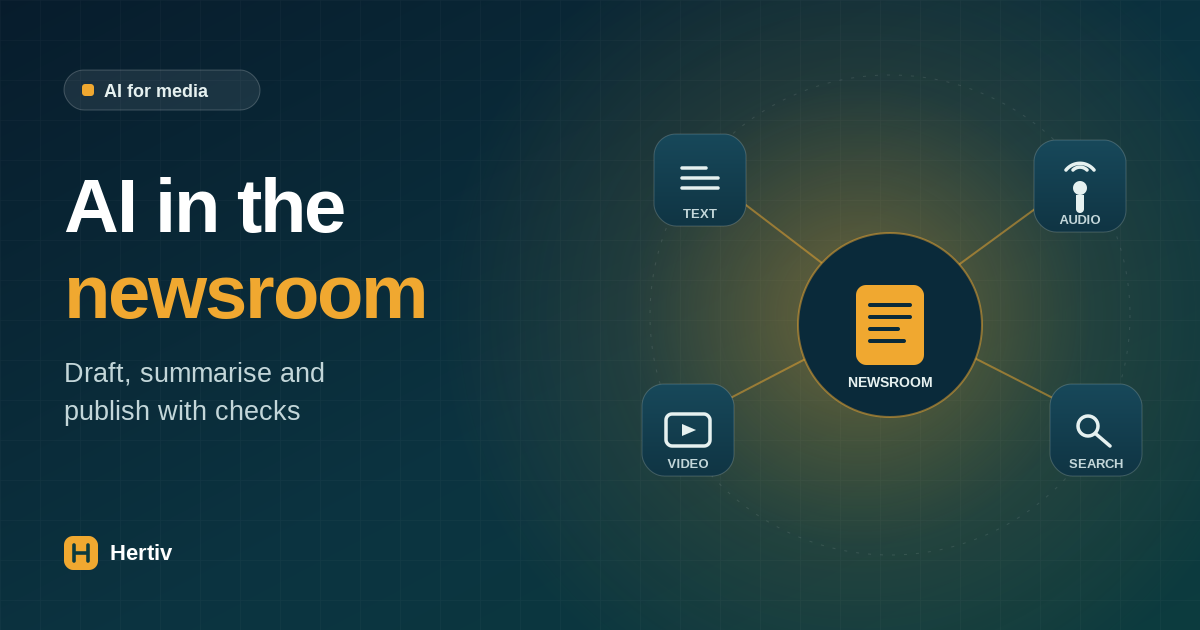
Typical capabilities include drafting and editing, transcription, translation, summarisation, image and video generation, metadata tagging, and personalisation of feeds and newsletters. The platform usually sits between the content management system and the publishing channels, so AI output passes through the same editorial checks as human work.
What can media teams use it for?
Media teams use generative AI platforms across the whole production chain, from research to distribution. The strongest uses are the repetitive ones, where a model saves hours and an editor still makes the final call.
| Job | What the platform does | Who checks it |
|---|---|---|
| Research and summarising | Condenses reports, transcripts and wires into briefings | Journalist |
| Drafting | Produces first drafts of routine stories and captions | Editor |
| Audio and video | Transcribes, clips and captions recordings | Producer |
| Translation | Drafts versions in other languages | Bilingual editor |
| Personalisation | Tailors newsletters and feeds to reader interests | Audience team |
| Archive and tagging | Labels photos, clips and articles for search | Archivist |
Routine reporting is the clearest win: sports results, market moves, election counts and weather summaries follow a pattern, so a model can draft them and a human can verify the numbers. Investigative and opinion work stays human, because the value is in judgement, sourcing and voice.
How does a generative AI platform fit a newsroom workflow?
A generative AI platform fits a newsroom workflow when it slots into the existing editorial process instead of replacing it. The safest pattern is draft, check, publish, with AI handling the draft and people handling the check.
- Brief the model. Give it the source material, the style guide and the facts it may use, and forbid it from inventing quotes, names or figures.
- Draft with a human in the loop. A journalist writes the prompt, reviews the draft line by line and rewrites anything that sounds generic or unverified.
- Fact-check as usual. Every number, name and quote goes through the same verification as a human-written draft, with the source cited.
- Label AI involvement. Mark content that was drafted or translated by AI, so readers and colleagues know what they are reading.
- Publish and monitor. Track corrections, reader feedback and engagement for AI-assisted pieces separately, so the team can see whether quality holds up.
Teams that skip the checking step usually regret it. A model can produce confident, fluent text that contains a wrong figure or a made-up quote, and that error reaches the audience with the publisher's name on it.
What should you check on rights, licensing and disclosure?
Rights, licensing and disclosure are the three questions that decide whether a media AI platform is safe to use. Get them wrong and the cost is legal trouble and lost trust, not just a bad article.
- Training data and rights. Ask what the models were trained on and whether licensed material is used. Some publishers license their archive to model makers; others forbid it. Check your contracts before you feed archive material into a platform.
- Output ownership. Confirm who owns AI-generated text, images and audio, and whether the vendor claims any rights over what you create.
- Disclosure rules. Many regulators and industry codes now expect AI-generated or AI-assisted content to be labelled. Decide your labelling policy before you publish, not after a reader asks.
- Source protection. Never paste unpublished material, source names or embargoed information into a platform that trains on user input. Use a deployment that keeps your data private.
- Bias and accuracy. Models can repeat stereotypes and present rumours as fact. Build a review step for sensitive topics and keep a log of corrections.
If you need help wiring a platform into your publishing stack with these controls in place, a partner for generative AI development can build the integration around your editorial rules.
Example: a regional publisher planning a pilot
Example (hypothetical): a regional publisher with 25 journalists wants to test a generative AI platform for three months. The team picks one desk, local sports, and one job, drafting match reports from wire data.
Before the pilot, the team agrees the rules: the model drafts only from the wire feed and the club's own match data, every number is checked against the wire, and each published report carries a line saying it was drafted with AI assistance and checked by an editor. No quotes are generated, and no unpublished material is pasted into the platform.
The numbers are modest. The desk publishes 40 match reports a week. Drafting each one by hand takes about 90 minutes; with an AI draft and a 30-minute human check, the desk saves 60 minutes per report, or 40 hours a week across the desk. That time goes into two extra original stories a week, which the editor judges on readership and corrections.
After three months the team reviews corrections, reader complaints and time saved, and only then decides whether to extend the platform to other desks. The pilot is small on purpose: a failure costs one desk a few weeks, not the whole newsroom its reputation.
What are the common mistakes?
The most common mistakes with generative AI platforms for media are publishing unchecked output, feeding them material you do not have the right to share, and letting AI copy replace original reporting.
- Publishing unchecked drafts. A fluent draft with a wrong score, date or name damages trust faster than a late story. Check every fact as if a junior reporter wrote it.
- Training on your own archive without permission. Some platforms use customer data to improve models. Read the data terms and opt out where your contracts require it.
- Replacing reporting with generation. AI can summarise what exists, but it cannot interview anyone or attend a match. Use it to free up reporting time, not to remove reporting.
- No disclosure policy. Readers find out about AI use eventually. Decide your labelling rule early and apply it consistently.
- Judging by volume alone. Publishing more stories is not a win if corrections rise and readers stop trusting the byline. Track quality as well as output.
How do you pick a platform for media work?
You pick a generative AI platform for media work by testing it on your own content, with your own editors, before you sign a long contract. A demo on generic examples tells you almost nothing.
- Test on real material. Run the platform on your archive and your style guide, and have your editors score the drafts for accuracy and voice.
- Check the data terms. Confirm your content is not used for training, and that you can delete it on request.
- Check the integrations. It must connect to your content management system and your publishing channels, or the team will copy and paste around it.
- Ask about provenance. The platform should record which model and which sources produced each draft, so corrections can be traced.
- Start with one desk. A three-month pilot on one team gives you real evidence on time saved, corrections and reader reaction before you roll it out.
A platform that passes these checks is worth a pilot. One that fails the data terms or cannot work with your archive is not worth the risk, however good its demo looks. For a broader comparison of platform types, see generative AI platforms for retail, which covers similar selection questions in another sector.
Key takeaways
- A media AI platform drafts, summarises, transcribes and personalises content, but editors still check every fact
- Routine reporting is the strongest use; investigative and opinion work stays human
- Rights, licensing and disclosure must be settled before the first AI-assisted story is published
- Never paste unpublished material or source identities into a platform that trains on user input
- Start with a small pilot on one desk and judge it on corrections and time saved, not volume alone
- Test the platform on your own archive and style guide before signing a contract
Frequently asked questions
Can AI write a news story on its own?
It can draft a routine story from structured data, such as a sports result or a market move, but it cannot report, interview or verify. Every AI draft needs a human editor to check facts, quotes and numbers before publication, and most publishers label AI-assisted content so readers know.
Do readers need to know AI was used?
Most industry codes and many regulators now expect AI-generated or AI-assisted content to be labelled. A clear label protects trust: readers accept AI help when it is disclosed, and they react badly when they discover it was hidden. Decide your labelling policy before you publish.
What is the biggest risk of using AI in a newsroom?
The biggest risk is publishing a confident-sounding error, such as a wrong figure or an invented quote, under your own name. Models can also repeat bias and leak confidential material if the platform trains on your input. Both risks are managed with human checks and clear data terms.
Can a generative AI platform replace journalists?
No. It can speed up drafting, summarising and transcription, which frees journalists for reporting, interviews and analysis. The work that needs judgement, sourcing and voice still needs a person, and publishers that cut reporting to chase volume usually lose reader trust.
How much does a generative AI platform for media cost?
Pricing varies widely and most vendors sell on quote, so see the vendor site for current plans. Budget for the platform fee, the integration work, editor training and the ongoing review time, because the checking step is a real cost, not a one-off task.
Which media companies use generative AI platforms?
Many large publishers and broadcasters now use AI for transcription, translation, summarisation and routine drafting, usually through a platform built for media or through their own internal tools. The common pattern is a pilot on one desk, with editors checking every output before publication.


