Generative AI Pipeline Evaluation: A Practical Guide
Generative AI pipeline evaluation tests every stage, from retrieval to generation to safety checks, so you can find which stage caused a bad answer.
On this page
Short answer
Generative AI pipeline evaluation is the practice of testing a whole generative AI pipeline, stage by stage, against a fixed set of real inputs with known good outputs. Instead of judging the model alone, it measures retrieval, generation, tool use and safety checks separately, so a bad answer can be traced to the stage that caused it.
What is generative AI pipeline evaluation?
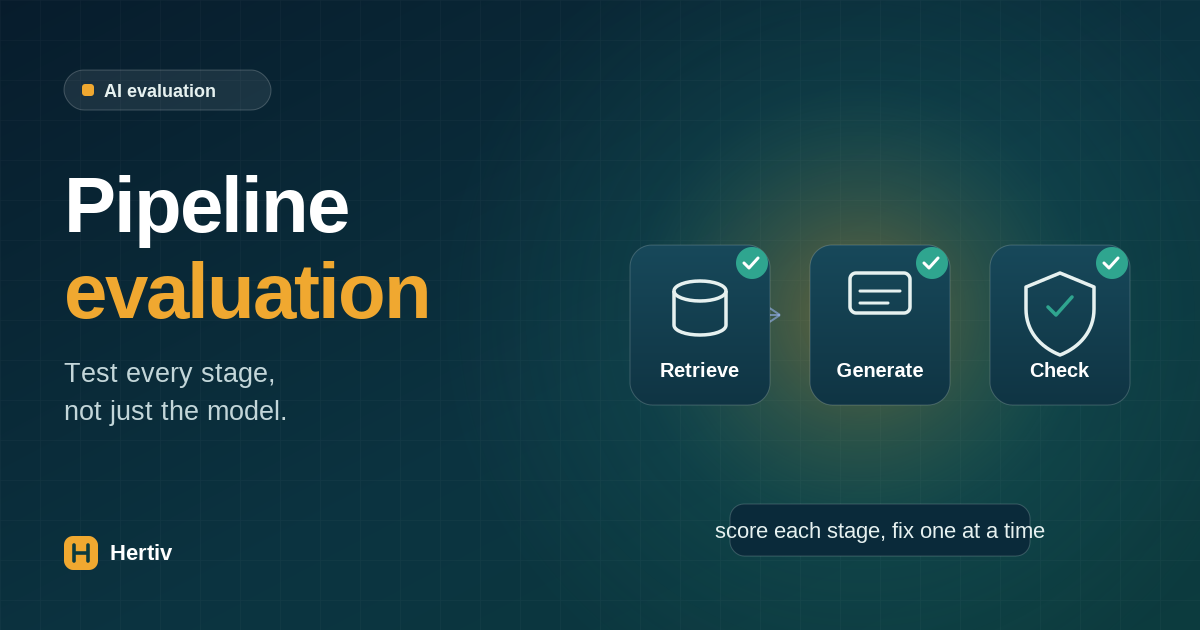
Generative AI pipeline evaluation is the practice of testing a whole generative AI pipeline, stage by stage, against a fixed set of real inputs with known good outputs. A pipeline is the chain of steps behind an answer: the prompt, the retrieval of documents, the model call, any tool use, and the checks that run before the answer reaches the user.
It differs from testing a model on its own. A model test asks whether the model can answer a question. A pipeline test asks whether your system answers it, with your documents, your prompts, your tools and your checks. Most production failures live in the pipeline around the model, not in the model itself.
Teams run pipeline evaluation when a feature is about to ship, after any change to prompts, documents or models, and on a schedule once it is live. The goal is the same each time: know whether the system got better or worse, and know which stage changed.
What should you measure at each stage?
Each stage of a pipeline fails differently, so each stage needs its own measure. Retrieval fails by fetching the wrong documents. Generation fails by ignoring the documents or inventing facts. Tool use fails by calling the wrong tool or passing bad arguments. Safety checks fail by passing bad output or blocking good output.
| Stage | What to measure | How to judge it |
|---|---|---|
| Retrieval | Did it fetch the right documents? | Share of cases where the needed passage is in the top results |
| Generation | Is the answer grounded in the documents? | Share of claims supported by a cited passage |
| Tool use | Did it call the right tool with the right inputs? | Share of calls with the correct tool and arguments |
| Safety checks | Did checks block bad output and pass good output? | Share of bad outputs blocked and good outputs passed |
| End to end | Would a user accept the answer? | Human rating on a fixed sample |
Measure stages separately and end to end. Stage measures tell you where to fix; the end-to-end measure tells you whether the fix mattered to users.
How do you build a golden test set?
A golden test set is a fixed set of real inputs with known good outputs, used to judge the pipeline after every change. Build it from real traffic: past user questions, real documents and real tool calls, with the correct answers written by someone who knows the subject.
Size it for the job. Fifty to one hundred cases is enough to catch big regressions and to compare two versions of a pipeline. A few hundred is better when the pipeline serves many topics or when small changes matter. More than that is rarely worth the labelling effort until the system is live and the set can grow from real failures.
Cover the hard cases on purpose. Include questions with no good answer in the documents, questions that need two documents at once, and questions where the correct answer is to say you do not know. A test set made only of easy questions will pass a broken pipeline.
How do you run the evaluation?
Run the evaluation the same way every time, so results are comparable. Freeze the test set, run the whole pipeline on it, record every stage output, and score each stage against its measure. Then change one thing, run it again, and compare.
Automate the scoring where you can. Retrieval and tool-use checks can often be scored by rules: was the right document fetched, was the right tool called. Generation needs a judge, which can be a second model with a clear rubric or a human on a sample. Use the model judge for speed and a human sample for trust.
Run the full evaluation before a release and on a schedule once live, such as weekly. Also run it after any change to prompts, documents, models or tools, even a small one, because small changes cause most regressions.
How do you read the results and fix failures?
Read the results stage by stage. If retrieval is wrong, fix the documents, the chunking or the search, not the prompt. If retrieval is right but the answer is wrong, the problem is generation or the prompt. If the answer is right but the tool call is wrong, the problem is the tool description or the arguments.
Keep a list of failure types, not just a score. A pipeline that scores 80 percent can hide three different problems: five retrieval misses, ten invented facts and five blocked good answers. Each type needs a different fix, and the list tells you which fix to do first.
Fix one stage at a time and re-run. Changing the prompt, the documents and the model together makes it impossible to know which change helped. The discipline of one change per run is what turns evaluation from a report into a tool.
Example (hypothetical): a support team tests 100 questions
Example (hypothetical): a support team builds a golden set of 100 real customer questions with known good answers. On the first run, 78 answers pass. Of the 22 failures, 12 are retrieval misses, where the needed article was not fetched, and 10 are generation errors, where the article was fetched but the answer ignored it.
The team fixes retrieval first, by splitting long articles into smaller pieces and adding the missing product names to the index. On the second run, retrieval misses fall from 12 to 4, and the pass count rises from 78 to 86. The 10 generation errors are unchanged, so the team knows the next fix belongs in the prompt, not in retrieval.
After a prompt fix that tells the model to answer only from the fetched articles, generation errors fall from 10 to 3, and the pass count rises to 93. The team ships at 93, with the 7 remaining failures logged as known cases to revisit.
What are the common mistakes?
Most pipeline evaluation failures come from testing the wrong thing: the model instead of the pipeline, easy questions instead of real ones, or a score instead of a failure list. Each mistake hides the information that would have fixed the system.
- Testing the model alone and ignoring retrieval, tools and checks
- Building a test set of easy questions that any pipeline would pass
- Changing prompts, documents and models at once, then guessing what helped
- Scoring only the final answer, so nobody knows which stage failed
- Running evaluation once before launch and never again
- Trusting a model judge without checking it against human ratings
For the model-level view, how to implement LLM evaluation covers building an evaluation set and running it.
For retrieval specifically, RAG evaluation shows how to judge answer quality over your documents.
If you need help setting this up, generative AI consulting is the place to start.
Key takeaways
- Evaluate the whole pipeline, not just the model, so failures can be traced to a stage.
- Measure retrieval, generation, tool use and safety checks separately.
- Build a golden test set from real traffic, including the hard cases.
- Change one thing per run, then re-run and compare.
- Keep a failure list by type, not just a single score.
Frequently asked questions
What is the difference between pipeline evaluation and model evaluation?
Model evaluation tests the model on its own, such as whether it can answer a question. Pipeline evaluation tests the whole system, including retrieval, prompts, tools and safety checks, so a bad answer can be traced to the stage that caused it.
How many test cases do I need?
Fifty to one hundred real cases is enough to catch big regressions and compare two versions. A few hundred is better when the pipeline serves many topics. Grow the set from real failures once the system is live.
Can a model judge the pipeline instead of a human?
Yes, for speed, using a second model with a clear rubric. Check the judge against human ratings on a sample first, because a judge can share the same blind spots as the model it scores.
How often should I run pipeline evaluation?
Before every release, after any change to prompts, documents, models or tools, and on a schedule once live, such as weekly. Small changes cause most regressions, so test after each one.
What is a golden test set?
A fixed set of real inputs with known good outputs, written by someone who knows the subject. It stays the same across runs so that results are comparable and changes can be judged fairly.
What should I do when the score drops after a change?
Look at the failure list by stage before reverting. If retrieval broke, fix the documents or search. If generation broke, fix the prompt. Revert only when the failure list shows the change itself caused the drop.


