Generative AI in Industry: Where It Works
Generative AI in industry helps with maintenance, quality checks, training and reporting. Learn where it works on the factory floor, what it needs and its limits.
On this page
Short answer
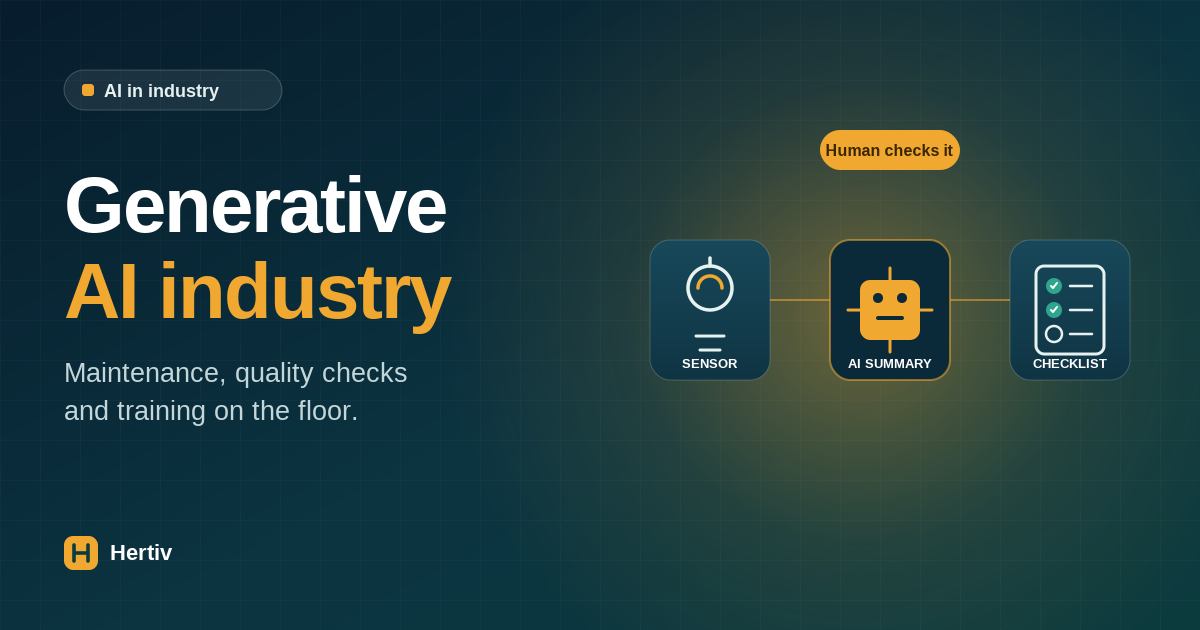
Generative AI in industry means using language and image models inside factories, plants and field operations to summarise data, draft documents, guide maintenance and speed up training. It works best where skilled staff spend hours turning sensor data and manuals into decisions, and where a human still checks the result.
What is generative AI in industry?
Generative AI in industry is the use of language and image models inside factories, plants, warehouses and field operations. The models read manuals, sensor readings, maintenance logs and shift reports, then produce summaries, draft procedures, answer questions and suggest next steps.
It differs from the office uses of the same models because the data is messier and the stakes are higher. A wrong summary in a marketing draft is embarrassing; a wrong maintenance instruction can stop a line or hurt someone. That is why industrial uses keep a human in the loop for every decision that affects safety or production.
The most common starting points are maintenance support, quality documentation, operator training and shift reporting. Each one has a clear input, a clear output and a person who checks the work before it is used.
Where is generative AI used in factories and plants?
Generative AI is used across the factory, but the value concentrates in a few jobs where reading and writing take up most of the shift. The table below shows the main applications and what each one produces.
| Application | What the model does | Who checks it |
|---|---|---|
| Maintenance support | Suggests likely causes from symptoms and history | Maintenance technician |
| Quality documentation | Drafts inspection notes and non-conformance reports | Quality engineer |
| Operator training | Turns manuals into guided lessons and quizzes | Training lead |
| Shift reporting | Summarises logs into a handover note | Outgoing shift lead |
| Spare parts search | Finds parts and substitutes from catalogues | Stores clerk |
| Safety briefings | Drafts briefings from incident and hazard data | Safety officer |
Maintenance support usually comes first because the data already exists in work orders and sensor logs, and the saving is easy to measure in downtime. Logistics teams use a similar pattern, as generative AI in logistics shows for planning and dispatch.
How does generative AI help maintenance teams?
Generative AI helps maintenance teams by turning a fault symptom into a short list of likely causes, each linked to the manual page and the past cases that support it. A technician facing an unfamiliar fault can ask the system what has fixed this symptom before, instead of searching through years of work orders.
The system works by grounding the model in the plant's own documents: equipment manuals, maintenance history and sensor trends. When the model answers, it cites the work order or the manual section it used, so the technician can check the source before acting.
The gain is speed and consistency. Junior technicians get the benefit of the senior team's experience, and the senior team spends less time answering the same questions. The model does not replace the technician's judgement, because it cannot see the machine, hear the noise or smell the overheating bearing.
Accuracy depends on the documents. If the maintenance history is thin or the manuals are out of date, the model will guess, and the guesses will look confident. Cleaning the work-order history is usually the first job, not the model. Supply chain teams face the same data problem, as AI in supply chain work shows.
What does it take to run generative AI on the factory floor?
Running generative AI on the factory floor takes clean documents, a retrieval system, a review step and a way to work when the network is poor. The steps below are the usual path from a pilot to daily use.
- Pick one use case with an owner. Maintenance support for one line, or shift reporting for one team, with a named person who checks the output.
- Gather the source documents. Collect manuals, work orders, incident reports and procedures for that line, and remove duplicates and outdated versions.
- Build retrieval first. Set up search over the documents so the model answers from plant records, not from general knowledge.
- Add the review step. Decide who checks each output and what happens when the output is wrong. No maintenance instruction goes to the floor unchecked.
- Plan for poor connectivity. Factory networks drop out, so the tool should queue requests and work from cached documents when the link is down.
- Measure one number. Track downtime, time to diagnose or reporting time before and after, and expand only if the number moves.
The build is mostly data and process work. The model itself is the smallest part, and teams that start with the model usually discover the document problem late. A short AI proof of concept with one line and one use case is the cheapest way to find the gaps.
Example: a parts plant cuts downtime with AI summaries
Example (hypothetical): a parts plant runs three lines, and each unplanned stop costs about 4 hours of lost output. The plant has 12 unplanned stops a month, and diagnosing the fault takes an average of 90 minutes because the technician must search manuals and past work orders.
The plant builds a maintenance assistant grounded in its own manuals and 5 years of work orders. A technician types the symptom and the machine code, and the assistant returns the three most likely causes with links to the manual pages and the past cases.
Diagnosis time falls from 90 minutes to 40 minutes. That is a saving of 50 minutes per stop, times 12 stops a month, or 600 minutes, which is 10 hours a month of faster diagnosis.
At 4 hours of lost output per stop, the plant does not gain back the full 10 hours, because repair time stays the same. But the line restarts sooner, and the night shift spends less time waiting for a senior technician.
The plant measures the result for three months before expanding to the other two lines. The lesson is that the gain is in diagnosis time, not repair time, and the team that measures it can prove the value before asking for more budget.
What are the limits and risks?
The limits of generative AI in industry are accuracy, connectivity, safety and the quality of the underlying documents. Each one needs a plan before the tool reaches the floor.
Accuracy is the biggest limit. Models can invent a procedure step or cite a manual page that says something else. In an office that is a bad draft; on a factory floor it can be a safety incident. Every output that affects equipment or people must pass a human check.
Connectivity matters because many plants have patchy networks. A tool that needs a constant cloud connection will fail at the moment it is needed most. Cache the documents and queue the requests so the tool still works offline.
There is also a data risk. Manuals and work orders can contain supplier pricing, customer names and process details that must not leave the plant. Run the model inside your own network or with a vendor that keeps your data private, and check the contract before uploading anything. Retail teams weighing the same trade-offs can see them in generative AI in retail.
What are the common mistakes?
The most common generative AI mistakes in industry are skipping the document clean-up, letting the model give instructions without a human check, and measuring usage instead of downtime.
- Grounding the model in messy documents. Outdated manuals and duplicate work orders produce confident wrong answers.
- No human check on instructions. A maintenance step that nobody reviewed is a safety risk, not a time saving.
- Starting with five use cases. One line and one job teach more than a plant-wide rollout that nobody owns.
- Measuring logins instead of outcomes. The number that matters is downtime or diagnosis time, not how often staff open the tool.
- Forgetting the offline case. A tool that only works with a perfect network will be abandoned after the first outage.
If you are planning an industrial AI pilot, generative AI consulting can help scope the first use case and the document work that comes before it.
Key takeaways
- Generative AI in industry summarises manuals, logs and reports so staff decide faster
- Maintenance support is the usual first use case because the data already exists
- Every output that affects equipment or safety needs a human check
- The hard part is clean documents and retrieval, not the model itself
- Measure downtime or diagnosis time, not how often staff open the tool
Frequently asked questions
Can generative AI replace maintenance technicians?
No. It can suggest likely causes and pull up the right manual page, but it cannot inspect a machine, hear a fault or judge a safety risk. The technician still makes the decision and does the repair.
What data does an industrial AI assistant need?
It needs equipment manuals, maintenance history, work orders, sensor summaries and procedures for the lines it covers. The documents must be current and deduplicated, or the model will answer from outdated information.
Does generative AI work offline on the factory floor?
It can, if the documents are cached and the requests are queued. A fully cloud-dependent tool will fail when the factory network drops, so plan for offline use from the start.
How much does an industrial AI pilot cost?
The model and hosting are usually the smaller part. Most of the cost is gathering and cleaning documents, building retrieval and training staff. A pilot for one line and one use case is the cheapest way to learn the real cost.
Is generative AI safe for safety-critical instructions?
Only with a human check. A model can draft a safety briefing or a procedure, but a qualified person must review it before it is used. Never let an unchecked model output become a work instruction.
Which industries use generative AI first?
Manufacturing, energy, logistics and field service are the early users, because they have large document sets and clear maintenance and reporting jobs. The pattern is the same in each: one use case, grounded in the company's own records.


