Generative AI for Business Transformation: A Practical Guide
Generative AI changes a business only when workflows, roles and decisions change with it. Learn to run a transformation that redesigns work instead of adding a tool.
On this page
Short answer
Generative AI transforms a business when it changes how work is done, not when it is added to existing routines. The shift comes from redesigning workflows around drafted and checked output, changing who reviews what, and measuring the result in time, cost or quality. Tools alone do not transform anything; the new way of working does.
What does generative AI business transformation mean?
Generative AI business transformation is the redesign of how a company works around language models that draft, summarise and answer from its own documents and data. It is not the purchase of a tool. It is a change to workflows, roles, checks and measures, so the same work gets done in a different and faster way.
The distinction matters because most early projects stop at the tool. A team buys access to a model, a few people try it, and the old process stays in place with a new step bolted on. That saves a little time in places and changes nothing about how the business runs.
Transformation starts from the other end. Leaders pick a workflow that matters, such as handling supplier orders or answering customer questions, and ask what it would look like if drafting and summarising were cheap. Then they rebuild the steps, the handovers and the checks around that answer. For the use cases that usually come first, see generative AI for enterprises.
How is transformation different from adding a tool?
Adding a tool leaves the process, the roles and the measures untouched. A person still does every step in the same order and simply asks a model for help with one of them. The gain is small and fades as soon as the novelty wears off, because the bottleneck was never the typing.
Transformation changes the steps themselves. Work that used to wait for a person to write a first draft now starts from a model draft, and the person becomes a reviewer. Work that used to need a meeting to share information now starts from a summary everyone can read. The handovers change, the skills that matter change, and the measures change too.
A useful test is to ask what would stop working if the model were switched off for a week. If the answer is almost nothing, the project was a tool purchase. If whole workflows would slow down because drafts, summaries and triage depend on it, the work has actually changed.
Which parts of a business change first?
The parts that change first are the ones where writing, summarising and searching take up the most staff time. Those are also the parts where a wrong draft is easy to catch, because a person already reviews the output before it reaches a customer.
| Area | What changes | What stays human |
|---|---|---|
| Customer support | Draft replies and summaries from tickets | Decisions on refunds and complaints |
| Sales | Account briefs and follow-up drafts | Negotiation and relationships |
| Operations | Document summaries and exception triage | Approvals and judgement calls |
| HR | Job posts, policy answers, onboarding packs | Hiring and people decisions |
| Finance | Report drafts and document extraction | Sign-off and audit decisions |
| Legal | First-pass contract review and research | Advice and final sign-off |
Start with one or two rows, not the whole table. A single workflow redesigned end to end teaches the company more than a thin layer of AI spread across every department at once.
How do roles and teams change?
Roles change when drafting stops being the work and reviewing becomes the work. A support agent who once wrote every reply from scratch now checks drafts, corrects facts and handles the cases the model cannot. A sales rep who once spent mornings on research now spends them on calls, because the brief arrives ready to read.
This shift needs new skills. Staff need to learn how to check model output, how to spot a confident error, and how to write a clear brief for the model. Managers need to learn how to set the rules for what the model may do and what it must never do, such as sending a message to a customer without review.
Team shapes change too. Some teams merge steps that used to sit in different departments, because a summary can cross a handover that once needed a meeting. Others add a small group that owns the shared documents, the prompts and the evaluation, so each team does not invent its own version. The org chart follows the workflow, not the other way round.
What governance does a transformation need?
Governance is the set of rules that decides what the model may see, what it may do and who is responsible when it gets something wrong. Without it, teams improvise, and the same company ends up with different answers to the same question in different departments.
Four rules cover most of the risk. First, decide which data the model may see, and keep personal and confidential data out of tools that store or train on prompts. Second, decide what needs a human check before it leaves the company, such as anything sent to a customer or filed with a regulator.
Third, log what the model produced and who approved it, so mistakes can be traced. Fourth, name an owner for each workflow who answers for its quality.
These rules are not paperwork for its own sake. They are what lets a company move fast without each team re-deciding the same questions. If your organisation has no AI governance in place yet, AI governance is worth setting up before the rollout widens.
How to run a transformation in stages
You run a transformation in stages, with each stage proving value before the next one starts. A big-bang rollout across the whole company is the fastest way to lose trust, because the first failures land everywhere at once.
- Pick one workflow that matters. Choose work with high volume, clear inputs and a human review step already in place, such as support replies or document summaries.
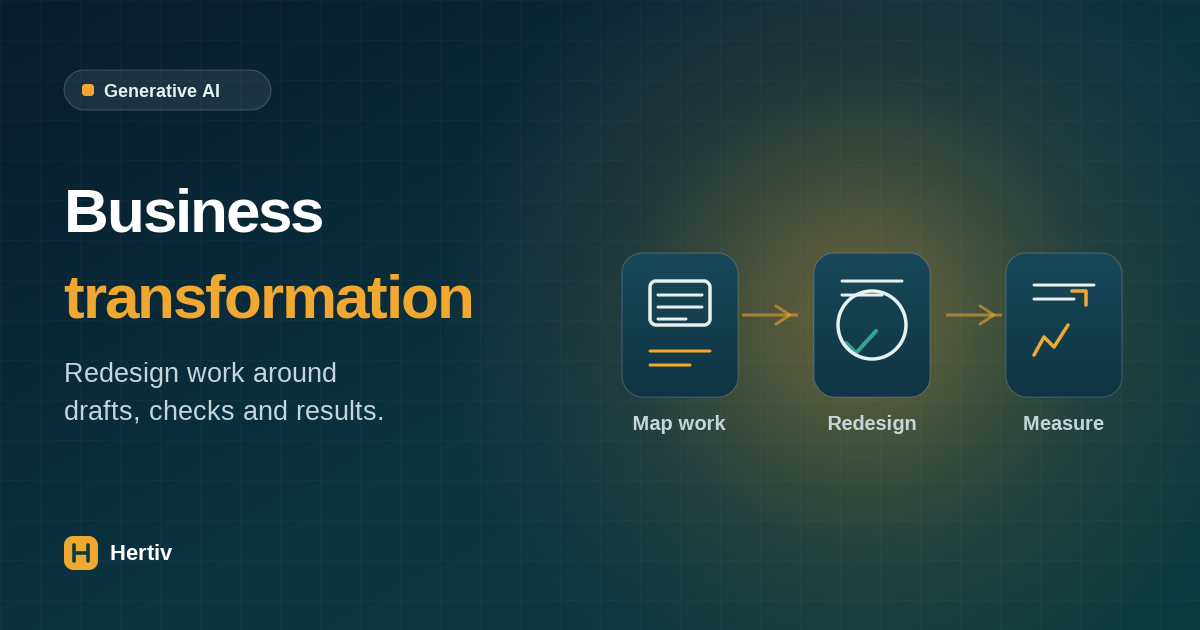
- Map the workflow as it is today. Write down every step, handover and check, with the time each takes. This is the baseline you will measure against.
- Redesign the steps. Decide which steps become drafts, which become checks, and which disappear entirely. Assign an owner to each new step.
- Run a pilot with real work. Let a small team use the new workflow for a month and log the errors, the time saved and the cases that still need a person.
- Fix the rules from what the pilot showed. Update the checks, the prompts and the data before expanding, and train the next team on what the pilot team learned.
Measure each stage against the baseline: time per case, error rate and staff time freed. If a stage cannot show a result, stop and fix it rather than adding more scope. A short AI proof of concept with a fixed evaluation set is the cheapest way to test a stage before committing budget.
Example (hypothetical): a distributor redesigns order handling
Example (hypothetical): a 300-person distributor receives 400 supplier orders a week by email, each with a PDF attached. Staff read each order, check the price against the contract, enter the lines into the ordering system and confirm by email. The work takes about 20 minutes per order, which is 400 times 20 minutes, or about 133 hours a week across the team.
The redesign changes the steps. A model reads each PDF and drafts the order lines with the contract price beside them. Staff check the draft, fix the lines the model flagged as uncertain, and confirm. Checking takes about 6 minutes per order, so 400 orders take 400 times 6 minutes, or 40 hours a week. The team saves about 93 hours a week.
The saved time goes into the exceptions: orders where the price does not match the contract, or the supplier changed the terms. Those used to wait in a queue. The roles change too: order entry becomes order checking, and one person owns the contract documents the model reads, so prices stay current.
What are the common mistakes?
The most common mistakes in a generative AI transformation are buying tools before redesigning work, skipping the baseline, and letting teams improvise their own rules.
- Buying tools before redesigning work. A model licence without a new workflow is a faster way to do the old job, not a transformation.
- No baseline. Without measuring time and errors before the change, nobody can say whether the new way is better.
- Every team inventing its own rules. Different prompts, different data and different checks in each team produce different answers to the same question.
- Removing the human check too early. Drafts still need review, especially where money, safety or a customer relationship is involved.
- Measuring output instead of outcomes. More drafts per day is not a result. Time saved, errors avoided and cases resolved are.
- Forgetting the people. Staff who are not trained or consulted will route around the new workflow, and the old one will quietly return.
Key takeaways
- Transformation means redesigning workflows, roles and checks — not buying a tool
- Start where drafting and summarising eat the most staff time, and where a human already reviews the output
- Roles shift from writing first drafts to checking them; staff need training in how to check
- Four governance rules cover most risk: data limits, human checks, logging and a named owner per workflow
- Run it in stages with a baseline, a pilot and measured results before expanding
- Measure outcomes — time, errors, cases resolved — not how much text the model produced
Frequently asked questions
What is the difference between AI adoption and AI transformation?
Adoption means people use a model inside the old workflow. Transformation means the workflow itself changes: steps are removed, handovers move, roles shift from writing to checking, and success is measured in time or quality rather than usage. Most companies adopt first and transform later, one workflow at a time.
How long does a generative AI transformation take?
A single workflow can be redesigned and piloted in a few months. Changing how a whole company works takes longer, usually one to two years of staged rollouts, because each stage needs training, new rules and measured results before the next one starts.
Do we need to change the org chart?
Not at first. The workflow changes come first, and the org chart follows when handovers move between teams. Some companies add a small team that owns shared documents, prompts and evaluation, so each department does not build its own version.
What should we measure?
Measure time per case, error rate and staff time freed, against a baseline taken before the change. Also track how often human reviewers correct the model, because a rising correction rate is an early warning that documents or prompts are going stale.
What is the biggest risk?
The biggest risk is removing human checks too early. A model that drafts confidently can produce a wrong price, a wrong policy answer or a wrong contract term that nobody notices until it reaches a customer. Keep a person in the loop for anything that affects money, safety or reputation.
Should every department transform at once?
No. Pick one or two workflows with high volume and a clear review step, prove the result, then expand. A thin layer of AI across every department at once spreads effort too thin and makes failures hard to trace.


