Generative AI Development Companies for Enterprises: 8 to Shortlist
Generative AI development companies for enterprises range from model builders to specialist studios. Shortlist by use case, data rules and budget.
On this page
Short answer
The generative AI development companies worth shortlisting for an enterprise are the model builders and specialist studios that have shipped production systems, not demos: OpenAI, Anthropic, Cohere, Mistral AI, Databricks, Writer, Jasper and AI21 Labs. Shortlist by use case first, then check data handling, integration depth and whether they build with your team or hand you a finished product.
Which generative AI companies should enterprises shortlist?
The generative AI companies worth shortlisting for an enterprise fall into two groups: the model builders that supply the models and the tooling, and the specialist studios that build custom systems on top of them. The right shortlist depends on whether you need a model, a platform or a finished product built for your workflows.
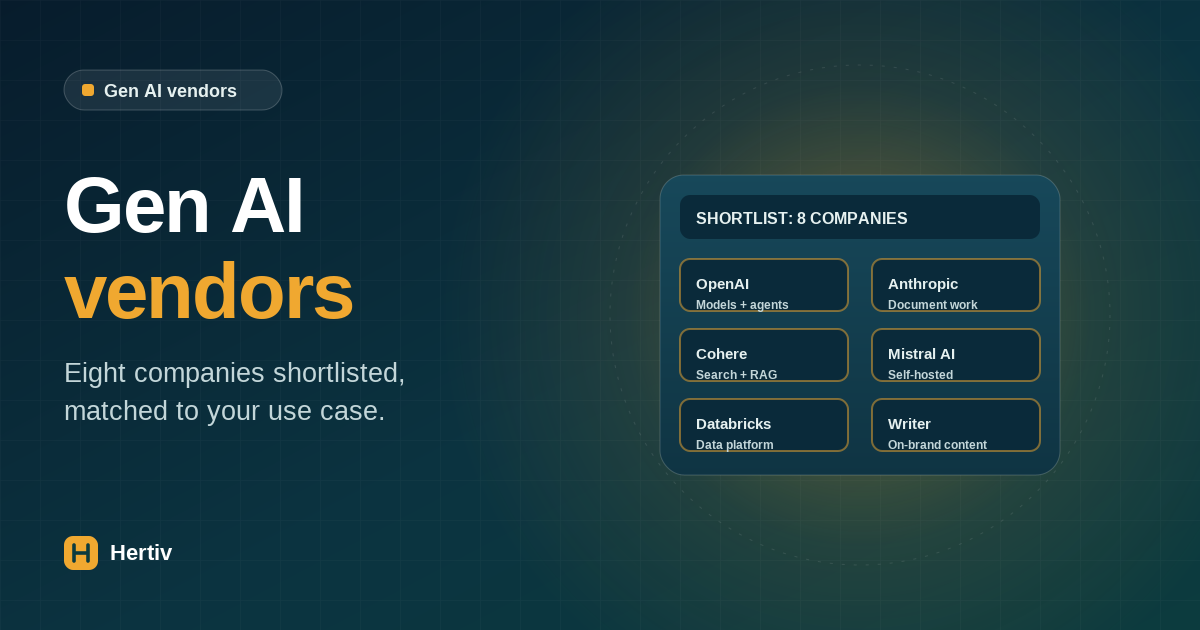
Use this comparison to shortlist. All eight are well-known products operating today, and pricing is "see vendor site" in every case, because enterprise pricing is quoted per project.
| Company | Main strength | Best for |
|---|---|---|
| OpenAI | Flagship models and APIs | General-purpose copilots and agents |
| Anthropic | Long-context reasoning models | Document work and careful analysis |
| Cohere | Enterprise search and RAG | Search over internal documents |
| Mistral AI | Open-weight models | Self-hosted and regulated deployments |
| Databricks | Data platform with model serving | AI built on your own data |
| Writer | Enterprise writing platform | On-brand content at scale |
| Jasper | Marketing content platform | Marketing teams and campaigns |
| AI21 Labs | Task-specific language models | Reading, summarising and extraction |
Start with the use case, not the vendor. A support agent, a document search tool and a marketing content system need different strengths, and the best company for one is rarely the best for all three.
The model builders
1. OpenAI: best for general-purpose copilots and agents
OpenAI builds the models most enterprises start with, plus the APIs, assistants and agent tooling around them. Its strength is breadth: the same platform can power a support copilot, a document summariser and a coding assistant, which makes it a safe first choice when a company is not yet sure which use case will matter most.
For enterprises, the relevant offer is the business tier with data controls, admin tools and support, rather than the consumer product. Teams should check data handling, retention and regional availability before committing, and confirm that the model is not trained on their inputs.
Pros: the widest model range and the largest developer ecosystem; strong tooling for agents and retrieval; well-documented APIs.
Cons: pricing is usage-based and can grow fast at scale; model behaviour changes with new versions, so evaluation sets matter.
2. Anthropic: best for document work and careful analysis
Anthropic builds the Claude family of models, known for long documents and careful, structured reasoning. Its strength for enterprises is work that needs a model to read a long contract, a research file or a ticket history and produce a faithful summary or a reasoned answer.
Anthropic positions its enterprise offer around safety and control, with admin tools, data handling rules and the ability to run through cloud partners. That fits regulated teams that need to show how the model handles their data.
Pros: strong on long documents and structured analysis; clear data handling and safety controls; good API documentation.
Cons: a smaller ecosystem than the largest model providers; fewer third-party integrations in some tooling areas.
Search, retrieval and open models
3. Cohere: best for search over internal documents
Cohere focuses on enterprise search and retrieval-augmented generation, with models built for finding the right document and answering from it. Its strength is the retrieval layer: embedding and reranking models that make internal search work, plus generation models tuned for business documents.
For an enterprise with a large wiki, a document store or a ticket history, Cohere's offer is the search and answer layer rather than a general chatbot. Teams should test it on their own documents, because retrieval quality depends on the data, not the demo.
Pros: purpose-built retrieval and reranking; deployment options including private cloud; strong on multilingual document sets.
Cons: less suited to open-ended creative work; the value depends heavily on how clean the source documents are.
4. Mistral AI: best for self-hosted and regulated deployments
Mistral AI builds open-weight models that enterprises can run on their own infrastructure, which suits teams with strict data rules. Its strength is control: the model can live inside your cloud or your data centre, so sensitive data never leaves your environment.
The trade-off is effort. Running a model yourself means owning the hosting, the updates and the monitoring, so Mistral fits teams that already have platform skills, or that work with a partner to run it. For a quick pilot, a hosted API is the faster route.
Pros: open-weight models you can host yourself; strong European data positioning; good performance for the model size.
Cons: self-hosting needs platform skills; the ecosystem of ready-made integrations is smaller than the largest providers.
Data platforms and content specialists
5. Databricks: best for AI built on your own data
Databricks is a data platform that added model serving, fine-tuning and agent tooling, so enterprises can build AI on the data they already hold. Its strength is the data layer: governance, lineage and access control are built in, which matters when the AI touches customer or financial data.
For an enterprise that already runs its analytics on Databricks, building the AI there avoids moving data to a second platform. For a team without that base, the platform is a bigger commitment than a single model API.
Pros: data governance and lineage built in; model serving and fine-tuning on one platform; strong for regulated data.
Cons: a platform commitment, not a single tool; pricing depends on compute use and needs a careful estimate.
6. Writer: best for on-brand content at scale
Writer is an enterprise writing platform that builds generative AI for content teams, with brand rules, style guides and approval workflows built in. Its strength is consistency: every draft follows the company's voice, terminology and compliance rules, instead of drifting with each prompt.
Writer fits marketing, communications and support teams that produce a high volume of text and need it checked before it goes out. The platform includes review queues and guardrails, so a draft does not reach a customer unchecked.
Pros: brand and style controls built in; approval workflows for regulated content; strong for high-volume writing teams.
Cons: focused on writing, not on agents or search; the value depends on having brand rules worth enforcing.
Marketing content and task-specific models
7. Jasper: best for marketing teams and campaigns
Jasper is a marketing content platform that uses generative AI to draft campaigns, product descriptions and social posts, with brand voice and campaign templates. Its strength is speed for marketing teams: a campaign that took a week of drafting can start from a set of on-brand first drafts in a day.
Jasper fits teams that already run campaigns and need more variants, faster, without losing the brand voice. It is less suited to technical document work or to building custom agents, which need a different kind of platform.
Pros: fast campaign drafting with brand voice; templates for common marketing formats; easy for non-technical teams to use.
Cons: marketing-focused, so it does not cover agents, search or document analysis; drafts still need human editing.
8. AI21 Labs: best for reading, summarising and extraction
AI21 Labs builds task-specific language models for reading and summarising long documents, extracting fields and answering from source text. Its strength is precision on document tasks: summarising a 100-page report, pulling clauses from contracts, or answering a question with a citation to the source page.
For enterprises with heavy document work in legal, finance or insurance, a task-specific model can beat a general model on accuracy and cost, because it does one job well. Teams should test it on their own documents, with an evaluation set of real cases.
Pros: strong on long-document reading and extraction; answers grounded in source text; good for regulated document work.
Cons: narrower than a general-purpose model; the ecosystem is smaller than the largest providers.
How to choose a generative AI development company
Choose a generative AI development company by starting with the use case, then checking data handling, integration depth and the working model. A shortlist of eight is too many; aim to talk to three.
- Name the use case. Support agent, document search, content drafting or a custom agent each point to a different strength. Pick one use case for the first project.
- Check data handling. Ask where your data goes, how long it is kept, and whether it is used for training. Get the answer in writing.
- Test on your own data. Give each shortlisted company the same 20 real cases with known good answers, and compare the results on that set.
- Ask who builds and who runs it. Some companies hand you a finished product; others build with your team and hand over the code. Know which one you are buying.
- Price the running cost. Ask for the monthly cost at your expected volume, not the pilot price. Usage-based pricing grows with success.
The evaluation set is the most important step. Twenty real cases with known good answers will tell you more about a vendor than any demo or benchmark. Generative AI consulting can help set up the evaluation before you talk to vendors.
What are the common mistakes?
The most common mistakes when choosing a generative AI development company are picking on brand name, skipping the evaluation set, and buying a platform for one use case that needs a different strength.
- Choosing on brand alone. The best-known model is not the best for every task. A document search tool and a marketing content system need different strengths.
- Skipping the evaluation set. Without 20 real cases and known good answers, you cannot compare vendors, and every demo looks good.
- Ignoring data handling. Ask where data goes and whether it is used for training, and get the answer in writing before you send real data.
- Buying a platform for a single task. A full data platform is a big commitment for one pilot. Start with the smallest tool that fits the use case.
- Forgetting the running cost. Usage-based pricing grows with volume. Price the monthly cost at your expected scale, not at pilot volume.
For the general picture on AI vendors for enterprises, see AI development companies for enterprises.
If the project needs custom building, generative AI development covers the build options.
Key takeaways
- Shortlist by use case first: support, document search, content and custom agents need different strengths
- Model builders supply the models; specialist studios build the finished system on top of them
- Test every shortlisted company on the same 20 real cases with known good answers
- Check data handling in writing: where data goes, how long it is kept, and whether it trains the model
- Price the monthly running cost at your expected volume, not at pilot volume
Frequently asked questions
Which generative AI company is best for enterprises?
It depends on the use case. OpenAI and Anthropic suit general copilots and document work, Cohere suits internal search, Mistral AI suits self-hosted deployments, and Writer and Jasper suit content teams. Shortlist by use case, not by brand.
What is the difference between a model builder and a development company?
A model builder supplies the model and the API. A development company builds the finished system around it: the retrieval, the workflows, the integrations and the guardrails. Most enterprises need both, and some companies do both.
How should an enterprise evaluate generative AI vendors?
Give each shortlisted vendor the same 20 real cases with known good answers, and compare the results. Add a check on data handling, integration depth and the monthly running cost at your expected volume.
Do enterprises need to host their own models?
Not usually. Most start with a hosted API and its data controls. Self-hosting with open-weight models fits teams with strict data rules or regulated data, and it needs platform skills to run well.
What does generative AI development cost?
Enterprise pricing is quoted per project, so vendors ask you to see their site or request a quote. The running cost depends on volume: model calls, hosting and staff time for review, which you should price at your expected scale.
Should we fine-tune a model or use retrieval?
Start with retrieval over your own documents, which is faster and easier to update. Fine-tuning fits when you need a consistent format or tone at scale, and it is easier to justify once you have an evaluation set.


