Generative AI Architecture for Enterprises, Explained
Enterprise generative AI architecture connects your data, models, guardrails and applications into one governed system. Here is how the layers fit together.
On this page
Short answer
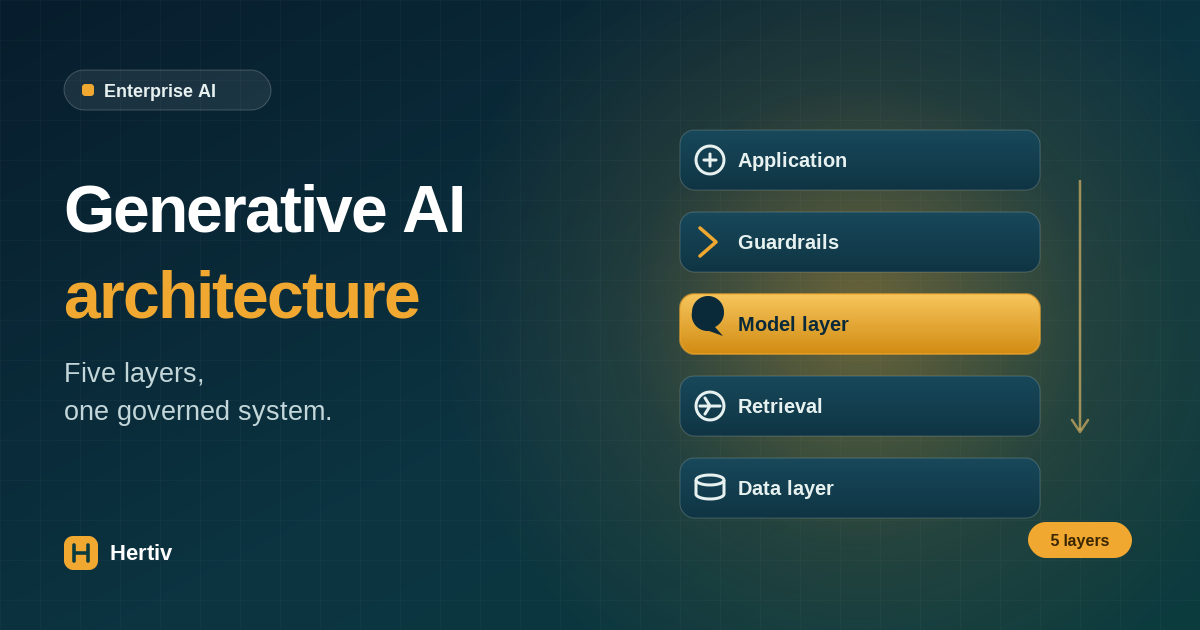
Generative AI architecture for enterprises is a layered system: a data layer that prepares and governs your documents, a retrieval layer that finds the right context, a model layer that generates answers, a guardrail layer that checks outputs, and an application layer that puts the result into staff workflows. Each layer has its own owner and controls, so the system can be tested, audited and changed without rebuilding everything.
What is generative AI architecture?
Generative AI architecture is the design of a system that lets a large language model work safely on your own data inside your own workflows, with controls at every step. It is not the model alone; it is the data, retrieval, guardrails, applications and monitoring around it.
The reason architecture matters is that a model on its own has no memory of your business, no access to your systems and no sense of what it may or may not say. The architecture supplies all three, and it is where most enterprise projects succeed or fail.
Think of it as five layers that pass work along: data, retrieval, model, guardrails and application. Each layer can be changed without rebuilding the others, which is what makes the system maintainable as models and rules change.
What are the layers of an enterprise generative AI stack?
Each layer has one job and one owner. When a layer has no owner, its quality drifts and the whole system suffers, usually in ways that show up as wrong answers reaching customers.
| Layer | Job | Owner |
|---|---|---|
| Data layer | Clean, current documents and records | Data team |
| Retrieval layer | Find the right context for each question | Search or platform team |
| Model layer | Generate answers from the context | AI engineering |
| Guardrail layer | Check outputs for policy and accuracy | Risk or compliance |
| Application layer | Put answers into staff workflows | Product or operations |
The data layer is the one teams underestimate most. If the documents are outdated or duplicated, retrieval returns the wrong context and the model writes a confident answer from it. Clean data is the cheapest quality control in the whole stack.
How does data flow through the system?
A question travels through the layers in order, and each layer adds something the next one needs. The flow is the same whether the user is a support agent, a salesperson or a finance analyst.
- The user asks a question in the application, such as a support console or an internal search page.
- The retrieval layer searches the governed documents and returns the most relevant passages, with their sources.
- The model layer drafts an answer using only those passages, with instructions about tone and format.
- The guardrail layer checks the draft against policy, blocks disallowed content and flags low-confidence answers for human review.
- The application shows the answer with its sources, and logs the question, the sources and the human decision.
The log in step five is what makes the system improvable. Without it, you cannot tell which documents fail, which prompts drift or which answers staff distrust, so every change becomes a guess.
How do you keep it safe and compliant?
Safety in enterprise generative AI comes from controls at several layers, not from a single filter. A filter alone is easy to bypass; a layered set of controls is much harder to break by accident.
- Access control at the data layer. Retrieval must respect the same permissions as the source systems, so an assistant never shows a document the user cannot open.
- Grounding rules. The model answers from the retrieved passages only, and says it does not know when the passages do not cover the question.
- Output checks. Guardrails screen for policy breaches, personal data and hallucinated citations before the answer reaches a user.
- Human gates. High-risk actions, such as sending a message to a customer or changing a record, need a human approval step.
- Audit trails. Every run is logged with its inputs, sources and decisions, so a bad answer can be traced back to its cause.
For the governance side of this work, AI governance covers the policies and reviews that sit around the technical controls. The architecture only works when someone owns each control and checks that it still holds.
How do you scale from pilot to production?
Scaling is a sequence, not a single decision. Each step proves one thing before the next step spends more money or reaches more users.
- Pick one workflow with a human reviewer, and build an evaluation set of twenty real cases with known good answers.
- Ship the pilot to a small group and measure answer quality, time saved and handoff quality for four weeks.
- Fix the data and prompts that the pilot exposed, and set the guardrails that the review found missing.
- Connect the second system, such as the CRM or the ticketing tool, and extend the evaluation set to cover it.
- Roll out to the wider team with training, an owner for the knowledge base and a weekly quality review.
The step teams skip most often is the evaluation set. Without it, scaling is a matter of opinion: one team says quality improved, another says it got worse, and nobody can settle it. Twenty real cases with known good answers settle most arguments.
Example (hypothetical): a bank rolls out an internal assistant
Example (hypothetical): a bank with 2,000 staff wants an internal assistant that answers policy questions from 800 documents. The pilot covers one department of 120 people. Staff ask 500 questions a week, and answering each one by hand takes 6 minutes, or 50 hours a week across the team.
The assistant answers 350 of the 500 questions directly, at a 1-minute review each, which is about 6 hours. The other 150 still go to a human at 6 minutes each, or 15 hours. Total time falls from 50 hours to about 21 hours, saving roughly 29 hours a week, or about 1,500 hours over a working year.
The build costs $140,000, plus $4,000 a month to run. At $45 an hour, the saving is worth about $67,500 a year, so the first year costs more than it saves. The case only closes when the assistant reaches all 2,000 staff, where the same math gives roughly 480 hours saved a week. The pilot proves the quality; the rollout proves the economics.
What are the common mistakes?
The most common mistakes with enterprise generative AI architecture are building on messy data, skipping evaluation and treating launch as the finish line.
- Building on messy documents. If the knowledge base has five versions of one policy, retrieval will return all five. Clean the documents first.
- No evaluation set. Without real cases and known good answers, you cannot tell whether a change helped or hurt.
- One layer doing everything. When the model is asked to retrieve, judge policy and act, failures are hard to trace. Keep the layers separate.
- No owner per layer. Each layer drifts without an owner. Assign one, and review each layer on a schedule.
- Scaling before the pilot proves itself. A pilot that has not been measured is not a proof; it is a demo with more users.
For a shortlist of use cases that hold up in production, generative AI use cases that work in production shows where to start.
For the data side, data engineering covers the pipelines that keep the data layer clean.
Key takeaways
- Enterprise generative AI is five layers: data, retrieval, model, guardrails and application
- Clean data is the cheapest quality control in the whole stack
- Retrieval must respect the same permissions as the source systems
- An evaluation set of real cases settles quality arguments
- Scale in steps: pilot, measure, fix, connect, then roll out
- Give every layer an owner, or it drifts without anyone noticing
Frequently asked questions
What is generative AI architecture?
It is the design of the system around a language model: the data it reads, the retrieval that finds context, the model that drafts answers, the guardrails that check outputs and the application that puts answers into workflows. The architecture is what makes a model safe and useful inside a company.
Do enterprises need RAG for generative AI?
Most do. Retrieval-augmented generation grounds the model on your own documents, so answers come from sources you control instead of from the model's training data. It also makes answers traceable, because each answer can cite the passages it used.
How is enterprise generative AI different from ChatGPT?
A public chatbot has no access to your documents, no permission model and no audit trail. An enterprise system adds all three, plus guardrails and human approval gates, so it can work inside your workflows without leaking data or acting without oversight.
What does it cost to build enterprise generative AI?
A narrow proof of concept on one workflow usually takes a few weeks when the data is ready. A production system with integrations, evaluation and governance takes two to four months. Running costs scale with usage, so estimate them at three usage levels before committing.
How do you keep generative AI outputs accurate?
Ground answers on retrieved passages, require citations, flag low-confidence answers for human review and keep an evaluation set of real cases. Accuracy improves fastest when you fix the documents and prompts that the evaluation set shows are failing.
Who should own generative AI architecture?
Ownership is split by layer: the data team owns the data layer, AI engineering owns the model and retrieval layers, risk or compliance owns the guardrails, and product or operations owns the application. One person should own the whole system and its weekly quality review.


