What a GDPR Privacy Policy Must Contain
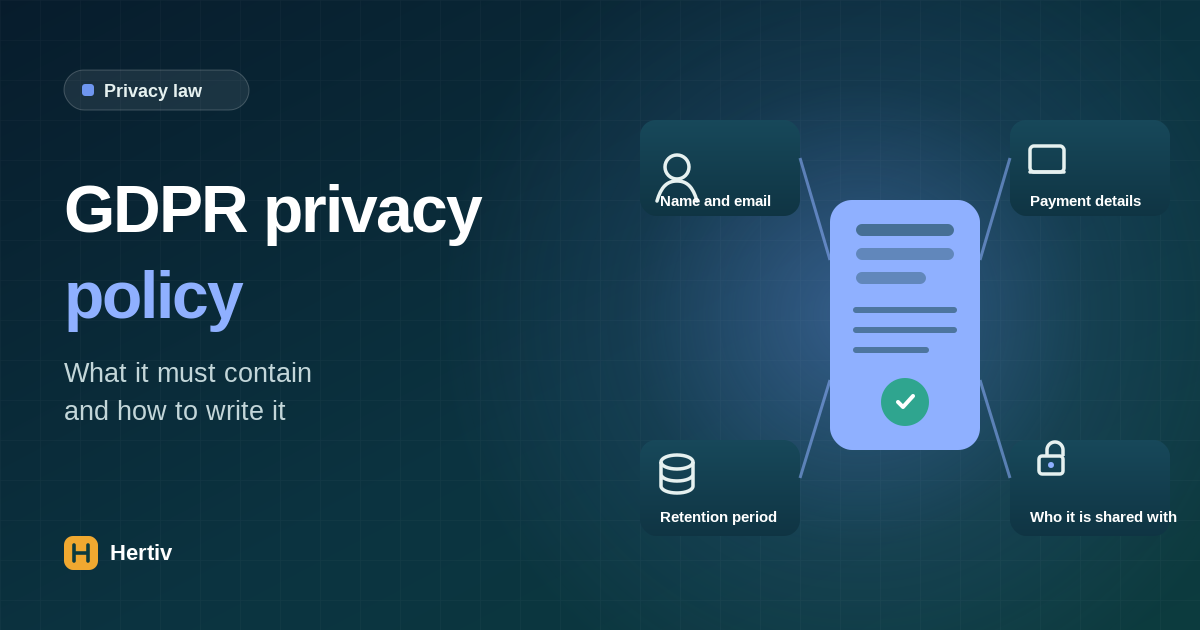
A GDPR privacy policy must name the data you collect, why you collect it, how long you keep it and who you share it with. Here is what to include.
On this page
Short answer
A GDPR privacy policy is a public document that explains what personal data a business collects, why it collects it, how long it keeps it and who it shares it with. It is required by the General Data Protection Regulation for any business that offers goods or services to people in the EU, and it must be written in plain language that a normal reader can understand.
What is a GDPR privacy policy?
A GDPR privacy policy is a written notice that tells people what personal data your business collects about them and what you do with it. Personal data means any information that can identify a person: a name, an email address, a delivery address, an IP address, a payment reference or a photo.
The policy is required by the General Data Protection Regulation, the EU law that governs how personal data is handled. If your business offers goods or services to people in the EU, or watches how they behave online, the law applies to you even if your business is based elsewhere.
The policy is not the same as your terms of service. Terms cover what a customer agrees to when they buy from you; the privacy policy covers only how you handle their personal data. For the wider picture of what GDPR asks of a business, see what GDPR compliance means.
A good policy does two jobs at once. It keeps you on the right side of the law, and it tells customers in plain words what happens to their information, which builds trust. A policy that nobody can read or understand does neither job.
What must a GDPR privacy policy include?
A GDPR privacy policy must cover the items the regulation lists in Articles 13 and 14. The list is not optional: leaving an item out means the policy does not meet the law, even if the rest is well written.
The table below sets out each required item and what it means in practice for a small business.
| Required item | What to write |
|---|---|
| Who you are | Your business name, contact details and, if you have one, your data protection officer |
| What data you collect | Every type of personal data: names, emails, addresses, payment details, cookies, location |
| Why you collect it | The purpose for each type: to deliver orders, answer questions, send marketing |
| The legal basis | Consent, contract, legal duty or legitimate interest, for each purpose |
| How long you keep it | A retention period for each type of data, or how you decide it |
| Who you share it with | Every recipient: payment providers, couriers, analytics tools, hosting companies |
| Transfers outside the EU | Where data goes and what safeguards apply, if it leaves the EU |
| People's rights | How a person can ask for a copy, a correction or deletion of their data |
| How to complain | How to contact you, and the right to complain to a data protection authority |
The hardest item for most businesses is the legal basis. Marketing emails need consent, while delivering an order is covered by the contract itself. If you rely on legitimate interest, say what that interest is and why it does not override the person's rights.
Retention is the item most policies get wrong. A vague line such as "we keep data as long as needed" is not enough. Give a period, such as 6 years for invoices or 90 days for support chats, or explain the rule you use to set the period.
How do you write a privacy policy in plain language?
A GDPR privacy policy must be written in clear and plain language, so a normal reader can understand it without legal training. That is a legal requirement, not a style choice.
Start with short sentences and everyday words. Write "we store your email address so we can send your order confirmation" instead of "the data subject's electronic mail address shall be retained for the purpose of transactional correspondence". If a sentence needs a lawyer to parse it, rewrite it.
Use headings and short sections so a reader can find one answer fast. Most people visit a privacy policy with one question in mind, such as whether their email will be sold or how long their address is kept. Put the answer where they can find it in seconds.
Keep the policy specific to your business. A policy copied from another company will name tools you do not use and miss the ones you do, which makes it wrong in both directions. Write down every tool that touches personal data first, then describe each one. For guidance on the data side of that inventory, see best practices for AI data privacy.
What happens if your policy is missing or wrong?
If your business has no privacy policy, or the policy does not cover what the regulation requires, a data protection authority can fine you. Fines under the GDPR can reach 20 million euros or 4% of worldwide turnover, whichever is higher, for the most serious breaches.
In practice, most small businesses are not fined at the maximum. Regulators usually start with a warning and a deadline to fix the problem, and fines follow when a business ignores the warning or the breach is large. Even so, a fine is not the only cost: a complaint can lead to an investigation that takes weeks of staff time.
The bigger risk for many businesses is lost trust. Customers who cannot find a clear privacy policy are less likely to create an account or hand over their details. A clear policy is also a selling point when you work with larger partners, who often ask to see it before they sign a contract.
Example (hypothetical): a small online shop's policy
Example (hypothetical): a small online shop sells handmade candles and takes about 500 orders a month. Each order collects a name, an email, a delivery address and a payment reference, and the shop uses a courier, a payment provider and an email tool.
The shop's policy lists each item: names and addresses are kept for 6 years because tax law requires it, which is 500 x 12 x 6 = 36,000 order records over the period. Support chats are kept for 90 days and then deleted, and marketing emails go only to the 3,000 people who ticked the consent box at checkout.
When a customer asks for their data to be deleted, the shop deletes the marketing record and the support chats, but keeps the invoices for 6 years because the law requires it, and says so in the reply. The arithmetic is simple, but writing it down is what makes the policy honest: the shop knows exactly what it holds, where it is, and when it goes.
What are the common mistakes?
The most common mistakes businesses make with a GDPR privacy policy are copying one from another company, hiding it where nobody can find it, and never updating it.
- Copying another policy. A copied policy names tools you do not use and misses the ones you do, so it is wrong in both directions.
- Hiding the policy. A policy buried three clicks deep or written in legal jargon fails the plain-language rule, even if the content is right.
- No retention periods. Saying you keep data "as long as needed" does not meet the regulation; give a period or a clear rule.
- Missing third parties. Forgetting to name the payment provider, courier or analytics tool is the most common gap.
- Consent for everything. Asking for consent when the real basis is a contract creates confusion; use the right basis for each purpose.
- Never updating it. A policy written when the business used two tools is wrong once it uses ten.
How often should you review the policy?
Review your privacy policy at least once a year, and every time something changes in how you handle data. A new tool, a new market, a new way of using customer data or a new law all mean the policy needs another look.
- List every tool that touches personal data. Include payment providers, couriers, email tools, analytics, chat tools and AI features.
- Check each purpose and legal basis. Confirm the reason you collect each type of data is still true and the basis still fits.
- Check retention periods. Confirm old data is actually being deleted on schedule, not just promised in the policy.
- Update the text. Rewrite the changed parts in plain language and note the date of the change.
- Tell customers about big changes. If you start collecting a new type of data or sharing it with a new partner, say so before it happens.
Keep a record of each review: the date, what changed and who approved it. That record is useful if a regulator ever asks how you keep the policy up to date. For help putting the wider compliance picture together, see data security and compliance services.
Key takeaways
- A privacy policy is a legal notice, not a formality
- Name every type of data, its purpose and its legal basis
- Give real retention periods, not vague promises
- Name every third party that receives personal data
- Review the policy yearly and after every change
Frequently asked questions
What is a GDPR privacy policy?
A GDPR privacy policy is a public document that explains what personal data a business collects, why it collects it, how long it keeps it and who it shares it with. It is required by the General Data Protection Regulation for businesses that serve people in the EU.
Does every website need a GDPR privacy policy?
Any website that collects personal data from people in the EU needs one, including a simple contact form or newsletter signup. If you collect names, emails or analytics data, you need a policy that explains what you do with them.
What is the difference between a privacy policy and terms of service?
A privacy policy covers only how you handle personal data, while terms of service cover the whole agreement between you and the customer, including payment, delivery and returns. Most businesses need both documents.
Can I copy a privacy policy from another website?
Copying is a bad idea because the policy will name tools you do not use and miss the ones you do. It will also describe purposes and retention periods that do not match your business, which makes it inaccurate.
What is the maximum GDPR fine?
Fines under the GDPR can reach 20 million euros or 4% of worldwide turnover, whichever is higher, for the most serious breaches. Regulators usually start with a warning and a deadline to fix the problem.
How often should a privacy policy be updated?
Review it at least once a year and every time you add a tool, collect a new type of data or share data with a new partner. Keep a record of each review, including the date and what changed.


