The Future of Data Science: What Changes Next
Data science is moving from hand-built models toward automated pipelines, generative AI helpers and live data. Here is what changes for teams, skills and hiring.
On this page
Short answer
The future of data science is a shift from manual model building toward automated pipelines, generative AI assistants and real-time data products. Teams will spend less time writing routine code and more time framing problems, checking results and putting models into production where they change decisions.
What is the future of data science?
The future of data science is the next stage of the field, where automated tools, generative AI and live data change how teams turn raw data into decisions. The core job stays the same: find patterns in data and use them to guide action. What changes is how much of the routine work machines handle.
Today a data scientist still spends a large share of time cleaning data, writing boilerplate code and tuning models by hand. Automated machine learning tools already handle much of that, and generative AI can now draft code, explain results and write first versions of reports. The human work moves toward choosing the right problem, judging whether an answer is trustworthy and getting a model into daily use.
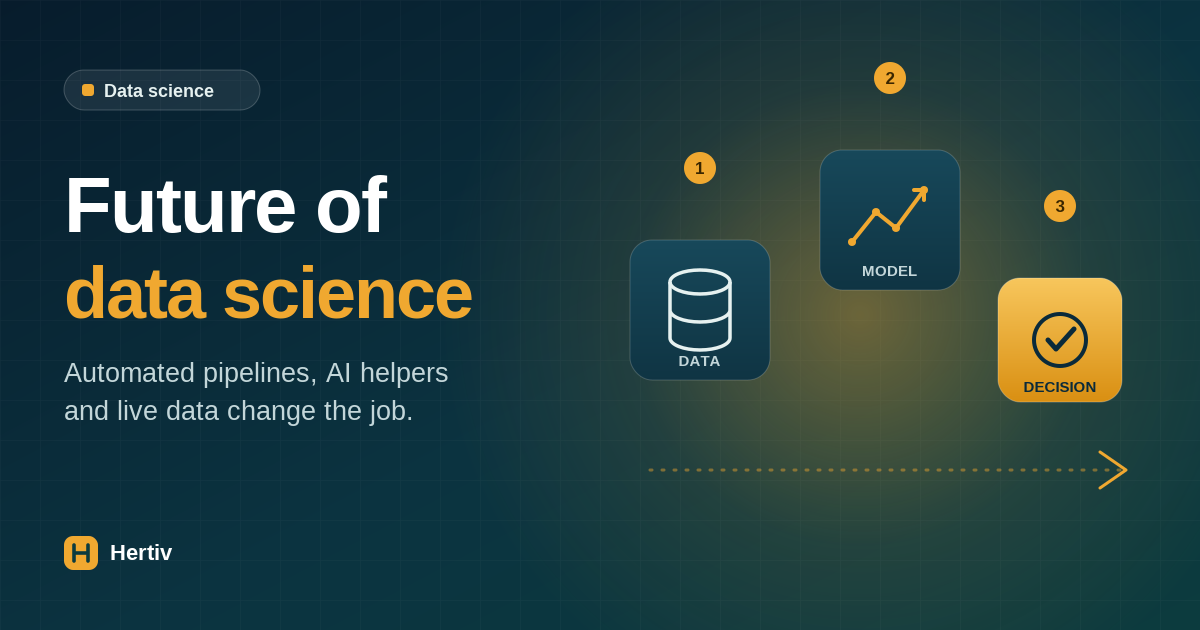
Three shifts define the direction. First, data pipelines become more automated, so fresh data flows into models without manual steps. Second, models become easier to build and harder to tell apart, so the edge comes from good data and clear business framing.
Third, results must arrive faster, often while a decision is being made rather than in a weekly report. Teams that plan for these shifts will adapt more smoothly than teams that treat them as a passing trend.
How is generative AI changing data science work?
Generative AI is changing data science work by taking over the drafting and explaining parts of the job, while leaving judgement and verification to people. A data scientist can ask a model to write a data-cleaning script, suggest features for a model or draft a plain-language summary of results, then check and correct the output.
The most useful change is speed on routine tasks. Writing SQL, building charts and documenting a pipeline are now faster, which leaves more time for the parts that need thought: deciding what to measure, spotting a biased sample and testing whether a model still works after the data changes. The risk is that fast output can look right while being wrong, so review skills matter more, not less.
Generative AI also opens data work to more people. A product manager can ask questions in plain language and get a chart back, and a business analyst can explore a dataset without waiting for a specialist. That does not remove the data scientist. It moves them toward setting up reliable data, defining metrics and checking answers, which is where generative AI for data analytics already shows the pattern.
Which data science skills will matter most next?
The data science skills that will matter most next are problem framing, data judgement, model checking and clear communication, alongside solid coding and statistics. As tools automate more of the coding, the skills that set people apart are the ones machines do poorly.
| Skill | Why it matters | How it shows up |
|---|---|---|
| Problem framing | Tools cannot decide what to solve | Turning a business goal into a measurable question |
| Data judgement | Bad data gives confident wrong answers | Spotting bias, gaps and stale sources |
| Model checking | Automated models still fail silently | Testing, monitoring and explaining results |
| Communication | Results only help if people act on them | Plain-language summaries and honest limits |
| Production skills | Models must run reliably every day | Pipelines, monitoring and safe updates |
Statistics and coding remain the foundation. A data scientist still needs to read code, understand what a model assumes and test whether results hold on new data. But hiring is shifting toward people who can own a problem end to end, from messy data to a decision that sticks. Specialists in one modelling method are less in demand than people who can ship a working data product and explain it to non-technical colleagues.
Where is data science heading in business?
Data science in business is heading toward smaller, faster and more embedded uses, where models sit inside everyday tools instead of living in separate reports. Pricing, stock, support and sales tools increasingly carry a model inside them, and the model updates as new data arrives.
Real-time work is one clear direction. Fraud checks, recommendations and demand forecasts already run while a customer is on a page or a truck is on a route. That needs data pipelines that stay fresh and models that can be monitored hour by hour, not just rebuilt each quarter. Teams that only build batch reports will find their work used less.
Another direction is tighter rules on data use. Privacy laws, audit demands and internal governance mean data scientists must track where data came from, who can see it and how a model reached its answer. This is slow, detailed work, and it is becoming a core part of the job rather than an afterthought.
Business leaders who fund data work now ask about governance and cost as well as accuracy, and the teams that answer those questions well win the budget.
Example (hypothetical): a retailer rebuilds its forecasting team
Example (hypothetical): a retailer with 40 stores runs weekly demand forecasts from spreadsheets, and buyers spend two days each week fixing the numbers by hand. The team decides to rebuild the work around an automated pipeline and a generative AI assistant.
First, the team connects sales, stock and promotion data into one pipeline that refreshes every night, so the forecast always starts from current numbers. Next, it builds a model that predicts demand per store and product, and a dashboard that shows the forecast with the reasons behind it. A generative AI helper drafts the weekly summary for buyers, who check the numbers before acting on them.
The arithmetic shows the gain. Buyers used to spend 16 hours a week fixing forecasts; after the rebuild they spend 4 hours checking them, saving 12 hours a week across the team. Forecast error falls from 18 in 100 units to 12 in 100, so stock-outs drop and fewer goods sit unsold.
The team keeps one person responsible for checking the model each week, because a model that drifts without notice can cost more than the time it saved.
What are the common mistakes?
The most common mistakes in planning for the future of data science are chasing new tools, skipping data quality and trusting automated output without checks.
- Buying tools before fixing data. A new platform on top of messy, undocumented data produces faster bad answers.
- Treating generative AI as a source of truth. Drafts and summaries still need a person to verify the numbers and the logic.
- Ignoring model drift. A model trained on last year can quietly fail as customer behaviour changes.
- Building models nobody uses. A forecast that never reaches the buying decision is wasted work, however accurate it is.
- Skipping governance. Untracked data sources and unclear access rules create risk that shows up late and costs more to fix.
How should teams prepare for what comes next?
Teams should prepare for the future of data science by cleaning up data, automating one pipeline at a time and training people to check machine-made output.
- Document your data. Record where each dataset comes from, how often it updates and who owns it.
- Automate one pipeline. Pick the most repeated data flow and make it run without manual steps.
- Add model checks. Track accuracy and drift, and set an alert when results move outside a safe range.
- Teach verification. Train staff to check AI-drafted code and summaries before they are used.
- Start with a small win. Ship one data product that a real team uses daily, then expand from what you learn.
Preparation is mostly unglamorous work: better data, clearer metrics and honest testing. Teams that do that work now will be ready when the next wave of tools arrives, because the tools will slot into a system that already works. If you are building that system, data science for business shows where to start.
A partner for machine learning development can help put the first pipeline into production.
Key takeaways
- Data science is shifting from hand-built models toward automated pipelines and AI helpers
- The skills that gain value are problem framing, data judgement, model checking and communication
- Real-time and embedded models are replacing the weekly report as the main output
- Governance, privacy and cost now shape data work as much as accuracy does
- Preparation means better data, one automated pipeline and honest model checks
Frequently asked questions
Will data scientists still be needed as AI tools improve?
Yes. Tools take over routine coding and drafting, but someone still has to frame the problem, judge the data, check the output and take responsibility for the result. The role changes toward ownership and verification rather than disappearing.
What is automated machine learning?
Automated machine learning is software that handles parts of model building, such as choosing an algorithm, tuning settings and testing options. It speeds up routine work, but a person still has to define the problem, check the data and decide whether the result is safe to use.
How will generative AI change data science jobs?
It will change the daily tasks more than the job itself. Drafting code, writing summaries and exploring data get faster, while framing problems, verifying results and putting models into production take a larger share of the working day.
What should a new data scientist learn first?
Start with statistics, Python and SQL, then learn how to frame a business problem and check a model honestly. After that, add pipeline and deployment skills, because employers increasingly want people who can ship a working data product.
Is real-time data science only for large companies?
No. Small teams can start with one live feed, such as sales or support tickets, and one model that updates daily. The cost comes from unreliable data and missing monitoring, not from the size of the company.
How do teams keep AI-generated analysis trustworthy?
They keep a human in the loop, track data sources, test results against known cases and log what changed. A short checklist before any AI-drafted result is used in a decision catches most errors before they reach a customer.


