Fintech Startup Ideas: 8 Worth Building
Fintech startup ideas that solve real money problems: payments, lending, saving and investing for people and small businesses. Compare eight ideas worth building.
On this page
Short answer
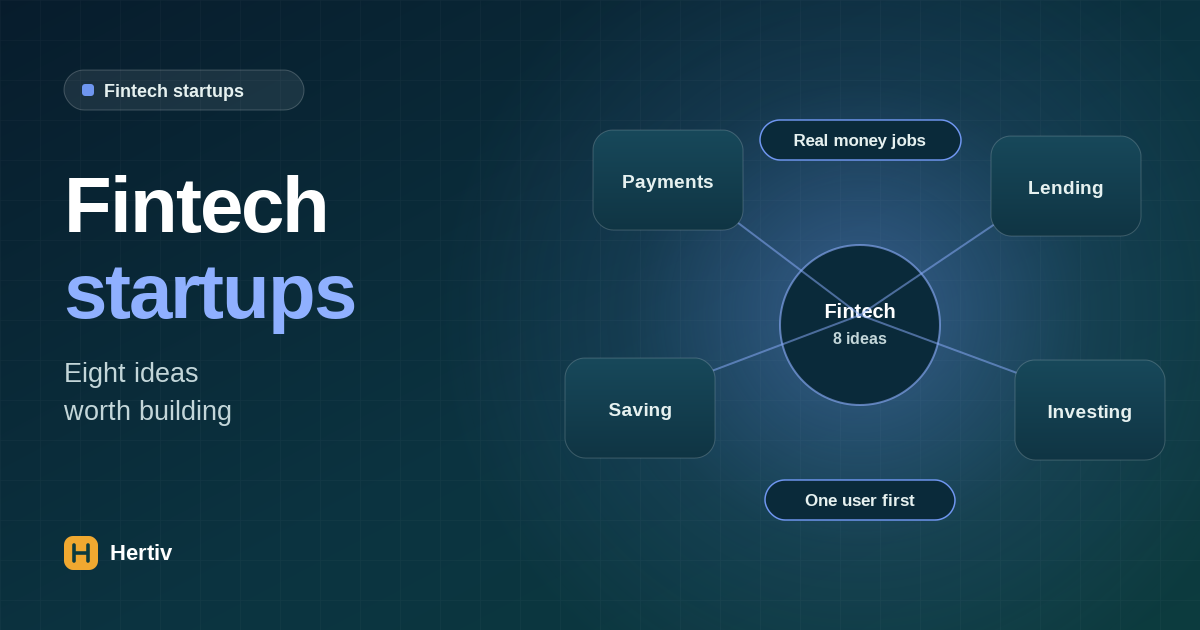
Fintech startup ideas worth building solve a real money problem for a clear group of users: faster payments, simpler lending, easier saving or clearer investing. The eight ideas below cover personal finance, small business and niche markets, with what each one needs to work and what makes it hard.
Fintech startup ideas at a glance
Fintech works best when it fixes a money job that is slow, confusing or expensive today. The ideas below all start from that test: a clear user, a clear money problem, and a product that is simpler than what exists now.
| Idea | Who it helps | Main money job | Hardest part |
|---|---|---|---|
| Small business payments | Shops and freelancers | Get paid fast | Partner fees |
| Teen money app | Teenagers and parents | Learn to save | Parent trust |
| Freelancer tax and invoicing | Freelancers | Invoice and set tax aside | Tax rules |
| Worker remittance | Migrant workers | Send money home cheaply | Licences |
| Micro-investing | First-time investors | Invest small amounts | Brokerage partner |
| Team expense cards | Small teams | Control team spending | Card partner |
| Supplier invoice finance | Small suppliers | Get paid early | Credit risk |
| Rent and credit building | Renters | Build a credit record | Credit bureau rules |
Pick by the user, not by the technology. An idea that helps a clear group with a painful money problem is worth more than a clever feature nobody asked for. For how fintech is changing the industry, see fintech digital transformation.
1. Small business payments: best for getting paid fast
1. Small business payments: best for getting paid fast
A small business payments app lets a shop or freelancer send an invoice and get paid by card or bank transfer, with the money arriving in a day or two instead of weeks. It suits the millions of small businesses that still chase payments by phone and email.
The product needs a payment partner, simple invoicing, reminders and a clear view of who has paid and who has not. The hard part is the partner fees, which eat into small payments, and the need to handle failed payments and refunds cleanly.
Pros: clear pain, many users; simple first version; revenue from transaction fees.
Cons: partner fees; crowded market; needs trust to handle money.
2. Teen money app: best for teaching saving early
A teen money app gives a teenager a card and an app, with a parent controlling limits, allowances and chores. It suits parents who want their children to learn about money with real amounts, not with a lecture.
The product needs a card partner, parent controls, savings goals and spending alerts. The hard part is earning parent trust: the app must show exactly where money goes, and it must handle lost cards and disputes quickly.
Pros: clear user and buyer; habits form early; parents pay for the service.
Cons: needs a card partner; strict rules for minors; slow growth per user.
3. Freelancer tax and invoicing: best for solo workers
3. Freelancer tax and invoicing: best for solo workers
A freelancer tax and invoicing app sends invoices, tracks payments, and sets aside a share of each payment for tax. It suits freelancers who earn from many clients and find tax season stressful because nothing was set aside during the year.
The product needs invoicing, payment tracking and a simple tax estimate by country or region. The hard part is the tax rules, which differ by place and change often, so the estimates must be clearly labelled and the app must not present itself as a tax adviser.
Pros: painful, recurring problem; users pay for peace of mind; clear value in hours saved.
Cons: tax rules differ by region; needs care with advice; accountants are competitors.
4. Worker remittance: best for sending money home cheaply
A worker remittance app lets a migrant worker send money home with low fees and a clear exchange rate, straight to a bank account or a mobile wallet. It suits workers who send money every month and lose a noticeable share to fees and poor rates today.
The product needs licences or partners in both countries, a clear rate shown before sending, and fast delivery. The hard part is the licences: money transfer rules differ by country and take time and money to meet.
Pros: large, recurring need; users compare fees closely; clear saving to show.
Cons: licences in every corridor; fraud risk; price competition is fierce.
5. Micro-investing: best for first-time investors
5. Micro-investing: best for first-time investors
A micro-investing app lets a beginner invest small amounts, such as spare change from purchases or a fixed sum each week, into a simple portfolio. It suits people who want to start investing but find traditional brokers confusing and the minimums too high.
The product needs a brokerage partner, a simple portfolio, clear fees and plain-language education about risk. The hard part is the partner and the rules: investing is regulated, and the app must not promise returns or hide the risks.
Pros: large audience of beginners; habit-forming; revenue from fees or subscriptions.
Cons: regulated and partner dependent; low revenue per user; must handle risk honestly.
6. Team expense cards: best for small team spending
A team expense card product gives each staff member a card with a limit, so a small business can control spending without collecting paper receipts. It suits teams of five to fifty people where the owner still approves every purchase by hand.
The product needs cards, limits per person, receipt capture and a simple approval flow. The hard part is the card partner and the credit risk, because the business spends before it pays the bill.
Pros: clear time saving; businesses pay for control; expenses data is valuable.
Cons: needs a card partner; credit checks; larger players already serve this market.
7. Supplier invoice finance: best for small suppliers
7. Supplier invoice finance: best for small suppliers
A supplier invoice finance product pays a small supplier early, against an invoice that a large buyer will pay in 60 or 90 days. It suits suppliers who wait months to be paid while their own bills are due now.
The product needs a way to check the invoice is real, a way to score the buyer, and money to advance. The hard part is credit risk: if the buyer does not pay, the product loses money, so the scoring must be careful.
Pros: urgent need for suppliers; revenue from a small fee; repeat use.
Cons: credit risk; needs capital to advance; fraud checks are essential.
8. Rent and credit building: best for renters with no credit record
A rent and credit building product reports on-time rent payments to credit bureaus, so a renter builds a credit record without a loan or a credit card. It suits renters who pay on time every month but have no credit history to show for it.
The product needs a link to the landlord or the bank, a way to verify rent payments, and agreements with the credit bureaus. The hard part is the bureau rules: reporting must be accurate, and disputes must be handled quickly and fairly.
Pros: helps people banks ignore; simple product; subscription revenue.
Cons: bureau agreements take time; accuracy duties; small revenue per user.
How to choose
Choosing a fintech startup idea comes down to the user, the regulation and the partner you need. Work through these steps before you build anything.
- Pick a clear user. Name the person, their money problem and how often it hurts. If you cannot name the user, the idea is too vague.
- Check the regulation. Find out which licences or partners the idea needs in your market. Some ideas need months of paperwork before the first user.
- Find the partner. Most fintech ideas need a banking, card or brokerage partner. Talk to partners early, because their fees and rules shape the product. For how fintech apps connect to banks, see use of APIs in fintech.
- Test the pain. Interview ten people with the problem and ask what they pay today to solve it. If nobody pays today, the idea may not be a business.
- Build the smallest version. One money job, one partner, one user group. For a broader shortlist of ideas, see tech startup ideas.
Keep the first version narrow. A fintech product that does one money job well earns trust; a product that does five jobs badly loses it.
What are the common mistakes?
The most common fintech startup mistakes are ignoring regulation, underestimating partner fees, and building for everyone at once.
- Ignoring regulation. A fintech product that touches real money needs licences or partners. Discovering that after building is the most expensive mistake on this list.
- Underestimating partner fees. Banking, card and brokerage partners take a share of every transaction. Price the product with those fees included, not after.
- Building for everyone. A product for all users fits nobody. Pick one user group and solve their problem well.
- Promising returns. Never promise investment returns or guaranteed savings. Regulators treat that as advice, and it brings duties you may not want.
- No plan for fraud. Money products attract fraud from day one. Plan for identity checks, limits and dispute handling before launch.
Key takeaways
- Fintech ideas work when they fix a slow, confusing or expensive money job for a clear user
- Payments, saving and investing ideas need a licensed partner, so talk to partners early
- Regulation shapes the product: licences, fees and reporting must be planned before building
- Test the pain with ten real users before writing code
- Start with one money job, one partner and one user group
Frequently asked questions
What is a fintech startup?
A fintech startup is a young company that uses software to improve a financial service, such as payments, lending, saving or investing. It usually starts with one money job for one group of users, and works with a licensed partner to handle the money itself.
Do fintech startups need a licence?
Most work with a licensed partner, such as a bank, a card issuer or a broker, instead of getting their own licence. Some activities, such as holding client money or giving investment advice, need a licence or a partner that holds one. Check the rules in your market early.
How do fintech startups make money?
Common ways are transaction fees, monthly subscriptions, interest on balances, and a share of partner fees. The exact mix depends on the product. Price the product with partner fees included, because those fees are a real cost.
What is the hardest part of starting a fintech company?
Trust and regulation. Users must trust the product with their money, and regulators must be satisfied that it follows the rules. Both take time to earn, which is why a narrow first version is the right start.
Can a small team build a fintech product?
Yes, if the first version is narrow: one money job, one partner and one user group. The team needs product, engineering and compliance help, and the partner handles the regulated money movement.
Which fintech idea is best for beginners?
The best idea is the one where you know the user and the pain first-hand. If you have run a small business, payments or invoicing may fit. If you have sent money abroad, remittance may fit. Start where you have real knowledge.


