What Does Enterprise Procurement Software Cost?
Enterprise procurement software cost depends on users, modules and setup work. Budget for licences, rollout and yearly support, not just the sticker price.
On this page
Short answer
Enterprise procurement software is the system a large company uses to request, approve, order and pay for goods and services, and its cost depends on how many people use it, which modules are switched on, and how much work is needed to connect it to finance and supplier systems. The licence is usually only part of the first-year total.
What is enterprise procurement software?
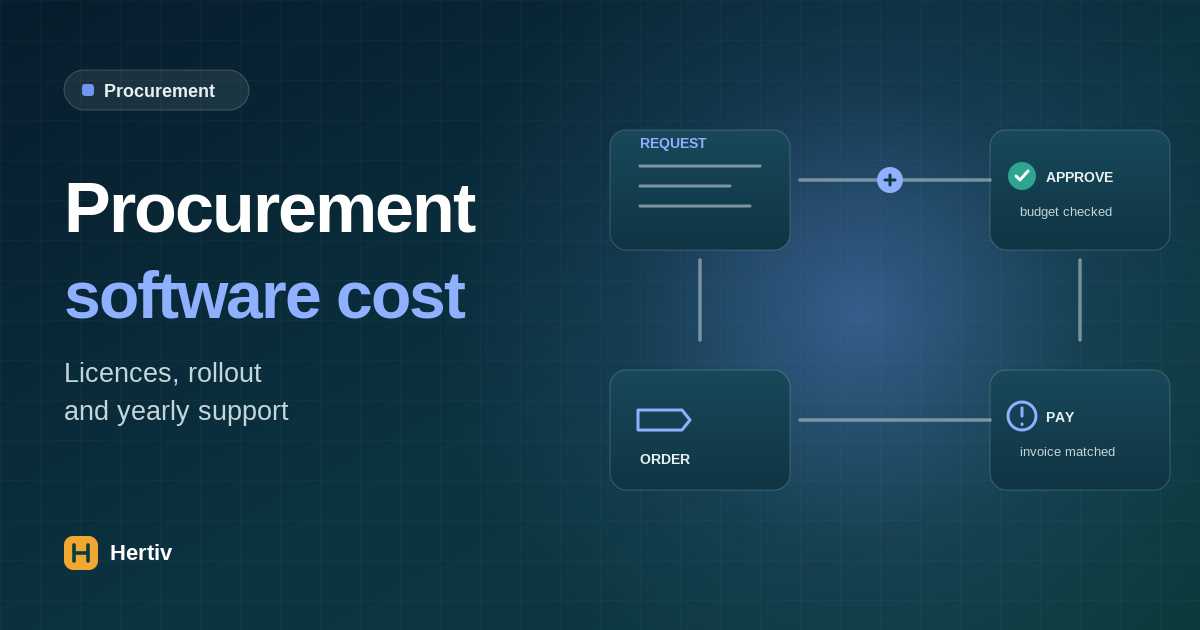
Enterprise procurement software is a system that manages how a large company buys things: staff raise purchase requests, managers approve them, orders go to suppliers, goods are received, and invoices are matched and paid. It replaces email chains and spreadsheets with one record everyone can see.
Typical modules cover purchase requests and approvals, supplier records and contracts, catalogues, purchase orders, goods receipt, invoice matching and spend reporting. Larger deployments add sourcing events, supplier risk checks and budget controls that stop orders once a department's budget is spent.
Procurement software sits between the people who need things and the finance team that pays for them. It connects to the accounting or ERP system so that an approved order becomes a commitment in the budget and a paid invoice closes the loop. That connection is where much of the implementation work goes.
What drives the cost?
The cost is driven by four things: how many people use the system, which modules are switched on, how the software is priced, and how much work is needed to set it up and connect it to other systems.
| Cost driver | What changes the price | Typical effect |
|---|---|---|
| Named users | Approvers, buyers and admins with logins | More logins, higher licence fee |
| Modules | Sourcing, contracts, supplier risk, analytics | Each module adds to the fee |
| Supplier count | How many suppliers are onboarded | More suppliers, more setup work |
| Integrations | ERP, finance, HR and tax systems | Each connection adds build time |
| Data migration | Old orders, suppliers and contracts | Messy data adds weeks of cleanup |
| Support level | Response times and named support | Premium support adds a yearly fee |
User count is the lever most buyers underestimate. A company may plan for 50 buyers but need 300 approvers across departments, and approver licences are often priced differently from full buyer licences. Ask the vendor to price both roles separately before you sign, and check how casual users who only approve one request a month are counted.
How is it usually priced?
Enterprise procurement software is usually priced per user per month or per year, with the fee rising as more modules are added. Some vendors price by company spend instead, charging a small share of the purchase volume that flows through the system.
Cloud software is usually sold as an annual subscription with a minimum term of one to three years. On-premise licences, where they still exist, are usually a larger one-off fee plus a yearly maintenance charge of around a fifth of the licence price. See the vendor site for current pricing, because list prices change and most enterprise deals are negotiated.
Watch for costs that sit outside the licence: supplier onboarding fees, catalogue hosting, electronic invoicing charges per document, and fees for extra environments such as a test system. A quote that looks cheap on licences can grow once these extras are added. Ask for a full first-year and third-year price, not just the licence line.
What does implementation add?
Implementation adds the work of setting up the system, connecting it to finance and supplier systems, moving old data, and training staff. For a mid-size company this usually takes two to six months and costs a sizeable share of the first-year total.
The main tasks are configuring approval flows to match how the company actually approves spending, loading supplier records and contracts, setting up catalogues, connecting the ERP for budgets and payments, and testing invoice matching against real supplier invoices. Each task needs people from procurement, finance and IT, not just the vendor.
Data cleanup is the step that most often runs over budget. Supplier records are usually duplicated, contracts are stored in several places, and old purchase orders use codes that no longer exist. Cleaning this before migration is slower than teams expect, but skipping it means the new system starts with the same mess. A partner for custom software development can help where the standard connectors do not fit your finance system.
How do you build a budget?
Build the budget in five parts so nothing is missed: licences, implementation, data and integration work, training, and the yearly running cost after go-live.
- Count users by role. List buyers, approvers, admins and read-only users separately, because each role is priced differently.
- Price the modules you need now. Leave nice-to-have modules out of year one and add them later when the core works.
- Get an implementation estimate in writing. Ask the vendor to price configuration, integrations, data migration and testing as separate lines.
- Add training and change time. Budget for training sessions and for the weeks when staff run the old and new process side by side.
- Plan the yearly run rate. Add the subscription, support, hosting extras and one upgrade or improvement cycle per year.
Compare vendors on the three-year total, not the first-year price. A cheap first year with a steep renewal and expensive add-ons often costs more by year three than a higher first-year price with flat renewals. If procurement touches suppliers and invoices at scale, AI agents for procurement can cut manual matching work, which is worth pricing into the business case.
Example (hypothetical): a 500-person company budgeting for procurement software
Example (hypothetical): a 500-person company buys office supplies, IT equipment and services through email and spreadsheets. It decides to move to a cloud procurement system with 40 buyers, 120 approvers and 5 admins.
The vendor quotes $60 per buyer per month, $15 per approver per month and $90 per admin per month. That is 40 x $60 = $2,400, plus 120 x $15 = $1,800, plus 5 x $90 = $450, giving $4,650 per month, or $55,800 per year for licences.
Implementation is quoted at $48,000 for configuration, two integrations and data migration, plus $9,000 for training. The first-year total is $55,800 + $48,000 + $9,000 = $112,800. From year two the company pays the $55,800 licence plus a $12,000 support and improvement budget, or $67,800 a year. The business case rests on cutting the 25 hours a week staff spend chasing approvals and matching invoices.
What are the common mistakes?
The most common mistakes are buying for the whole company at once, skipping data cleanup, and judging vendors on the licence price alone.
- Counting only buyers. Approvers often outnumber buyers three to one, and their licences add up fast.
- Buying every module on day one. Unused modules still cost money and complicate training. Start with requests, approvals and orders.
- Skipping supplier data cleanup. Duplicate suppliers and old contracts break matching and reporting from the first week.
- No finance team in the room. Procurement, finance and IT must agree on approval rules and budget checks before configuration starts.
- Comparing first-year prices only. Renewals, add-ons and support fees decide the real three-year cost.
If your current process runs on spreadsheets and email, a short review of how orders flow today is the cheapest first step. Enterprise software development companies can help scope the build when the standard product does not fit your approval rules.
Key takeaways
- The licence is only part of the cost — implementation, data work and training make up the rest
- Count approvers separately from buyers: they often outnumber buyers three to one
- Budget in five parts — licences, implementation, data, training and the yearly run rate
- Compare vendors on the three-year total, not the first-year price
- Clean supplier and contract data before migration, or the new system inherits the old mess
Frequently asked questions
Does enterprise procurement software replace an ERP?
No. Procurement software manages requests, approvals, orders and supplier records, while the ERP holds budgets, accounting and payments. The two systems connect so an approved order becomes a budget commitment and a matched invoice becomes a payment. Most companies keep both and integrate them.
How long does implementation usually take?
For a mid-size company, two to six months is typical. Configuration and integrations take most of the time, and data cleanup often runs longer than planned. A phased rollout — one department first, then the rest — usually goes live faster than a whole-company launch.
What is the difference between buyer and approver licences?
A buyer licence covers people who raise requests and place orders, while an approver licence covers managers who only approve or reject. Approver licences are usually cheaper, but approvers often outnumber buyers, so the total still adds up. Ask the vendor to price each role separately.
Can small companies use enterprise procurement software?
Most enterprise products are built for larger teams, and the licence minimums can be too high for a small company. Smaller teams usually start with a simpler purchasing tool or a finance system add-on, and move to enterprise procurement software once approvals and suppliers become hard to track.
What should I ask vendors before signing?
Ask for the full first-year and third-year price including implementation, data work, training and support. Ask how approvers are counted, what integrations are included, how supplier onboarding is charged, and what happens to your data if you leave. Get the answers in writing.
Does procurement software work with AI?
Some products now use AI to match invoices, flag unusual orders and suggest suppliers. These features help most where invoice volume is high and matching rules are clear. They do not replace approval rules or supplier checks, and they need clean data to work well.


