Enterprise Blockchain Governance Models: Which One Fits?
Enterprise blockchain governance decides who can join a network, change its rules and settle disputes. Four models show how each choice shapes control and trust.
On this page
Short answer
Enterprise blockchain governance is the set of rules that decides who can join a network, who can change its rules, and how disputes are settled. A clear model keeps members aligned, so a single disagreement does not stall the whole network.
What is enterprise blockchain governance?
Enterprise blockchain governance is the set of written rules and decision processes that control a shared business network. It covers who can join, who runs the nodes, how upgrades are approved, who pays for shared costs and how disputes are settled.
It matters because a business blockchain is shared infrastructure. No single company owns it, yet every member depends on it. Without agreed rules, a simple question such as who pays for a node upgrade can turn into a long argument that stops work.
Governance has two layers. Off-chain governance is the human side: charters, member agreements, committees and votes. On-chain governance is the code side: smart contract roles, voting contracts and upgrade keys. Most enterprise networks use both, with the charter as the final authority. Enterprise blockchain only works well when both layers are written down before the network goes live.
What governance models can a consortium choose?
Four models cover most enterprise networks. Each one trades control against speed in a different way, so the right choice depends on how many members there are and how much they trust each other.
| Model | Who decides | Best for | Watch out for |
|---|---|---|---|
| Single operator | One company | Small pilots with a clear owner | Members may see it as one-sided |
| Consortium council | Elected member council | Peer groups of similar firms | Votes can be slow |
| Foundation-led | Independent foundation board | Large open networks | Board can drift from members |
| On-chain voting | Token-weighted member votes | Networks with clear voting rules | Large holders gain more say |
A single-operator model is the fastest to start. One company writes the rules, runs the main nodes and invites partners to join. It suits a pilot where one firm funds the build and others join later.
A consortium council spreads power across members. The council votes on upgrades, new members and budgets. It is slower, but members accept decisions more readily because they helped make them.
Who decides what in each model?
Good governance names each decision and the group that makes it. The three decisions that matter most are membership, upgrades and money. If any of these is left vague, the network will argue about it later.
Membership decisions cover who can join, what proof they must show and how a member is removed. In a council model, the council votes on new members. In a single-operator model, the operator decides, and members accept that when they join.
Upgrade decisions cover smart contract changes, new node software and changes to the data rules. These need a clear approval threshold, such as a simple majority or two thirds of voting members. Without a threshold, one member can block an urgent fix.
Money decisions cover shared costs, fees and how income is shared. The charter should state how costs are split, for example by transaction volume or equally per member, and what happens when a member pays late.
Day-to-day operations are usually delegated to a small working group or an operator, so the council only votes on bigger changes. Implementing enterprise blockchain goes faster when the charter separates routine operations from decisions that need a full vote.
How do members join, leave or get removed?
Joining starts with an application and a check. The network should state what a new member must prove, such as a business licence, a technical review of its node setup and agreement to the charter. A checklist keeps the process fair and fast.
New members usually pay a joining fee and take on a share of running costs. The fee should be written in the charter, not negotiated each time, so later members are treated the same as early ones.
Leaving should be simple. A member gives notice, settles its share of costs and hands over its data or node duties. If leaving is hard, firms will avoid joining in the first place.
Removal is the hardest case and needs a written process. Common grounds are repeated rule breaks, missed payments or a security failure. The charter should state who can propose removal, what vote is needed and whether the member can appeal.
Data is the part teams forget. When a member leaves, the charter should say who keeps the shared records and how the departing member's own data is handled. This matters most in regulated industries where records must be kept for years.
How do you set up governance in five steps?
Setting up governance is a project of its own. It should start before the first line of production code, because rules are far harder to add once members have joined and data is flowing.
- Name the members and their roles. List every founding member, what each one operates and who speaks for each firm.
- Pick a model and write the charter. Choose one of the four models and write down membership, voting, costs and dispute rules in plain language.
- Set voting thresholds. Decide what counts as a pass for routine changes, big upgrades and member removal, and write the numbers into the charter.
- Build the on-chain controls. Put roles, upgrade keys and voting into smart contracts that match the charter, and test them on a test network first.
- Agree a review date. Governance should be reviewed at least once a year, so rules that no longer fit can be changed by the same process they set up.
A common error is writing a charter that nobody reads. Keep it short, use plain language and give each member one named contact who owns governance for that firm.
Example (hypothetical): a food supply consortium picks a model
Example (hypothetical): twelve food companies want a shared network to track produce from farms to shops. Four of them fund the build, and the other eight join in the first year.
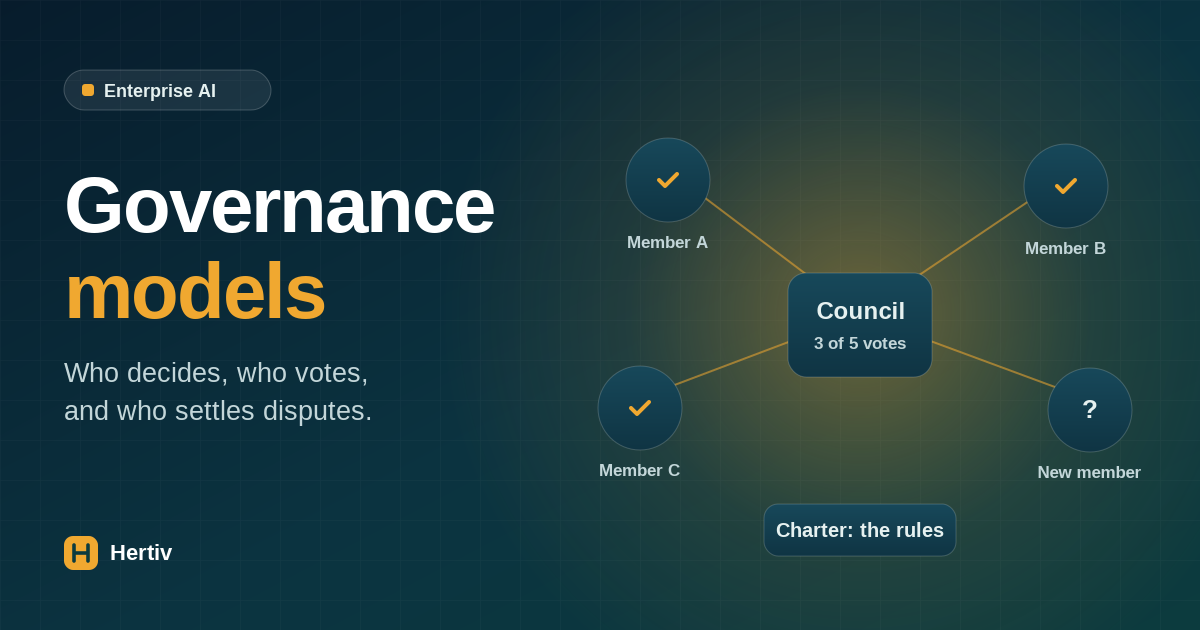
They pick a consortium council model. The council has five seats: two for the founding funders, two for the later members and one rotating seat. A routine change needs three of five votes, and a big upgrade needs four of five.
The shared costs are simple. Each member pays $5,000 a year, so twelve members bring in $60,000, which covers the shared nodes and an audit. Members also pay a small fee per shipment record, so the firms that use the network most pay most.
When a new retailer applies, the council checks its licence and node setup, then votes. Three members vote yes, one votes no and one abstains, so the application passes with three of five votes. The process takes two weeks because the checklist was agreed in advance.
A year later the council reviews the charter and changes the rotating seat rule, because the smallest members rarely win it. The review takes one meeting, and the change passes four votes to one.
What are the common mistakes?
The most common mistake is leaving governance unwritten. Teams build the network first and plan to agree rules later. By then, members have different ideas about who is in charge, and the first disagreement becomes a crisis.
A second mistake is copying another network's charter without changing it. A model that works for five banks will not fit twenty small suppliers. The voting thresholds, fees and membership rules should match the actual members.
A third mistake is giving one member a veto without saying so. If one firm's node must sign every upgrade, that firm has a veto in practice. Name that power in the charter or remove it.
A fourth mistake is forgetting the end. Networks need rules for members leaving, the network closing and the data that must be kept afterwards. Teams that skip this find it hard to recruit new members, because firms will not join a network they cannot leave.
Finally, do not let the charter and the code disagree. If the charter says a council vote is needed but the upgrade key sits with one developer, the code wins in practice. Check that the smart contract roles match the written rules before launch.
Key takeaways
- Governance is the written rules for joining, voting, spending and disputes.
- Single-operator models are fastest; council models share power more widely.
- Name who decides membership, upgrades and money before launch.
- Set vote thresholds for routine changes, big upgrades and removal.
- Review the charter yearly and keep it in line with the code.
Frequently asked questions
What is enterprise blockchain governance?
Enterprise blockchain governance is the set of rules that decides who can join a shared business network, who can change its rules, and how disputes are settled, covering both written charters and the smart contract controls that enforce them.
Which governance model is best for a small consortium?
A consortium council usually fits a small group of similar firms, because each member gets a voice and decisions carry more trust. A single-operator model is faster to start, but members may see it as one-sided once the network grows.
What should a governance charter include?
A charter should cover membership rules, voting thresholds, shared costs, upgrade approval, dispute handling and how members leave. It should be short and written in plain language so every member can read and follow it.
How are disputes settled on a business blockchain?
Most charters use a staged process: the working group tries to resolve the issue, then the council votes, and if that fails an independent mediator is used. The stages and time limits should be written down before any dispute arises.
Can governance change after the network launches?
Yes, if the charter says how. Most networks review governance once a year and change rules through the same voting process the charter sets up, so the rules can adapt without breaking trust.
Do small networks need formal governance?
Yes, even a three-member pilot benefits from a short written agreement. It prevents simple disagreements over costs or upgrades from stalling the pilot, and it makes it easier to add members later.


