Enterprise App Modernization: A Practical Programme Guide
Enterprise app modernization replaces or rebuilds the ageing systems a large company runs on, in waves, without stopping daily work. Here is how to plan it.
On this page
Short answer
Enterprise app modernization is the planned renewal of the business-critical systems a large organisation runs on, replacing or rebuilding ageing applications in waves while daily operations continue. It is a programme, not a single project: a portfolio review decides what to retire, rehost, replatform or rebuild, and each wave is funded on the value it returns.
What is enterprise app modernization?
Enterprise app modernization is the planned renewal of the business-critical applications a large organisation runs on, replacing or rebuilding ageing systems in stages while daily work continues. It covers the core systems that carry orders, customers, finance and operations, not just the website or the mobile app.
Modernization is different from a one-off rewrite. A rewrite replaces one system; modernization is a programme across a portfolio, with a shared method for deciding what each system needs. Some systems move to the cloud unchanged, some get a new platform underneath, and a few are rebuilt from scratch because the old design cannot support the business any more.
The work is driven by business pressure, not fashion. Systems become expensive to change, hard to staff, and risky to run: the people who built them leave, vendors stop supporting old versions, and every new request takes longer. Modernization is the answer to that drift, and it is judged on whether the business can change faster afterwards, not on how new the technology looks.
Which systems should you modernize first?
The systems to modernize first are the ones that block the most change and carry the most risk, not the oldest ones on paper. A portfolio review scores each system on business value, change friction and risk, and the top of that list becomes the first wave.
| System type | Signal it needs work | Usual approach |
|---|---|---|
| Customer-facing core | Every new feature is slow or risky | Rebuild in parts, strangler pattern |
| Internal workflow | Staff work around it with spreadsheets | Replatform, then simplify the process |
| Integration layer | Point-to-point links break often | Rebuild as managed APIs and events |
| Reporting and data | Reports take days to produce | Move to a governed data platform |
| End-of-life system | Vendor support has ended | Rehost quickly, then plan the rebuild |
Systems that are stable, cheap to run and rarely changed can wait. The mistake is to start with the easiest system instead of the one that matters most: an easy win that nobody uses teaches the organisation nothing. For the general picture first, application modernization explained covers the basic options before you apply them at enterprise scale.
What does a modernization programme look like?
A modernization programme runs in waves, each wave delivering a working system and a lesson for the next one. A wave is typically one system or one business capability, with its own team, budget and go-live date, and waves overlap once the method is proven.
Each wave follows the same shape. First, the team maps what the system actually does today, including the undocumented behaviour users rely on. Then it picks the target approach: rehost, replatform, refactor or rebuild. Then it builds the replacement alongside the old system, moves traffic in stages, and retires the old one only when the new one has run live for a while.
Governance sits above the waves. A small board owns the portfolio list, the sequencing and the funding gates, and it stops work that is not delivering. Without that board, waves drift into separate projects with different standards, and the estate ends up more fragmented than before. See custom software development for how a build team fits into this shape.
How do you modernize without stopping the business?
You modernize without stopping the business by running old and new side by side and moving traffic in small steps. The strangler pattern is the standard method: new requests go to the new system, old requests stay on the old one, and the old system shrinks until nothing is left to move.
- Freeze the scope of the old system. No new features on the old code; new work goes to the replacement.
- Put a facade in front of it. Route traffic through one entry point so you can switch paths without changing callers.
- Move one capability at a time. Start with a low-risk, well-understood slice, such as read-only views.
- Run both systems in parallel. Compare outputs on real traffic before you trust the new one.
- Switch traffic in stages. Move a small share of users, watch the results, then widen the share.
- Retire the old system. Only after the new system has handled full load for a defined period.
Data is the hardest part of the parallel run. If the new system writes to a new store, the old system must see those writes, and the reverse. Most teams solve this with a sync step or by keeping one shared store until the cutover. The cloud side of the move is covered in cloud services, including migration patterns for live systems.
What changes in the operating model after modernization?
Modernization changes who owns the system and how it is run. Old systems usually have a support team that keeps them alive; modernized systems have a product team that owns the roadmap, the backlog and the running cost, and stays with the system after launch.
Three shifts matter most. First, releases move from quarterly windows to small, frequent changes, which needs automated tests and a deployment pipeline. Second, running cost becomes visible per system, so teams can see what each capability costs and decide what to keep. Third, knowledge stops living in one person's head: the new system is documented, tested and observable, so a new engineer can learn it without a handover meeting.
Staffing is the part leaders underestimate. The same engineers who know the old system are needed to explain it, while new skills are needed to build the replacement. Plan for overlap: keep the old-system experts involved through the first wave, and train the wider team on the new stack before the second wave starts. DevOps services covers the pipeline and operating practices that make frequent releases safe.
Example (hypothetical): a 40-system estate
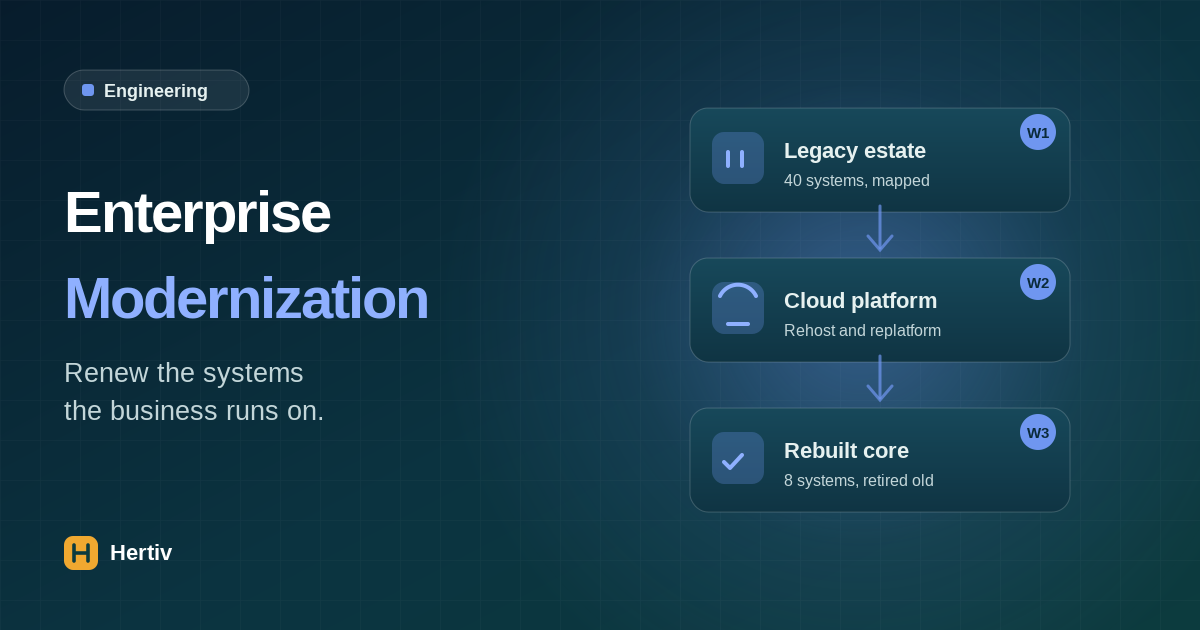
Example (hypothetical): a company runs 40 business systems. A portfolio review finds 8 that block change, 12 that are stable but costly, and 20 that are fine as they are.
The programme plans 3 waves. Wave 1 covers the 2 most blocking systems and takes 6 months with 2 teams. Wave 2 covers the next 3 systems and takes 6 months with 3 teams, because the method from wave 1 is reused. Wave 3 covers the remaining 3 blocking systems in 4 months, again with 3 teams.
The arithmetic: 2 plus 3 plus 3 is 8 systems modernized, and 6 plus 6 plus 4 is 16 months of programme time.
The 12 stable but costly systems are not rebuilt; they are rehosted in the background during the same period, and the 20 healthy systems are left alone. The point is that only a fifth of the estate needed a rebuild, and the plan says so up front instead of discovering it halfway through.
What are the common mistakes?
The most common enterprise modernization mistakes are starting with technology instead of the portfolio, and treating the programme as a single big project.
- Starting with the easiest system. An easy win that nobody uses proves nothing and burns goodwill.
- Big-bang cutover. Replacing a core system in one go is the highest-risk move in the programme.
- Skipping the discovery step. Undocumented behaviour in the old system becomes a defect in the new one.
- No retirement date. If the old system never switches off, you pay for two systems forever.
- Forgetting the operating model. A modern system run the old way costs more and changes no faster.
- One team for everything. A single team becomes the bottleneck; waves need parallel teams.
Key takeaways
- Modernization is a programme across a portfolio, not a single rewrite
- Start with the systems that block the most change and carry the most risk
- Run old and new side by side and move traffic in small, reversible steps
- Each wave should deliver a working system and a lesson for the next one
- Retire the old system on a date, or you pay for two systems forever
- The operating model has to change too, or the new system runs the old way
Frequently asked questions
What is enterprise app modernization?
Enterprise app modernization is the planned renewal of the business-critical systems a large organisation runs on. A portfolio review decides what to retire, rehost, replatform or rebuild, and the work runs in waves so daily operations continue while each system is replaced.
How is it different from a rewrite?
A rewrite replaces one system. Modernization is a programme across a portfolio, with a shared method, a sequencing board and funding gates per wave. It also changes the operating model, so the new systems are owned by product teams and released frequently.
How long does enterprise modernization take?
It depends on the size of the estate and how many systems block change. A first wave usually takes several months, and later waves get faster as the method is reused. Programmes run in waves over a year or more rather than as one fixed project.
What is the strangler pattern?
The strangler pattern moves traffic from an old system to a new one in small steps. A facade routes requests, new capabilities go to the new system first, and the old system shrinks until nothing is left to move. It avoids a risky big-bang cutover.
Which systems should be modernized first?
The ones that block the most change and carry the most risk, such as customer-facing cores where every feature is slow or risky. Stable, cheap, rarely changed systems can wait, and some systems only need rehosting rather than a rebuild.
What happens to the old system?
It runs in parallel with the new one until the new system has handled full load for a defined period. Then it is retired on a set date, including its data, integrations and licences, so the organisation stops paying for two systems.


