What Is an Ensemble Model and When Should You Use One?
An ensemble model combines several models so their combined prediction beats any single one. Learn bagging, boosting and stacking, and when the effort pays off.
On this page
Short answer
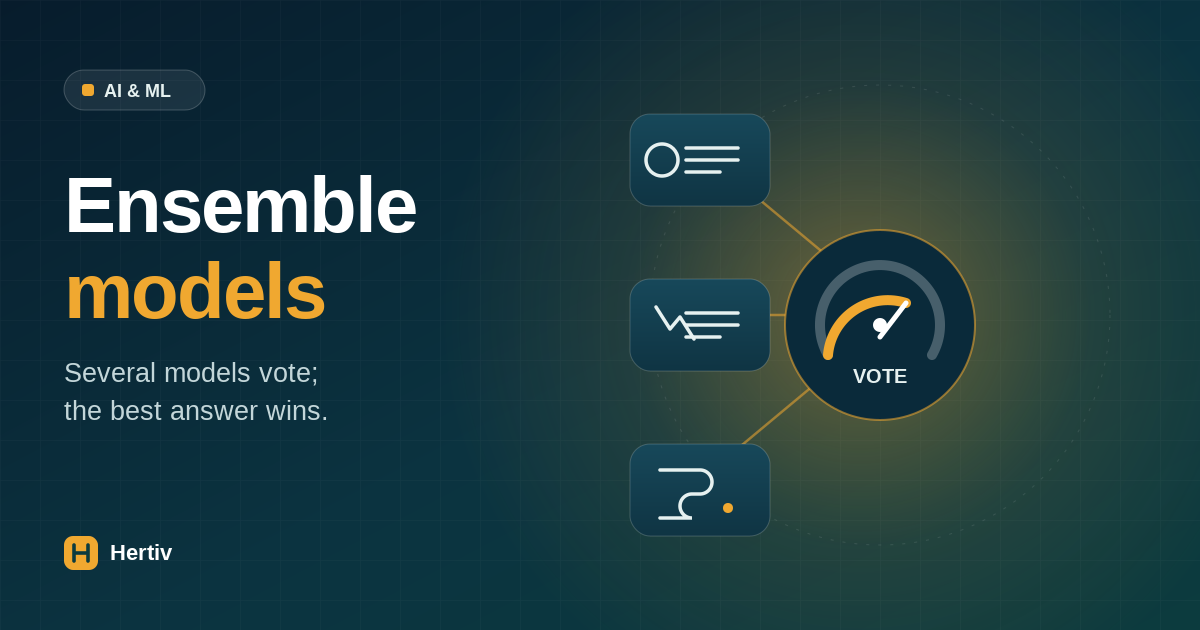
An ensemble model is a model built from several smaller models whose predictions are combined, by voting or averaging, so the result is more accurate and stable than any single model on its own. It works because different models make different mistakes, and combining them cancels some of those errors out. Ensembles cost more to train and run, so they pay off when accuracy matters more than speed or simplicity.
What is an ensemble model?
An ensemble model is a machine learning model made by combining several smaller models, called base models, and merging their predictions into one answer. Each base model is trained on the same problem, and the ensemble decides by voting, averaging or a second model that weighs their outputs.
The idea is simple: one model can be wrong in one way, while another is wrong in a different way. When you combine them, the errors partly cancel out and the shared signal survives. That is why ensembles often beat a single model on the same data, even when the single model is well tuned.
Ensembles are used wherever accuracy matters more than simplicity: fraud detection, demand forecasting, medical screening and ranking. They are not a way to fix bad data. If the training data is wrong or incomplete, an ensemble of models trained on it will still be wrong, only more confidently.
The three main ways to build an ensemble are bagging, boosting and stacking. They differ in how the base models are trained and how their answers are combined, and each fits a different kind of problem.
How does bagging work?
Bagging works by training many copies of the same model on different random samples of the training data, then averaging or voting on their predictions. Each copy sees a slightly different view of the data, so each makes slightly different mistakes.
The classic example is a random forest: hundreds of decision trees, each trained on a random sample of rows and a random subset of features. One tree on its own overfits easily, but the average of hundreds is far more stable. Bagging helps most when the base model is unstable, meaning small changes in the data change its predictions a lot.
Bagging is easy to run in parallel, since each model trains on its own. The cost is size: you store and run hundreds of models instead of one, which matters when predictions must be fast. For a deeper look at what to measure, see evaluating machine learning models.
How does boosting work?
Boosting works by training models one after another, where each new model focuses on the examples the previous ones got wrong. The first model makes its best attempt, the second corrects its errors, the third corrects what is left, and so on until the errors stop shrinking.
Unlike bagging, boosting is sequential: each model depends on the ones before it, so you cannot train them in parallel. The result is usually a strong model built from many weak ones, and gradient boosting is one of the most used methods in tabular data competitions and production systems.
Boosting can overfit if you keep adding models after the errors stop improving, and it is sensitive to noisy labels, since it keeps chasing the hardest examples. That is why boosted models need a held-out test set and early stopping: stop adding models when the test score stops improving.
What is stacking?
Stacking works by training several different kinds of models, then training a second model, called the meta-model, to combine their predictions. The base models might be a decision tree, a linear model and a nearest-neighbour model; the meta-model learns which one to trust for which kind of input.
Stacking is the most flexible of the three, because the base models can be completely different from each other. That diversity is its strength: a linear model and a tree model fail in different ways, so the meta-model can lean on whichever is right more often for a given input.
The risk is complexity. You now have two layers to train, tune and debug, and the meta-model can overfit to the base models' outputs if you are not careful. Stacking pays off when you already have several good models and want a small extra gain, not as a first attempt at a problem.
When should you use an ensemble model?
You should use an ensemble model when accuracy matters more than speed or simplicity, and when you already have a working single model to compare against. If a single model is already good enough for the decision, an ensemble adds cost without adding value.
| Method | How it works | Best when | Watch out for |
|---|---|---|---|
| Bagging | Many models on random samples, then average | Base model is unstable | Large model size |
| Boosting | Models in sequence, each fixing past errors | Tabular data, accuracy matters | Overfitting and noisy labels |
| Stacking | Different models plus a meta-model | You have several good models | Two layers to debug |
| Simple voting | Majority vote of a few models | Quick win, low effort | Models that agree too much |
Start with a single model and a clear metric, then try bagging or boosting and check whether the gain is real on held-out data. A gain of a few points on the test set is worth the extra cost only if the decision it feeds is worth that much. For the features that feed any of these models, see feature engineering in machine learning.
Example: an ensemble that routes support tickets
Example (hypothetical): a support team receives 500 tickets a day and routes each one to billing, technical or account help. A single model routes 400 correctly, which is 80% accuracy, so 100 tickets a day land in the wrong queue and need re-routing.
The team builds an ensemble of three models: one trained on ticket text, one on customer history and one on product data. Each on its own scores about 80%, but their errors differ, so a majority vote routes 450 correctly, which is 90% accuracy. That is 50 fewer misrouted tickets a day.
Over a five-day week that saves 250 re-routings, and each re-routing costs a support agent about 4 minutes, so the team saves about 1,000 minutes, or roughly 16 hours a week. The ensemble costs three times as much to run, but the team decides the saved hours are worth it. The numbers are made up; the point is to measure the gain on real tickets before committing.
What are the common mistakes?
The most common mistakes with ensemble models are building them before a single model works, combining models that are too similar, and skipping the comparison that proves the ensemble is actually better.
- Ensembling before a baseline exists. If no single model works yet, an ensemble of broken models will not fix it; fix the data and the baseline first.
- Models that agree too much. Three copies of the same model trained on the same data make the same mistakes, so the vote adds nothing.
- Testing on the training data. An ensemble can memorise training data easily; only held-out data shows whether the gain is real.
- Ignoring the running cost. Three models mean three times the compute and three times the monitoring, which matters in production.
- Forgetting the fallback. When the ensemble is unsure, route the case to a human rather than letting a confident average decide. See top machine learning algorithms for the single models worth trying first.
Key takeaways
- An ensemble combines several models so their errors partly cancel out
- Bagging averages many models on random samples; boosting fixes errors in sequence; stacking adds a meta-model
- Ensembles help most when accuracy matters more than speed or simplicity
- Always compare against a single-model baseline on held-out data
- Three similar models add nothing; diversity between base models is what makes the vote work
Frequently asked questions
What is the difference between bagging and boosting?
Bagging trains many models in parallel on random samples of the data and averages them, which reduces variance. Boosting trains models in sequence, with each one focusing on the errors of the previous ones, which reduces bias. Bagging is easier to run in parallel; boosting usually reaches higher accuracy on tabular data.
Is a random forest an ensemble model?
Yes. A random forest is a bagging ensemble of decision trees. Each tree is trained on a random sample of rows and features, and the forest predicts by majority vote for classification or by averaging for regression. It is one of the most widely used ensemble methods.
Do ensemble models always beat a single model?
No. An ensemble beats a single model when the base models make different mistakes, so combining them cancels errors out. If the base models are too similar, or if the data is noisy, the ensemble may match the single model or even do worse, while costing more to run.
How many models should an ensemble have?
It depends on the method. Bagging often uses hundreds of trees, since adding more rarely hurts. Boosting uses as many rounds as improve the held-out score, then stops. Stacking usually uses three to five diverse base models. In every case, stop when the test score stops improving.
Are ensemble models slower in production?
Yes, usually. Running three or ten models costs more compute and more time per prediction than running one. If latency matters, distil the ensemble into a single model, or use fewer base models. Measure the latency on real traffic before you commit to an ensemble in production.
Can you use an ensemble with a language model?
Yes, in limited ways. You can run the same prompt through several models and vote on the answers, or combine a language model with a smaller classifier for routing. The cost grows with each model call, so this pattern fits offline scoring better than real-time chat.


