Electric Vehicle Software: How Cars Became Computers
Electric vehicle software now controls the battery, the driving assists, the cabin and the updates. Here is what changed and what the software does.
On this page
Short answer
Electric vehicle software is the code that runs the battery, the motors, the driver-assistance systems, the infotainment and the over-the-air updates of an electric car. It matters because an electric drivetrain has far fewer moving parts than a petrol engine, so the car's behaviour, range and features are set by software. The car that leaves the factory is no longer the finished product; it keeps changing through updates.
What is electric vehicle software?
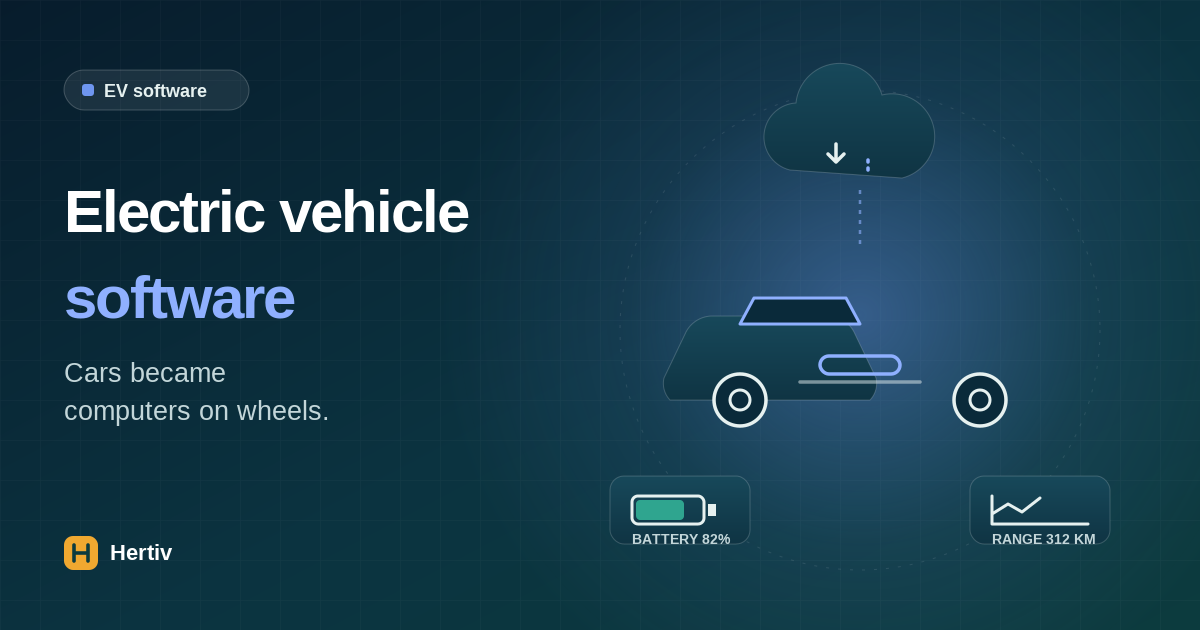
Electric vehicle software is the set of programs that control an electric car's battery, motors, charging, driver-assistance features, cabin systems and updates. It runs on computers inside the car and on cloud services that the car connects to.
The shift matters because an electric drivetrain is simple hardware: a battery, one or two motors and power electronics. With so little mechanical variety, the differences between cars come from software: how the battery is managed, how the car assists the driver, and how the cabin behaves.
The result is that a car is now a product that changes after sale. Features arrive by update, bugs are fixed without a workshop visit, and the car a buyer owns in year three can behave differently from the car they bought.
What does EV software actually do?
EV software covers five areas, and each one has its own team, its own safety rules and its own update cycle. The areas interact, but they are built and tested separately.
| Area | What it does | Why it matters |
|---|---|---|
| Battery management | Cell balance, charging, thermal control | Range, safety, battery life |
| Powertrain control | Motor torque, braking, energy recovery | Driving feel, efficiency |
| Driver assistance | Lane keeping, adaptive cruise, parking | Safety, driver workload |
| Infotainment | Navigation, media, voice, apps | Daily experience, charging stops |
| Updates and diagnostics | Over-the-air updates, fault reporting | Fixes and features after sale |
Battery management is the area with the least room for error. A battery pack has hundreds of cells, and the software must keep them balanced, keep temperatures in range and stop charging before any cell is stressed. A fault here is a safety fault, not a convenience fault.
Why did software become central to EVs?
Software became central because electric cars removed the parts that used to define a car. A petrol car differs from another in its engine, gearbox and exhaust; an electric car differs in its battery chemistry, its motor layout and, above all, its software.
Three forces pushed the change. First, electric drivetrains are simple and similar across brands, so software is where makers compete. Second, batteries are expensive, so the software that manages them decides range and lifespan, which decide the car's value. Third, buyers now expect their cars to behave like their phones, with updates and new features.
The business model changed with it. Makers now earn money after the sale through software features and services, and they keep a relationship with the car through the cloud. That is a different company from one that sells a car and sees it again only at service time.
How do over-the-air updates change car ownership?
Over-the-air updates let a maker fix bugs, improve range and add features without a workshop visit. The car downloads a package, checks it, installs it when parked and reports back. A recall that once took months of workshop bookings can now reach a whole fleet in days.
- The maker builds the update and tests it on bench rigs and test vehicles.
- The update is signed and sent to a small group of cars first, to catch problems early.
- Telemetry from that group is checked for faults before the wider rollout.
- The update reaches the full fleet in waves, with a rollback plan if faults appear.
- Each car reports its version, so the maker knows exactly which cars are current.
The risk is the same as the benefit: a bad update can reach every car at once. That is why staged rollouts, signing and rollback plans are not optional extras. A maker that skips them is betting the whole fleet on one test run.
What are the hard problems teams still face?
EV software is hard because the car is a safety system, a networked device and a consumer product at the same time. Each role pulls in a different direction.
- Safety and speed. Safety features need slow, careful testing; consumer features need fast releases. Teams must run both rhythms on the same vehicle without letting one break the other.
- Security. A connected car is a network endpoint. Updates must be signed, data must be protected and access must be limited, because a breach reaches the whole fleet.
- Fragmentation. Different models, years and hardware variants need different software, and each combination must be tested. The variant count grows fast.
- Battery ageing. Batteries degrade in ways that depend on use, climate and charging habits, so the software must adapt its estimates over the car's life.
- Supplier code. Much of the software comes from suppliers, so the maker must integrate and test code it did not write.
Security deserves special attention because the stakes are higher than in a phone. Cybersecurity services covers the controls that matter for connected products.
For the perception systems behind driver assistance, computer vision development covers how cameras and sensors are turned into driving decisions.
Example (hypothetical): an OTA update reaches a fleet
Example (hypothetical): a maker with 40,000 cars on the road ships an update that improves cold-weather range by changing how the battery pre-heats. The update is 800 MB, and the staged rollout sends it to 2,000 cars first, then 10,000, then the remaining 28,000 over three weeks.
In the first group, 12 cars report a fault where the heater stays on after parking, draining about 2 percent of charge overnight. The rollout pauses, the fault is fixed, and the remaining 38,000 cars get the corrected version. Total cars affected by the fault: 12 out of 40,000, or 0.03 percent of the fleet.
Without the staged rollout, all 40,000 cars would have received the faulty version at once, and the same fault rate would have affected about 240 cars. The staged rollout costs three weeks; the alternative costs a fleet-wide recall. The arithmetic is why every serious maker rolls out in waves.
What are the common mistakes?
The most common mistakes in EV software are treating the car like a phone, skipping staged rollouts and underestimating variant testing.
- Treating the car like a phone. A phone bug is an annoyance; a car bug can be a safety fault. Safety code needs its own testing rhythm.
- Skipping staged rollouts. Shipping an update to the whole fleet at once turns a small bug into a fleet-wide problem.
- Underestimating variants. Each model, year and hardware combination needs testing. The variant count is the real schedule driver.
- Weak update security. Unsigned or unprotected updates are an open door to the fleet. Sign every package and verify it on the car.
- Ignoring battery ageing. Range estimates that never adapt to a degrading battery become wrong over time, and drivers lose trust.
Teams building the cloud side of a connected fleet can start from cloud services.
For the release pipelines that staged rollouts depend on, DevOps services covers the deployment side.
Key takeaways
- An electric car's behaviour is set by software, not by its simple drivetrain
- Battery management is the highest-stakes software in the car
- Over-the-air updates turn the car into a product that changes after sale
- Staged rollouts with a rollback plan protect the whole fleet
- Safety code and consumer features need different release rhythms
- Variant testing, not new features, is usually the schedule driver
Frequently asked questions
What is electric vehicle software?
It is the code that runs an electric car's battery, motors, charging, driver-assistance systems, infotainment and updates. It runs on computers inside the car and on cloud services the car connects to, and it decides how the car behaves, how far it goes and what features it gains over time.
Why is software more important in EVs than in petrol cars?
Electric drivetrains are simple and similar across brands, so software is where cars differ. Battery management decides range and lifespan, driver assistance decides safety, and updates decide what the car can do in year three. In a petrol car, the engine and gearbox played that role.
What is an over-the-air update in a car?
It is a software update sent to the car over a mobile or Wi-Fi connection, installed while the car is parked. It can fix bugs, improve range or add features without a workshop visit. Makers roll updates out in waves so a fault affects a small group first.
Is EV software safe?
It is safe when it is built and tested as a safety system: separate testing for safety code, signed updates, staged rollouts and a rollback plan. The risk comes when teams treat the car like a phone and ship fast without those controls.
What skills do EV software teams need?
They need embedded engineering for the car itself, cloud engineering for the connected services, data skills for battery and fleet analytics, and safety engineering for the driver-assistance features. Most teams also need security skills, because a connected car is a network endpoint.
Will my EV get new features after I buy it?
Often yes. Many makers add features, improve range estimates and fix bugs through over-the-air updates. The exact features depend on the maker and the car's hardware, so check what the maker has actually shipped to older models before assuming yours will get them.


