EHR and CRM Integration: How It Works in Healthcare
EHR and CRM integration connects a provider's clinical record system with its patient relationship system, so appointments and referrals flow without retyping.
On this page
Short answer
EHR and CRM integration connects a healthcare provider's electronic health record system with its customer relationship system, so appointments, referrals and reminders flow between them without retyping. The EHR stays the source of truth for clinical facts, the CRM for contact and communication, and consent governs everything that crosses between them.
What is EHR and CRM integration?
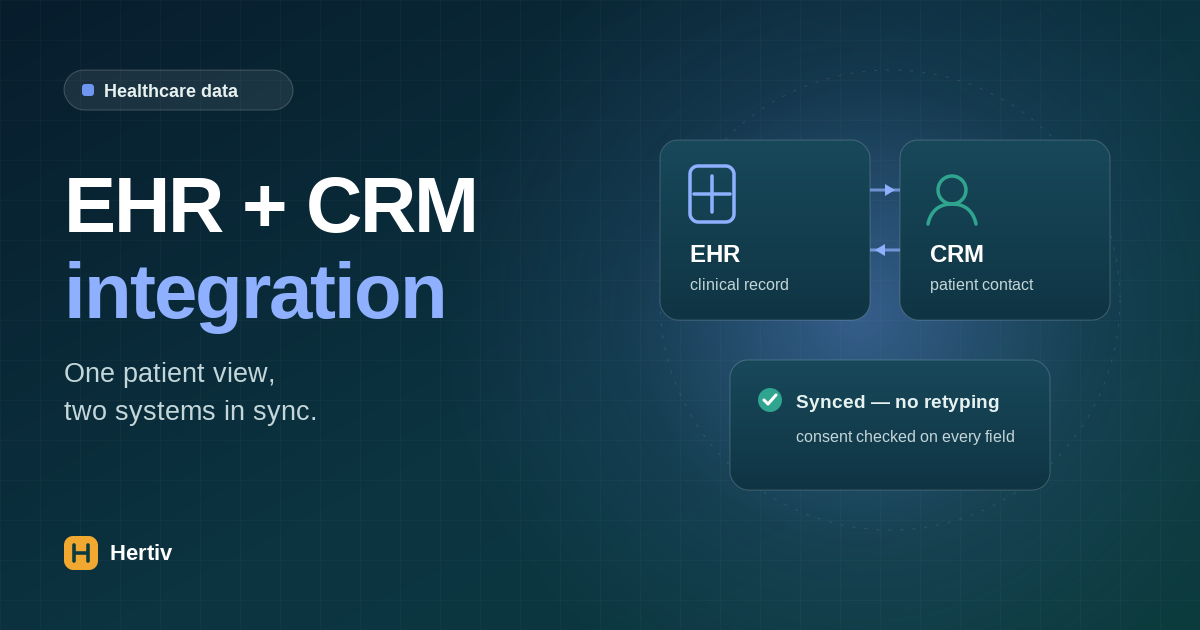
EHR and CRM integration is the connection between a healthcare provider's electronic health record system and its customer relationship system, so clinical and administrative information can flow between them without retyping. The EHR holds the clinical record; the CRM holds the relationship with the patient.
In practice, that means an appointment booked in the CRM appears in the clinic schedule, a care reminder sent from the CRM reflects the patient's actual care plan, and a referral recorded in the EHR reaches the right team without a phone call. The two systems stay separate, but they stop disagreeing about the patient.
Buyers are usually clinics, hospitals and health tech companies whose staff copy information between systems by hand. If the same patient details are typed into two systems, that is the problem integration solves. See AI for healthcare for how providers use connected systems more broadly.
How does the data flow between the two systems?
The data flows both ways, but not all data flows in both directions. Clinical detail stays in the EHR, and only the administrative facts a team needs to do its job cross into the CRM.
| Data | Direction | Example |
|---|---|---|
| Appointments | CRM to EHR | A booking appears in the clinic schedule |
| Patient contact details | EHR to CRM | A changed phone number updates reminders |
| Care reminders | CRM to patient | A follow-up message matches the care plan |
| Referrals | EHR to CRM | A referral reaches the right team |
| Billing status | EHR to CRM | A payment reminder matches the invoice |
| Consent and preferences | Both ways | A withdrawn consent stops all messages |
The rule is simple: the EHR is the source of truth for clinical facts, the CRM is the source of truth for contact and communication, and consent governs everything that crosses between them.
Integration patterns: APIs, FHIR and middleware
There are three common patterns for connecting an EHR and a CRM, and the right one depends on what the EHR allows and how much data needs to move.
- Direct API integration. The CRM calls the EHR's API for appointments, demographics and referrals. This is the simplest pattern when the EHR exposes a good API.
- FHIR-based exchange. FHIR is a standard for exchanging health data, so both sides speak the same format. It fits when several systems need the same data, and when the EHR supports it.
- Middleware or integration engine. A middle layer translates between the two systems, queues messages and handles failures. It fits when the EHR is older, the formats differ, or several systems need connecting.
Most real projects use a mix: FHIR where the standard fits, direct APIs for the simple flows, and middleware where the systems disagree. The pattern matters less than the data model: agree what a patient, an appointment and a referral mean in both systems before connecting anything. Data engineering covers that modelling work in more depth.
Example: a clinic that stops retyping
Example (hypothetical): a clinic with 6,000 patients handles 40 referrals a week. Each referral is currently retyped from the EHR into the CRM, taking 20 minutes of staff time, so 40 referrals times 20 minutes is 800 minutes a week, which is about 13 hours a week spent retyping.
After integration, the referral flows from the EHR to the CRM automatically, and staff spend 5 minutes checking each one instead of 20. That is 40 referrals times 5 minutes, which is 200 minutes a week, or about 3 hours a week. The saving is 800 minutes minus 200 minutes, which is 600 minutes, or 10 hours a week, and the referral reaches the right team the same day instead of the next.
The arithmetic is simple; the hard part is agreeing which fields flow, who can see them, and what happens when a referral is wrong. Those answers belong in the design, not in the first week of use.
What to get right: consent, access and audit
Health data is sensitive, so consent, access and audit are not extras. They are the conditions under which the integration is allowed to exist at all.
- Consent. Only the data a patient has consented to share crosses into the CRM, and a withdrawn consent stops the flow immediately.
- Access control. Staff see only the fields their job needs. A receptionist does not need clinical notes, and a clinician does not need billing detail.
- Audit logs. Every record that crosses between systems is logged, so the clinic can answer who saw what and when.
- Privacy rules. Rules such as HIPAA in the US govern how health data is handled. The integration must be designed around them, not fitted to them afterwards.
What are the common mistakes?
The most common mistakes are connecting the systems before agreeing the data model, moving more data than consent allows, and building a one-way sync that leaves the two systems disagreeing.
- No shared data model. If an appointment means different things in the two systems, the integration will create duplicates.
- Moving everything. Copying the full clinical record into the CRM creates a privacy problem and a system nobody trusts.
- One-way sync only. If changes in one system never reach the other, staff stop trusting both systems.
- No failure handling. When a message fails, someone must notice and fix it. A silent failure is worse than no integration.
- Skipping the clinic staff. The people who book, refer and follow up know where the process breaks. Design with them, not around them.
How to plan an EHR and CRM integration
Plan the integration from the patient journey backwards: what should happen when a patient books, is referred, or changes their details, and who needs to know?
- Map the patient journey. Booking, visit, referral, follow-up, billing. Write down what each step needs from each system.
- Agree the data model. Patient, appointment, referral, consent. One definition each, in both systems.
- Decide what crosses and what does not. Consent and job need decide every field. Write the list down.
- Choose the pattern. API, FHIR or middleware, based on what the EHR allows and how many systems are involved.
- Pilot with one clinic. One site, one referral flow, measured against the old way. Expand only when staff trust it. A partner for custom software development can run the pilot with the clinic staff involved.
Revisit the integration after the first month of real use. The fields staff actually use, and the failures they actually hit, will tell you what to fix before expanding to more sites.
Key takeaways
- The EHR holds the clinical record; the CRM holds the patient relationship. Integration connects them, not merges them.
- Clinical detail stays in the EHR; only administrative facts a team needs cross into the CRM.
- APIs, FHIR and middleware are the three patterns; the data model matters more than the pattern.
- Consent, access control and audit logs are conditions of the integration, not extras.
- Pilot with one clinic and one flow before expanding to more sites.
Frequently asked questions
What is EHR and CRM integration?
It is the connection between a healthcare provider's electronic health record system and its customer relationship system, so appointments, referrals and reminders flow between them without retyping. The two systems stay separate, but they stop disagreeing about the patient.
What data flows between an EHR and a CRM?
Appointments, contact details, referrals, billing status and consent move between the systems. Clinical detail stays in the EHR, and only the administrative facts a team needs to do its job cross into the CRM.
What is FHIR in healthcare integration?
FHIR is a standard for exchanging health data, so different systems can share the same format for patients, appointments and referrals. It fits when several systems need the same data and the EHR supports it.
Is EHR and CRM integration safe for patient privacy?
It is safe when consent, access control and audit logs are designed in from the start. Only data a patient has consented to share should cross into the CRM, and every record that crosses should be logged.
How long does an EHR and CRM integration take?
A pilot with one clinic and one flow, such as referrals, typically takes a few weeks to a few months, depending on what the EHR allows. Expanding to more sites and more flows takes longer, and should wait until staff trust the pilot.
What is the biggest mistake in EHR and CRM integration?
Connecting the systems before agreeing the data model. If an appointment or a referral means different things in the two systems, the integration creates duplicates and staff stop trusting both systems.


