DoorDash Business Model: Where the Revenue Comes From
DoorDash earns from merchant commissions of 15 to 30 percent, customer fees, DashPass subscriptions and advertising. Here is how each stream works.
On this page
Short answer
DoorDash runs a three-sided marketplace that connects customers, restaurants and retailers, and independent delivery drivers called Dashers. It earns money from merchant commissions, customer delivery and service fees, DashPass subscriptions, advertising, and logistics services for other businesses.
What is DoorDash's business model?
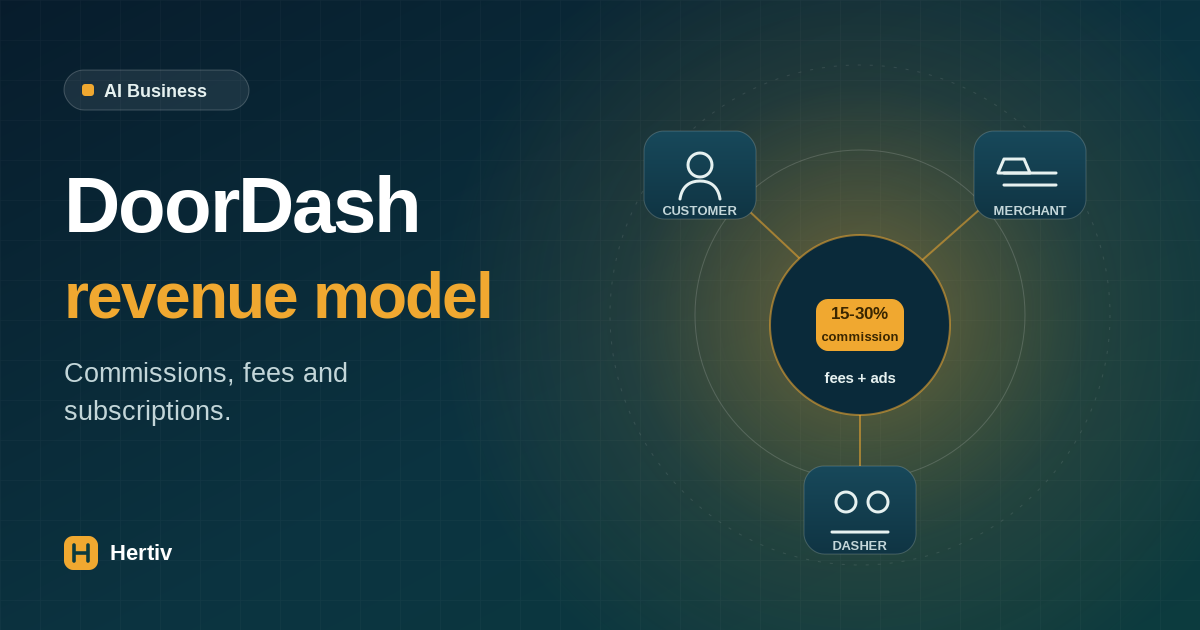
DoorDash's business model is a three-sided marketplace: customers order food and goods through the app, merchants list their products and pay to be reached, and Dashers pick up and deliver the orders as independent contractors. DoorDash sits in the middle of every order and takes a fee from more than one side of it.
The model works because each side needs the other two. Customers want a wide choice of nearby restaurants and stores with fast delivery. Merchants want orders they would not reach on their own. Dashers want flexible work they can start and stop. DoorDash earns its revenue by keeping all three sides active, and its income rises with order volume rather than with any single fee.
DoorDash reported revenue of more than $10.7 billion in 2024, its first profitable year. The table below shows where that revenue comes from.
| Revenue stream | Who pays | How it is charged |
|---|---|---|
| Merchant commissions | Restaurants and retailers | Percentage of the order subtotal |
| Delivery and service fees | Customers | Per-order fees on top of menu prices |
| DashPass subscriptions | Customers | Monthly or annual membership fee |
| Advertising | Merchants | Paid placement and sponsored listings |
| Logistics and software | Businesses | Delivery and ordering tools |
Most of the revenue comes from the first two rows: commissions and consumer fees. The other streams are smaller, but they grow faster and make the business less dependent on any single order.
How does DoorDash make money from merchants?
DoorDash makes most of its money from the commission merchants pay on each order placed through its marketplace. The commission is a percentage of the order subtotal, and the rate depends on the plan the merchant chooses. DoorDash's merchant pricing page lists three plans: Basic at 15 percent, Plus at 25 percent and Premier at 30 percent for orders delivered by a Dasher, with pickup orders charged at 6 percent.
The higher plans add more in return for the higher rate. Plus and Premier give merchants more visibility in search and more marketing support, so a restaurant that wants to be found by new customers pays more than one that only wants its regulars to order through the app. A large chain can negotiate a lower rate, while a small restaurant usually takes the published plan.
The commission covers more than the delivery itself. DoorDash says it pays for marketing, Dasher delivery costs, customer support, the ordering technology and card processing. That is why the rate looks high next to a card fee alone: the merchant is buying demand, delivery and support in one charge. For a similar model at a rival, see how Uber's business and revenue model works.
What do customers pay?
Customers pay on top of menu prices. Each order carries a delivery fee and a service fee, and some orders add a small-order fee or a long-distance fee. The delivery fee varies by merchant and by distance, while the service fee is a variable charge on the order subtotal.
These fees are where DoorDash earns from the customer side of the marketplace. The delivery fee helps pay the Dasher, and the service fee helps pay for the platform: the app, payment processing, support and refunds when an order goes wrong. A customer who orders often pays these fees many times a month, which is why the subscription exists.
Fees are shown before checkout, so a customer can see the full cost before confirming. That matters for trust: a delivery service that hides fees until the last screen loses repeat orders. DoorDash also waives the delivery fee on eligible orders for DashPass members, which turns a per-order cost into a reason to subscribe.
What does DashPass add to the model?
DashPass is DoorDash's subscription, and it adds recurring revenue that does not depend on any single order. Members pay a flat monthly or annual fee and get $0 delivery fees on eligible orders, a reduced service fee and $0 long-distance fees on qualifying restaurant orders. DoorDash reported more than 35 million DashPass, Wolt+ and Deliveroo Plus members at the end of 2025.
The subscription changes customer behaviour in a useful way. A member who has already paid for the month orders more often, because each extra order feels cheaper without a delivery fee. That higher frequency raises order volume for merchants too, which keeps them on the platform and paying commission.
For DoorDash, the value is predictability. Commission and per-order fees rise and fall with demand, while subscription fees arrive every month. That steady base makes it easier to plan driver supply, marketing spend and support staffing. A rival delivery platform used the same idea: Postmates' business model and revenue also mixed fees with membership-style income.
Where else does DoorDash earn revenue?
DoorDash earns revenue beyond its core marketplace in three places: advertising, logistics services and merchant software. Advertising is the fastest-growing of the three. Merchants pay for sponsored listings and promoted placement in search results, so their restaurant appears first when a customer is ready to order. That intent is valuable, and the ads carry very little extra cost for DoorDash.
DoorDash Drive is the logistics service. It lets a merchant take orders through its own website or app and still use DoorDash's drivers for delivery, with DoorDash paid for the delivery work. Storefront is the ordering side of the same idea: online ordering tools a merchant can run under its own brand. Both earn fees outside the marketplace, from businesses that do not want to pay the full marketplace commission.
The third area is category expansion. DoorDash started with restaurant food, then added grocery, convenience, retail and alcohol delivery, and it runs Wolt in Europe. Each new category brings merchants who pay commission and customers who pay fees, using the same driver network. That is the same pattern as any delivery business: starting a food delivery business works when one network serves many kinds of orders.
Example (hypothetical): a restaurant's month on DoorDash
Example (hypothetical): a small restaurant takes 400 orders through DoorDash in a month, with an average order subtotal of $30. Total order value is 400 times $30, or $12,000. The restaurant is on the Plus plan, so it pays 25 percent commission: $12,000 times 0.25 is $3,000, and it keeps $9,000 before its own food and labour costs.
Customers on those same orders pay delivery and service fees on top of the menu prices, so DoorDash earns from both sides of the same 400 orders. If 100 of those customers are DashPass members, they pay no delivery fee on eligible orders, but DoorDash still collects the subscription fee from them each month.
Now suppose the restaurant buys a sponsored listing for $200 that brings 40 extra orders. Those 40 orders add $1,200 in order value, and at 25 percent commission DoorDash earns another $300 from them, plus the $200 ad spend. The lesson is that DoorDash earns from the order, the customer fee, the subscription and the ad at the same time, which is why volume matters more to it than any single charge.
What are the common mistakes?
The most common mistakes in copying the DoorDash model are underpricing delivery, ignoring driver pay and depending on a single revenue stream. Each one looks small at first and becomes expensive as volume grows.
- Charging too little for delivery. A fee that does not cover driver pay and support means every order loses money, and volume makes the loss bigger, not smaller.
- Treating drivers as free capacity. If pay falls below what drivers earn elsewhere, supply drops, delivery times rise and customers leave.
- Depending only on commission. A marketplace that earns from one stream has no cushion when demand falls. Subscriptions and advertising spread the risk.
- Hiding fees until checkout. Customers who discover fees late abandon the order and rarely return.
- Ignoring the merchant's margin. A commission that leaves the restaurant with nothing pushes merchants off the platform or onto a rival.
Building a similar app is a separate question from running the model: how much an app like DoorDash costs to build covers the engineering side.
Key takeaways
- DoorDash is a three-sided marketplace: customers, merchants and Dashers
- Merchant commissions of 15 to 30 percent are the largest revenue stream
- Customers pay delivery and service fees on top of menu prices
- DashPass turns per-order fees into predictable monthly revenue
- Advertising, Drive logistics and Storefront add income outside the marketplace
Frequently asked questions
How much commission does DoorDash charge restaurants?
DoorDash's merchant pricing lists three plans: Basic at 15 percent, Plus at 25 percent and Premier at 30 percent of the order subtotal for Dasher-delivered orders, with pickup orders at 6 percent. The higher plans add visibility and marketing support in return for the higher rate.
Is DoorDash profitable?
DoorDash reported revenue of more than $10.7 billion in 2024, its first profitable year. Revenue comes from merchant commissions, customer delivery and service fees, DashPass subscriptions, advertising and logistics services, minus Dasher payouts, refunds and promotions.
What is DashPass and is it worth it for customers?
DashPass is DoorDash's subscription. Members pay a flat monthly or annual fee and get $0 delivery fees on eligible orders, a reduced service fee and $0 long-distance fees on qualifying restaurant orders. It suits people who order often; occasional customers usually pay less by ordering without it.
How does DoorDash pay its drivers?
Dashers are mostly independent contractors who earn per delivery, including base pay and tips. DoorDash's revenue is what remains after Dasher payouts, refunds, credits and promotions are taken out of the commissions and fees collected on each order.
Does DoorDash make money from advertising?
Yes. Merchants pay for sponsored listings and promoted placement in search results, so their restaurant appears first when a customer is ready to order. Advertising is one of the fastest-growing revenue streams because it carries very little extra cost for DoorDash.
What is DoorDash Drive?
DoorDash Drive is a white-label delivery service. A merchant takes orders through its own website or app and uses DoorDash drivers to deliver them, paying DoorDash for the delivery work. It earns revenue from businesses that do not want to pay the full marketplace commission.


