Document AI in Pharma: What It Reads and Why
Document AI reads pharma documents, such as trial records and safety reports, and pulls out structured data. It cuts manual reading time.
On this page
Short answer
Document AI in pharma is software that reads pharmaceutical documents, such as clinical trial records, drug labels, safety reports and regulatory filings, and pulls out structured data a team can search, check and act on. It matters because pharma teams handle thousands of long, standard documents where manual reading is slow and errors are costly.
What is document AI in pharma?
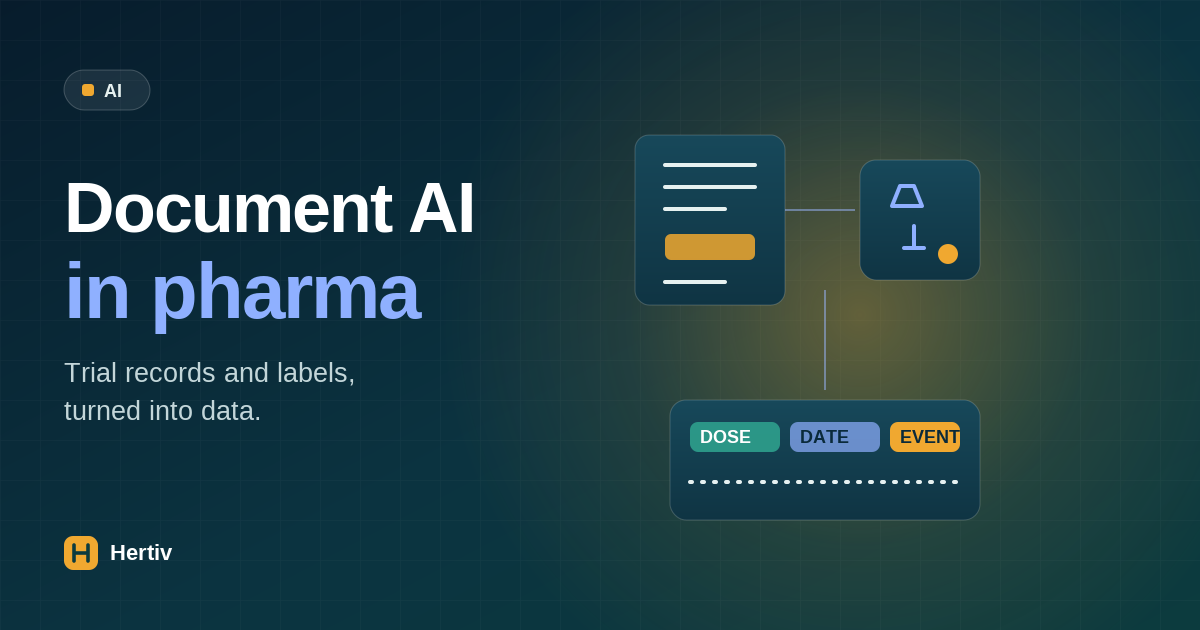
Document AI in pharma is software that reads pharmaceutical documents and turns them into structured data. A clinical trial report, a drug label, a safety report or a regulatory filing arrives as a PDF or a scan; document AI reads the text, finds the fields that matter, such as a dose, a date or an adverse event, and puts them into a table or a database a team can search.
It is different from a simple search tool. Search finds words; document AI understands the layout and the meaning of a page. It can tell a table of lab results from a paragraph of notes, and it can link a patient number in one document to the same number in another, even when the formatting differs.
Pharma is a strong fit because its documents are long, standard and high stakes. A missed safety signal or a wrong dose on a label can harm patients and breach rules. Document AI in retail shows the same idea in a different industry, where the documents are invoices and receipts rather than trial records.
Which documents does document AI handle in pharma?
Pharma teams work with a wide range of documents, and document AI handles the ones that follow a repeatable shape. The most common are clinical trial records, safety reports, drug labels, manufacturing batch records and regulatory submissions. Each of these has standard sections, which makes it easier for the model to find the right fields.
| Document | What is pulled out | Who uses it |
|---|---|---|
| Clinical trial records | Patient data, doses, outcomes | Clinical teams |
| Safety reports | Adverse events, dates, severity | Safety teams |
| Drug labels | Dose, warnings, interactions | Regulatory teams |
| Batch records | Materials, quantities, checks | Manufacturing teams |
| Regulatory filings | Sections, references, dates | Regulatory teams |
Documents that are free-form, such as a researcher's handwritten notes or a meeting transcript, are harder. They can still be searched, but the structured extraction is less reliable. Start with the standard documents, where the layout is stable and the fields are known.
How does document AI work in a pharma team?
Document AI works in three steps. First, the document is read: text is extracted from the PDF or scan, including tables and handwriting where the tool supports it. Second, the model finds the fields: it looks for the dose, the date, the patient number or the adverse event, using the layout and the words around them. Third, the results are checked: a person reviews the low-confidence fields before the data is used.
The human check is not optional in pharma. A wrong dose or a missed adverse event can have serious consequences, so every extracted field that affects a decision should be reviewed by a qualified person. The goal is not to remove people from the process, but to let them spend their time checking rather than typing.
Integration matters as much as accuracy. The extracted data must land in the systems the team already uses, such as a trial management system or a safety database. Document AI in real estate faced the same integration question, where the data had to reach property systems rather than pharma ones.
Where does document AI save time in pharma?
The biggest saving is in data entry. A clinical trial can generate thousands of pages, and copying the key fields by hand takes weeks of staff time. Document AI can read the same pages in hours, leaving the team to check the results instead of typing them. The saving grows with the number of pages, so large trials gain the most.
The second saving is in search. When a regulator asks for every mention of a specific adverse event across five years of reports, a team with structured data can answer in minutes. A team with paper files or unsearchable PDFs needs days. That speed matters most during an audit or an inspection, when the deadline is short.
The third saving is in consistency. The same document read by three people can produce three different summaries, especially when the readers are tired. A model applies the same rules every time, so the output is more consistent, even if a person still checks it. That consistency also makes it easier to compare results across trials and sites.
What are the limits and risks?
Document AI is not perfect, and its limits matter in pharma. Poor scans, unusual layouts and rare document types all reduce accuracy. A model trained on one company's trial reports may struggle with another company's format, so the model must be tested on your own documents before it is trusted.
Data privacy is a real risk. Pharma documents hold patient data, so the tool must meet the privacy rules that apply, including where the data is stored and who can see it. Check whether the vendor processes documents on your own systems or sends them to a cloud service, and confirm that the arrangement meets your rules.
Validation is the third limit. In regulated pharma work, software that affects decisions must be validated: tested, documented and shown to work as intended. Budget time for validation, and keep the records, because an inspector will ask for them. A tool that cannot be validated is a tool that cannot be used for regulated work.
Example (hypothetical): processing a trial's safety reports
Example (hypothetical): a pharma team receives 600 safety reports a month, each about 8 pages long. Reading and entering the key fields by hand takes a trained reviewer about 30 minutes per report, so the team spends 600 x 0.5 = 300 hours a month on this work, which is nearly two full-time roles.
With document AI, the software reads each report in about 2 minutes, and a reviewer checks the flagged fields in about 8 minutes. Total time per report is 10 minutes, so the monthly work falls to 600 x 10 / 60 = 100 hours. The team saves 200 hours a month, which is about 2,400 hours a year.
The team still reviews every report, because a missed adverse event is not acceptable. The saving comes from reading less and checking more: the reviewer sees the extracted fields and the source page side by side, and confirms or corrects each one. The 200 hours saved are spent on follow-up and analysis instead of typing.
Common mistakes
The most common mistake is trusting the output without checking it. Document AI makes mistakes, especially on unusual layouts, and a wrong dose or a missed event can have serious consequences. Always keep a human check on any field that affects a decision.
Another mistake is starting with the hardest documents. Free-form notes and rare document types give poor results and disappoint the team. Start with the standard documents, prove the value there, and only then move to the harder ones.
A third mistake is skipping validation. In regulated work, an unvalidated tool cannot be used for decisions, no matter how accurate it looks. Plan the validation work into the project from the start, and keep the records an inspector will want to see.
Key takeaways
- Document AI turns pharma documents into structured, searchable data.
- It fits standard documents best: trial records, safety reports, labels and filings.
- A human must still check any field that affects a decision.
- The biggest savings are data entry time, search speed and consistency.
- Validation and patient data rules must be planned from the start.
Frequently asked questions
What is document AI in pharma?
Document AI in pharma is software that reads pharmaceutical documents, such as trial records, safety reports and drug labels, and pulls out structured data a team can search and check. It turns long, standard documents into tables and databases instead of leaving the key facts buried in pages of text.
Can document AI replace reviewers in pharma?
No. A human must still check any field that affects a decision, such as a dose or an adverse event, because the software can make mistakes. Document AI lets reviewers spend their time checking rather than typing, but it does not remove them from the process.
Which pharma documents work best with document AI?
Standard documents with a repeatable layout work best: clinical trial records, safety reports, drug labels, batch records and regulatory filings. Free-form notes and rare document types give less reliable results and should come later.
Is patient data safe with document AI?
It depends on the setup. Pharma documents hold patient data, so the tool must meet the privacy rules that apply, including where data is stored and who can see it. Confirm whether the vendor processes documents on your systems or in the cloud before signing.
How much time can document AI save a pharma team?
It depends on the volume of documents. A team processing hundreds of similar reports a month can save a large share of the reading and typing time, while still reviewing every result. The saving grows with the number of pages, so large trials gain the most.
Does document AI need validation in pharma?
Yes, for regulated work. Software that affects decisions must be tested, documented and shown to work as intended, and the records kept for inspection. Budget time for validation from the start, because an unvalidated tool cannot be used for regulated decisions.


