Document AI in Ecommerce: What Shops Can Read Faster
Document AI reads invoices, returns forms and customs paperwork so shops can process them faster. Here is what it reads first, and where it helps most.
On this page
Short answer
Document AI in ecommerce is software that reads the paperwork a shop handles every day — supplier invoices, returns forms, customs declarations, delivery notes and identity documents — and pulls out the fields staff need, such as order numbers, amounts, dates and addresses. It checks the extracted data against rules and records, then routes clean documents to the right system and sends the rest to a person for review.
What is document AI in ecommerce?
Document AI in ecommerce is software that reads the paperwork a shop handles every day — supplier invoices, returns forms, customs declarations, delivery notes and identity documents — and pulls out the fields staff need, such as order numbers, amounts, dates and addresses. Instead of a person retyping each page, the software returns structured data the shop's systems can search, check and act on.
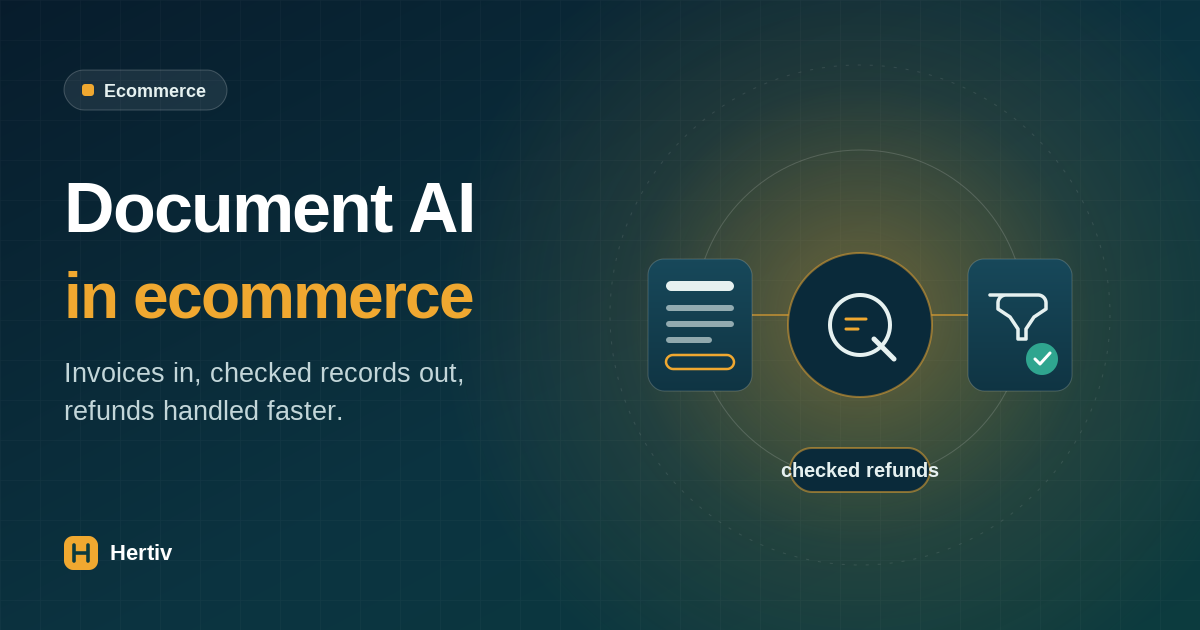
The software works in three steps. First it reads the page, whether the page is a scanned paper form, a PDF or a photo taken on a phone. Then it finds the fields and returns them in a fixed format, such as an invoice line or a returns record.
Finally it checks the result against rules — an amount that does not match the order, a date that cannot exist, a missing signature — and sends anything doubtful to a person.
Document AI does not decide refunds, payments or customs duties. It prepares the paperwork so staff can decide faster, and it leaves a record of what was read, what was checked and who reviewed it. For a shop, that record matters as much as the speed, because money and customer trust both depend on paperwork that adds up. For the general picture, Document AI explains how extraction plus validation works.
Which documents does it read first?
Shops should start with the documents that arrive in the largest numbers and follow the most regular format. A form that looks the same every time is easy to teach the software to read, while a free-form email is not. The table below lists the documents most shops automate first, and what the software pulls from each one.
| Document | Fields it extracts | Why start here |
|---|---|---|
| Supplier invoices | Supplier, amount, date, order number | Money that must add up |
| Returns forms | Order number, item, reason, condition | Daily volume, fixed layout |
| Delivery notes | Order, items, quantities, carrier | Needed to confirm receipt |
| Customs declarations | Goods, value, origin, tariff code | Needed before goods move |
| Identity documents | Name, document number, expiry | Needed for age and fraud checks |
| Warranty claims | Product, fault, purchase date | Repeatable, rule-based |
Start with one document type, not six. A single invoice pipeline processed well teaches the team how to set rules, measure accuracy and handle exceptions, and that learning carries over to the next document.
Shops that try to automate every document at once usually end up with six half-working pipelines instead of one reliable one. A similar staged start shows up in other sectors, such as the way document AI in retail began with invoices before widening to other paperwork.
How does it handle returns and refunds?
Returns are usually the first place shops feel the difference, because returns arrive in a rush after sales events and every one needs the same checks. Document AI reads each returns form, pulls out the order number, item and reason, and matches them against the order record. If the item matches and the reason is covered, the refund is prepared; if anything does not match, the return goes to a person.
The check against the order record is the whole design. A return for an item the customer never bought, or a refund for more than the item cost, is caught by the rules before money moves. The software does not approve the refund on its own; it prepares the case and shows the person the original form next to the extracted fields, so the decision takes seconds instead of minutes.
The change is visible in the first sale period. Instead of spending the week after a sale retyping returns forms, the team works from a list of exceptions — damaged goods, missing items, claims outside the returns window — while the routine returns are prepared automatically. Customers get faster refunds, and the shop has a record of every return, which helps when a supplier asks why so many of one item came back.
What changes for supplier and marketplace paperwork?
Supplier paperwork is the second place document AI pays off, because a shop that buys from many suppliers receives invoices in many formats. The software reads each invoice, pulls out the supplier, amount and order number, and matches them against the purchase order. If the amount matches, the invoice is ready for payment; if it does not, it goes to review with the mismatch highlighted.
Marketplace paperwork adds a second layer. A shop selling on several marketplaces receives settlement statements, fee breakdowns and chargeback notices in different formats, and each one must be matched against the shop's own orders. Document AI reads each statement into the same format, so the finance team can see what each marketplace owes, what it charged, and where the numbers disagree, without retyping every line.
Customs declarations are the hardest of the three, because the fields must match the goods exactly and the rules change by country. The practical approach is to use document AI to prepare the declaration and let a person sign it off, with the software flagging any field that does not match the shipment. That keeps the speed without handing a legal document to software alone.
How do you check what it read?
Extraction without checking is just faster typing, so the checking step is where document AI earns its place. The software applies rules to every field it reads: amounts must match the order, dates must fall inside the returns window, quantities must match the delivery note, and reference numbers must match the format the shop uses.
Each field also gets a confidence score. A clean printed field scores high and passes through on its own. A handwritten reason on a returns form or a smudged amount on an invoice scores low and goes to a review queue, where a staff member sees the original image next to the extracted value and confirms or corrects it. The correction feeds back into the system, so the same handwriting reads better next time.
Two checks matter most in ecommerce. The first is money: invoice amounts must match the purchase order before payment is approved, and refund amounts must match the item price before money moves.
The second is identity: the name on an identity document must match the order before an age-restricted or high-value item ships. Both checks are simple rules, and both prevent the errors that cost shops the most time to fix. Banks run the same kind of checking, as document AI in finance shows.
Example (hypothetical): a shop clears its returns backlog
Example (hypothetical): an online shop receives 400 returns in the week after a sale event. Each return is a form with the order number, item, reason and condition, and a staff member needs about 8 minutes to read one form, find the order and prepare the refund. That is 400 × 8 minutes = 3,200 minutes, or about 53 hours of work, spread across a team that also answers customer messages.
With document AI, the software reads each form in under a minute and passes about 320 of the 400 straight through, because the order matches, the reason is covered and the item is in good condition.
The remaining 80 go to a review queue, and a staff member spends about 5 minutes on each one, checking the flagged field against the original form. That is 80 × 5 minutes = 400 minutes, or about 7 hours of review.
The shop saves about 46 hours in one week, and the saving is not the whole story. Fewer typed details means fewer refunds for the wrong amount, and every return has a record of what was read and who checked it. The team still reads every flagged return; it simply stops retyping the 320 that were already correct.
What are the common mistakes?
The most common mistakes with document AI in ecommerce are starting with the hardest documents, skipping the checking step, and letting the software move money nobody reviews.
- Starting with free-form emails. Begin with printed forms that follow a fixed layout, such as invoices and returns forms, and add free-form documents only after the first pipeline works.
- Trusting every extraction. Set a confidence threshold and review everything below it; a wrong refund amount filed without review is worse than a slow one.
- No plan for exceptions. Every document type has edge cases, such as a return outside the window or an invoice in a different currency, and someone must own those cases.
- Letting the software approve payments. Document AI prepares invoices and refunds, but a person approves the money moving. That rule should never be relaxed for speed.
A short pilot on one document type, with a named owner and a weekly review of the exception queue, avoids most of these. The pilot also gives the shop real numbers on accuracy and time saved, which is what a wider rollout needs to be approved. Logistics teams ran the same kind of pilot first, as document AI in logistics shows.
Key takeaways
- Document AI turns shop paperwork into structured data staff can search and check
- Start with one high-volume, fixed-layout document type, not every form at once
- Every field needs a rule check and a confidence score, with low-confidence fields going to review
- Returns and refunds gain the most, because they arrive in a rush and need the same checks
- Document AI prepares invoices and refunds, but a person approves the money moving
Frequently asked questions
What documents can document AI read in a shop?
It reads the documents that follow a regular layout: supplier invoices, returns forms, delivery notes, customs declarations, identity documents and warranty claims. Free-form emails are harder, and shops usually add them only after the first pipeline works well.
Does document AI approve refunds on its own?
No. It prepares the case — order number, item, reason and condition matched against the order record — and a person approves the refund. The software shows the original form next to the extracted fields, so the decision takes seconds instead of minutes.
How accurate is document AI on shop documents?
Accuracy depends on the document. Clean printed forms read well, while handwritten reasons and smudged amounts need review. Shops measure accuracy on a sample of real documents during a pilot, and they keep a review queue for everything below the confidence threshold.
What happens to documents that fail the checks?
They go to a review queue, where a staff member sees the original image next to the extracted value and confirms or corrects it. The correction feeds back into the system, so the same handwriting or layout reads better next time.
Can document AI handle customs declarations?
It can prepare them by reading the shipment details into the declaration format, but a person should sign them off, since the fields must match the goods exactly and the rules change by country. The software flags any field that does not match the shipment.
How long does a shop pilot take?
A pilot on one document type usually runs for about four weeks: two weeks to gather samples and define checks, then two weeks of processing with review. That gives the shop real numbers on accuracy and time saved before it decides on a wider rollout.


