Digital Workforce in Retail E-Commerce: What It Is
A digital workforce in retail e-commerce is AI agents doing routine retail work alongside human staff, from product questions to supplier follow-ups.
On this page
Short answer
A digital workforce in retail e-commerce is a set of AI agents and automated systems that carry out routine retail work alongside human staff. Each digital worker handles one defined task, follows rules set by the retailer, and hands off to a person when a case needs judgement. The result is a shop where people spend their time on customers and decisions instead of repetition.
What is a digital workforce in retail e-commerce?
A digital workforce in retail e-commerce is a set of AI agents and automated systems that carry out routine retail work, such as answering product questions, updating stock records and chasing suppliers, alongside human staff. Each digital worker handles one defined task, follows rules set by the retailer, and hands off to a person when a case needs judgement.
The idea is older than the name. Retailers have automated stock counts, price updates and order confirmations for years. What is new is that AI agents can now handle the messy, language-based work as well: reading a customer message, checking the order system, and writing a useful reply, instead of only following a fixed script.
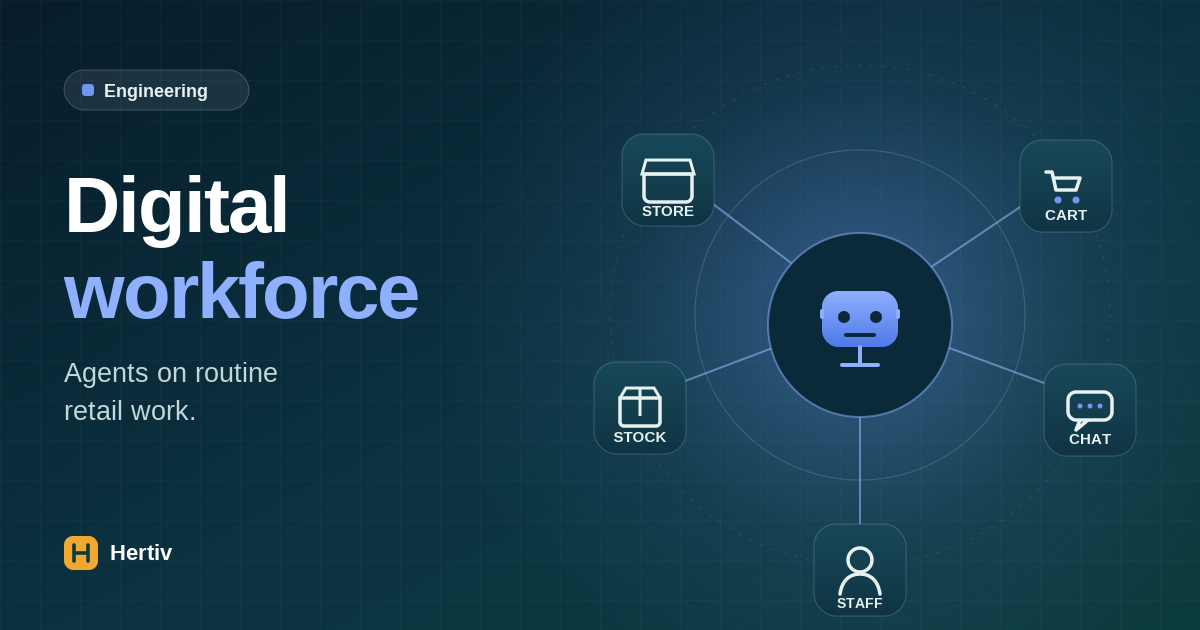
A digital workforce is not one product. It is a set of agents, integrations and rules that together cover the repetitive work across the storefront, the warehouse and the support inbox. Retailers usually start with one area, such as support messages, and add more once the first agent proves itself.
What does a digital workforce actually do?
A digital workforce takes the high-volume, low-judgement work first, and leaves the cases that need a person to a person. The split is what makes the model work: agents are fast and consistent, humans handle the exceptions.
| Task | Digital worker does | Human still does |
|---|---|---|
| Product questions | Answers from the catalogue and stock data | Handles complaints and sensitive cases |
| Order updates | Sends tracking and delivery status | Resolves lost or damaged parcels |
| Stock checks | Flags low stock and slow lines | Approves reorders and price changes |
| Returns | Starts the return and issues the label | Inspects damaged goods and refunds |
| Supplier follow-ups | Chases late deliveries by message | Negotiates terms and new suppliers |
The table shows the pattern: the agent does the lookup, the draft and the follow-up, while the human makes the decision. Retailers that hand agents open-ended authority without that split are the ones that run into trouble, because an agent can offer a discount or a refund that no person approved.
Where digital workers fit in the retail flow
Digital workers fit wherever a task is repeated, follows a pattern and can be checked against a system of record. In practice that means three places: the storefront, the warehouse and the support inbox.
On the storefront, agents answer product questions, suggest alternatives when an item is out of stock, and guide buyers through checkout problems. In the warehouse, they watch stock levels, flag slow lines and draft purchase orders for a human to approve. In the support inbox, they classify incoming messages, answer the routine ones and route the rest to the right person with a summary attached.
The common thread is that each agent reads from a real system, such as the catalogue or the order database, rather than guessing. An agent that answers from live stock data is useful; one that invents delivery dates is worse than no agent at all. That is why the integration matters more than the model. See AI agents for customer support for how the handoff to humans is designed.
Build or buy: how retailers get started
Retailers get started in two ways: buying a platform that already covers retail tasks, or building agents on a general agent framework. Buying is faster for standard work such as support messages, while building fits retailers with unusual systems or rules.
Bought platforms come with retail integrations already built, such as connections to common storefronts and order systems, and they usually include the guardrails for refunds and discounts. The cost is less flexibility: if your warehouse system is unusual, the platform may not connect to it without custom work.
Building on a framework gives you full control over the agent's tools, prompts and approval rules, but you take on the integration and the testing yourself. Most mid-size retailers start by buying one agent for support, learn how their staff and customers react, and only then decide whether to build. AI agent development covers the build side in more depth.
Example (hypothetical): a 40-store retailer adds digital workers
Example (hypothetical): a retailer with 40 stores and an online shop receives 5,000 customer messages a month. Digital workers take on 60% of them, which is 3,000 messages, and each one saves about 4 minutes of staff time. That is 12,000 minutes, or 200 hours, saved each month.
At a loaded cost of $25 an hour, 200 hours is $5,000 a month of staff time freed up. The platform and the agent maintenance cost $1,500 a month, so the net saving is $3,500 a month, or $42,000 a year. The retailer keeps the same support team and uses the freed hours for the cases that need a person, such as damaged goods and complaints.
The numbers only hold if the handoff works. If the agents answer badly and customers write back twice, the message count rises instead of falling, and the saving disappears. That is why the retailer measures repeat contacts, not just messages handled.
How to start a digital workforce pilot
You start a digital workforce pilot by picking one task with high volume and low risk, then measuring it honestly for a month before expanding.
- Pick one task. Choose something repeated and checkable, such as order-status questions, rather than a task that needs judgement.
- Connect the real systems. Give the agent read access to the catalogue and order database so its answers come from live data.
- Set the handoff rules. Define exactly when the agent must pass a case to a person, such as refunds, complaints and anything involving money.
- Run it with supervision. Let staff review a sample of agent replies daily for the first month and correct the mistakes.
- Measure repeat contacts. If customers write back more often after the agent replies, the agent is not helping yet.
A pilot that covers one task well teaches the team how agents behave, how customers react and where the guardrails need to be. Expanding before that is how retailers end up with agents that sound confident and get things wrong.
Common mistakes with digital workforces in retail
The most common mistakes are giving agents authority they should not have, letting them answer without live data, and measuring the wrong thing.
- Authority without limits. An agent that can offer discounts or refunds without a rule will eventually offer too much.
- Answers without live data. An agent that guesses stock levels or delivery dates creates more work than it saves.
- Measuring messages handled. A high handle rate means little if customers write back twice because the first answer was wrong.
- Skipping the handoff. Customers who cannot reach a person when they need one will leave, however fast the agent replies.
- Rolling out everywhere at once. One task, measured for a month, beats five agents launched together and never reviewed.
Key takeaways
- A digital workforce is AI agents plus automation doing routine retail work alongside staff
- Agents take high-volume, checkable tasks; humans keep decisions, complaints and exceptions
- Every agent must answer from live catalogue and order data, not from memory
- Start with one task, supervise it for a month, and measure repeat contacts
- Authority needs limits: refunds and discounts should follow rules, not agent judgement
Frequently asked questions
What is a digital workforce in retail?
A digital workforce is a set of AI agents and automated systems that carry out routine retail work, such as answering product questions, updating stock and chasing suppliers, while human staff handle decisions and exceptions. It is not a shop without people; it is a shop where people spend less time on repetition.
Which retail tasks suit a digital workforce?
Tasks that are repeated, follow a pattern and can be checked against a system work best: order-status questions, stock checks, return starts and supplier follow-ups. Tasks that need judgement, such as complaints and refunds, should stay with people.
How much does a digital workforce cost?
Costs vary by platform and scope, and most vendors quote per project or per agent. Run your own pilot numbers first: hours saved per month, minus platform and maintenance cost, gives a clearer answer than any vendor estimate. Check the vendor site for current pricing.
Do digital workers replace retail staff?
They replace repetitive work, not people. In most pilots the same team handles more volume and spends the freed hours on cases that need a person. Retailers that cut staff at the same time as launching agents usually see service quality fall.
How do customers react to digital workers?
Customers accept fast, accurate answers and dislike being trapped with an agent that cannot solve their problem. A clear path to a person matters more than how human the agent sounds.
What is the biggest risk?
An agent that acts with authority it should not have, such as offering refunds or discounts without a rule. Limit what agents can do, log every action, and review a sample of cases daily during the pilot.


