Digital Product Engineering for Business: What It Covers
Digital product engineering turns a business idea into working software, from discovery and design to build, launch and ongoing improvement after release.
On this page
Short answer
Digital product engineering is the end-to-end work of turning a business idea into working software and keeping it improving after launch. It covers discovery, design, development, testing, release and ongoing iteration, with one team accountable for the product's results.
What is digital product engineering?
Digital product engineering is the end-to-end work of turning a business idea into working software and keeping it improving after launch. It covers discovery, design, development, testing, release and ongoing iteration, with one team accountable for the product's results.
It differs from a one-off software project because the work does not stop at launch. The team watches how people use the product, fixes what fails, and ships improvements in small steps. A product that stops changing after release falls behind its users and its competitors.
For a business, product engineering is the link between strategy and software. The strategy says which customers to serve and what outcome matters; the engineering team turns that into screens, services, data flows and release plans. When the link is missing, teams ship features that nobody asked for.
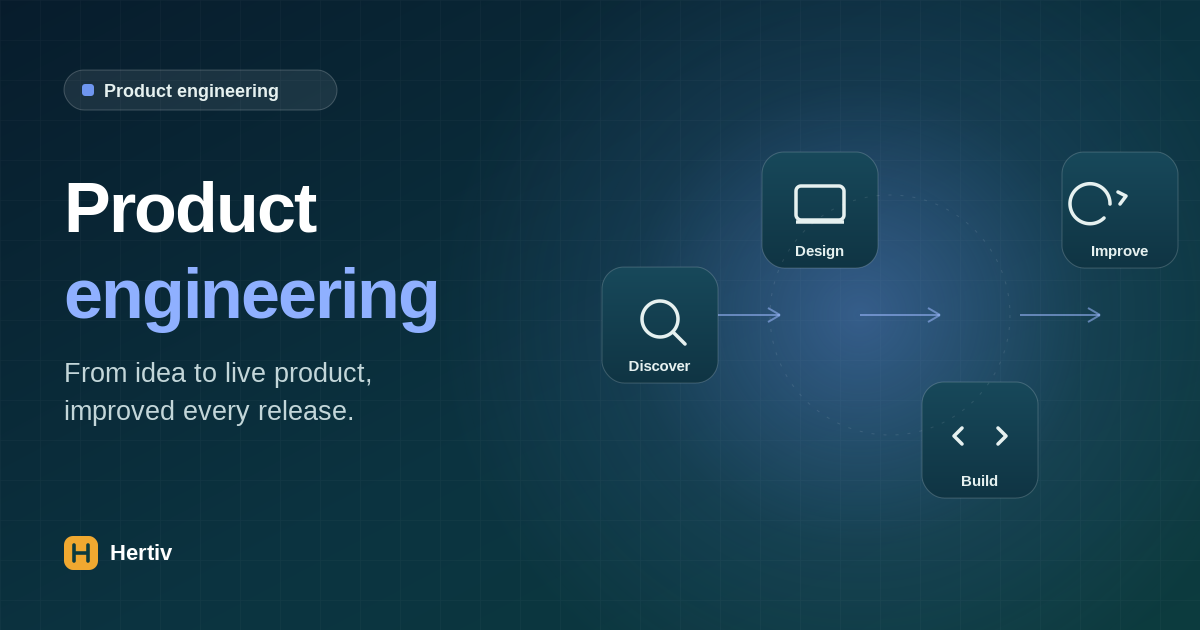
| Phase | What happens | Main output |
|---|---|---|
| Discovery | Talk to users, map the problem, test ideas | Validated concept |
| Design | Flows, screens, prototypes, usability checks | Tested prototype |
| Build | Code, integrations, data models, tests | Working release |
| Launch | Release, onboarding, support, measurement | Live product |
| Improve | Usage data, fixes, new features, releases | Steady updates |
Each phase feeds the next, and the cycle repeats. Discovery does not end when building starts; new findings from live users feed the next round of design and development.
What does a product engineering team do?
A product engineering team owns a product from idea to live use. It includes product managers, designers, engineers, testers and data analysts, and it makes decisions about what to build, how to build it and when to release it.
Day to day, the team works in short cycles. It picks a small set of improvements, designs and builds them, tests them with real users, releases them, and measures what changed. The cycle is short on purpose: small releases are easier to test, easier to reverse and easier to learn from than large ones.
The team also owns the unglamorous work that keeps a product alive. That includes monitoring, fixing bugs, updating dependencies, handling security issues and keeping documentation current. A product without this work slowly becomes unreliable, and unreliable products lose users quietly.
Good teams measure outcomes, not output. They track whether users finish key tasks, whether support tickets fall, and whether the product earns or saves money. Counting features shipped tells you nothing about whether the product is working.
How is product engineering different from software development?
Software development is the coding part: building features to a specification. Product engineering includes the coding, but it also owns the decisions before and after: which problem to solve, how to design the experience, and how to measure success once the software is live.
| Area | Software development | Product engineering |
|---|---|---|
| Scope | Build to a spec | Own the whole product |
| Decisions | Technical choices | Product and technical choices |
| Success measure | Features delivered | User and business outcomes |
| After launch | Fixes as requested | Continuous improvement |
| Team | Engineers | Product, design, engineering, data |
The difference shows up when requirements change, which they always do. A development team waits for a new specification. A product engineering team talks to users, reprioritises and adjusts the plan itself.
Neither model is wrong. A well-defined internal tool with fixed requirements may only need development. A customer-facing product in a changing market needs product engineering, because the plan will change and someone has to own those changes.
When does a business need product engineering?
A business needs product engineering when its software is a product that customers choose, not a tool that staff must use. Customer-facing apps, platforms and marketplaces all fall in this group, because users can leave for a competitor at any time.
It also matters when the product must keep changing. Regulations shift, competitors ship new features and user expectations move. A team that only builds to a fixed plan will fall behind, while a product engineering team treats change as normal work.
Scale is another trigger. A product with a few hundred users can be managed informally. A product with tens of thousands of users needs monitoring, release discipline, data analysis and a roadmap, and that is exactly what a product engineering team provides.
Finally, product engineering pays when the cost of a wrong feature is high. Building the wrong thing for three months is expensive. Discovery, prototypes and small releases reduce that risk, because the team learns what users want before committing months of work.
How to start a product engineering engagement
Start a product engineering engagement by defining the problem, the user and the outcome in plain language. If you cannot state those three things, no amount of engineering will fix the product.
- Define the problem and the user. Who struggles, with what, and what does it cost them today? Write it in one paragraph.
- Agree on one outcome. Pick a single measure of success, such as completed orders, resolved tickets or time saved, and write down the target.
- Run discovery first. Talk to users, review existing data and test a prototype before writing production code.
- Build a small first release. Ship the smallest version that solves the problem for real users, then learn from their behaviour.
- Set up measurement. Track the outcome from day one, so every later decision has evidence behind it.
- Plan the improvement cycle. Agree on release cadence, review meetings and who decides what gets built next.
The discovery step is the one teams most often skip, and the one that saves the most money. A week of user conversations can prevent months of building the wrong feature.
If you are scoping the first release, product discovery is the right place to start.
A minimum viable product keeps the first build small enough to learn from.
Example: a retailer rebuilds its ordering flow
Example (hypothetical): a regional retailer with 40 stores sells online, but only 2 in 100 visitors complete an order. The team suspects the checkout is the problem and starts a product engineering engagement.
Discovery takes three weeks. The team watches 30 shoppers use the site, reviews support tickets and finds that the delivery-date picker confuses people and the address form rejects valid postcodes. The prototype tests a simpler checkout with a clearer delivery choice.
The first release costs $90,000 and takes 10 weeks. It covers the new checkout, the fixed address form and a clearer order confirmation. Nothing else changes, so the team can measure the effect of the checkout alone.
After release, completed orders rise from 2 in 100 visitors to 3 in 100. With 50,000 visitors a month and an average order of $60, monthly orders rise from 1,000 to 1,500, which is $30,000 in extra sales a month. The $90,000 build pays for itself in three months, and the team then moves on to the next problem: delivery tracking.
What are the common mistakes?
The most common mistakes in digital product engineering are skipping discovery, measuring output instead of outcomes and treating launch as the finish line. Each one wastes money in a different way.
- Skipping discovery. Building before talking to users produces features that look right in a meeting and fail in real use.
- Measuring features shipped. A team can ship ten features and improve nothing. Measure the outcome the product is meant to change.
- Treating launch as the end. A product needs monitoring, fixes and iteration after release. Budget for it from the start.
- No single owner. When design, engineering and data report to different managers, nobody owns the result. One accountable team beats three handoffs.
- Big releases. Large releases are hard to test and hard to reverse. Small, frequent releases reduce risk and speed up learning.
If you are planning a product and want the build shaped around real user evidence, custom software development with a product engineering team keeps design, build and measurement in one place.
Key takeaways
- Product engineering owns the whole product, from discovery to live improvement
- It differs from plain development: it owns product decisions and outcomes, not just code
- Discovery and small releases reduce the risk of building the wrong thing
- Measure outcomes such as completed tasks, not features shipped
- Launch is the start of improvement, not the end of the work
- One accountable team beats separate design, build and data handoffs
Frequently asked questions
What is the difference between product engineering and product management?
Product management decides what to build and why, while product engineering is the team that designs, builds, tests and improves it. In a product engineering team the two work together daily, so decisions about scope and design happen with the people who build the software.
How long does a product engineering project take?
Discovery usually takes two to six weeks and a first release takes eight to sixteen weeks, depending on scope. After launch, improvement continues in short cycles. There is no fixed end date, because a live product keeps changing as users and markets change.
Do small businesses need product engineering?
Small businesses need it most when their software is how customers buy from them. A small team can still run the same cycle: talk to users, build a small release, measure the result and repeat. The team is smaller, but the discipline is the same.
What skills does a product engineering team need?
It needs product management, design, engineering, testing and data analysis. The exact mix depends on the product, but the key is that the team can decide, design, build and measure without waiting on outside groups for every step.
How much does product engineering cost?
Costs vary with team size, scope and region. A small team working on one product is the usual starting point, and the cost should be weighed against the outcome it is meant to change, such as sales, support load or time saved. Ask for a scope tied to one measurable outcome.
When should we hire a product engineering team instead of freelancers?
Hire a team when the product needs ongoing ownership, not a single feature. Freelancers suit a defined one-off task. A product that must keep improving needs a team that remembers the decisions, the users and the data from one release to the next.


