DevOps in Banking: How Banks Ship Software Safely
Banks cannot release software like startups: every change must be traceable and safe. Learn the practices, the adoption steps and the mistakes to avoid.
On this page
Short answer
DevOps in banking means building, testing and releasing software in small, frequent steps, with the same rigour banks apply to money. Automated tests, controlled rollouts, secrets in vaults and a full audit trail let banks release more often without losing control, because every change is checked, recorded and reversible.
What is DevOps in banking?
DevOps in banking is the practice of building, testing and releasing banking software in small, frequent steps, with the same rigour that banks apply to money. It brings together developers, operations teams and security specialists so that a change can move from an idea to production quickly, safely and with a clear record of what changed.
Banking software is different from most software because a mistake can move money, expose customer data or break a rule. That is why banks were slow to adopt DevOps: the old model released rarely, with long manual checks, because each release felt risky. DevOps does not remove the checks. It makes them automatic, repeatable and visible, so releases can happen more often without losing control.
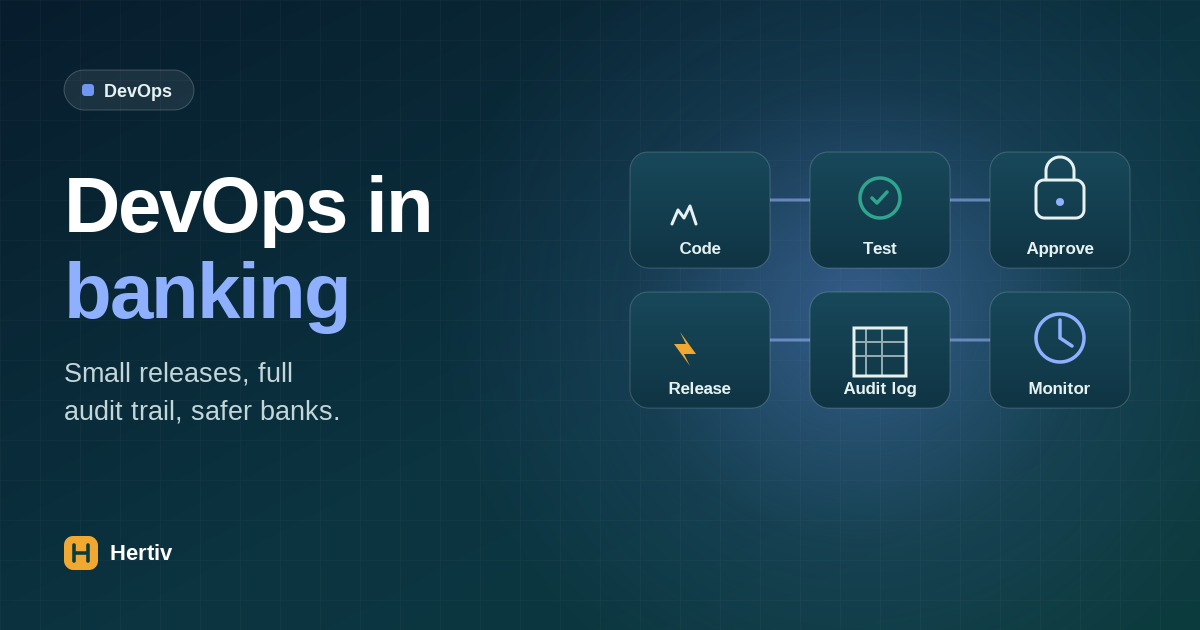
In practice, DevOps in a bank means automated tests, automated deployment, monitoring of every change, and a record that shows who approved what and when. A regulator, an auditor or a customer complaint can all be answered from that record, which is why the audit trail is as important as the speed.
Why is DevOps different in a bank?
DevOps is different in banking because the rules, the risks and the systems are stricter than in most industries. The table below shows the banking need on one side and the DevOps answer on the other.
| Banking need | DevOps answer |
|---|---|
| Every change must be traceable | Version control and a deployment record for each release |
| Customer data must stay protected | Secrets in vaults, encrypted data, least-privilege access |
| Systems must stay available | Gradual rollouts, automatic rollback, health checks |
| Regulators need evidence | Logs, approvals and test results kept for review |
| Old systems must keep working | Small changes, tested against the old system first |
| Fraud and errors must be caught fast | Monitoring and alerts on every transaction path |
The audit trail is the part that surprises teams from other industries. In a bank, it is not enough that a change works. Someone must be able to show, months later, who wrote it, who reviewed it, what tests ran, who approved the release and when it went live. A DevOps pipeline that records all of that automatically is worth more than a fast pipeline that records nothing.
Old systems are the other difference. Banks run core systems that are decades old, and those systems cannot be replaced in one project. DevOps in a bank usually means wrapping the old system in tests and small, safe changes, rather than rebuilding it. The new services around it move fast; the core moves carefully.
Which DevOps practices matter most in banking?
The DevOps practices that matter most in banking are the ones that make change both faster and more provable: automated testing, controlled deployment, secrets management and monitoring.
- Automated testing. Every change runs unit, integration and security tests before it can be merged, so faults are caught while the author still remembers the code.
- Code review and approval. At least one other person reviews each change, and approval for production is recorded, not given by word of mouth.
- Gradual rollout. A new version reaches a small share of users first, so a fault affects few people and can be rolled back quickly.
- Secrets in vaults. Passwords, keys and tokens live in a managed vault, never in code, and access is logged.
- Monitoring and alerts. Every service reports its health, errors and slowdowns, and the right person is alerted when a number moves.
- Infrastructure as code. Servers and networks are described in files that are reviewed like code, so environments can be rebuilt exactly.
Of these, gradual rollout is the one that changes the risk most. A bank that releases to 1% of customers first, watches for an hour, and then widens the rollout, can catch a fault before most customers ever see it. The old model, releasing to everyone at once on a weekend, put every customer at risk at the same time.
Secrets management is the practice teams most often skip, and the one that causes the most damage when it fails. A key left in code can be copied in minutes and used for months. A vault with short-lived credentials and logged access turns that into a small, visible event. For teams setting up the pipeline, DevOps services work usually starts with the pipeline, the vault and the monitoring together.
How does a bank adopt DevOps, step by step?
A bank adopts DevOps in steps, starting with one team and one service, because a big-bang change across a whole bank fails more often than it works.
- Pick one service. Choose a service that changes often, matters to customers, and can be released without touching the core banking system.
- Build the pipeline. Set up automated tests, code review and deployment for that service, with a record of every step.
- Add the audit trail. Make sure approvals, test results and deployment records are kept in one place an auditor can read.
- Introduce gradual rollout. Release to a small share of users first, with automatic rollback if health checks fail.
- Move secrets to a vault. Remove keys and passwords from code and configuration, and give each service its own short-lived credentials.
- Spread the pattern. Once one team works this way, help the next team copy the pipeline, the checks and the habits.
The first service is the proof. If it releases more often, with fewer incidents and a clear audit trail, the next team will want the same setup. If the first service is chosen badly, too big, too tangled in the core system, or owned by a team that does not want to change, the programme stalls and the sceptics win.
Training matters as much as tooling. Developers need to learn to write tests and to think about deployment; operations teams need to learn to review code; security teams need to learn to check a pipeline rather than a document. A bank that buys tools without training its people ends up with expensive tools and the same old habits. The guide to what DevOps is covers the same steps in general terms, without the banking rules.
Example (hypothetical): cutting release time for a banking app
Example (hypothetical): a bank releases its mobile banking app once a month, which is 12 releases a year. Each release needs 6 hours of manual checks, so the team spends 12 times 6, which is 72 hours a year on release checks.
The team builds a pipeline with automated tests and a gradual rollout. Releases move to every two weeks, which is 26 releases a year, and each release now needs 1 hour of checks, because the tests run themselves. That is 26 times 1, which is 26 hours a year.
The saving is 72 minus 26, which is 46 hours a year, and the bank now releases more than twice as often. The real gain is not the hours. It is that a fix for a customer problem can reach the app in days instead of waiting for the next monthly window, and each release reaches only a small share of customers first, so a fault is caught early.
The numbers are invented to show the arithmetic, not a real bank. The point is that automation does not just save time: it changes the shape of risk, from rare big releases that affect everyone to frequent small releases that affect few.
What are the common mistakes?
The most common mistakes in banking DevOps are copying a tech company's setup, skipping the audit trail, and letting speed outrun the controls.
- Copying a tech company's setup. A bank is not a startup. A pipeline that skips approvals and audit records will fail the first review.
- Skipping the audit trail. A fast pipeline that records nothing is useless in a bank. Approvals, tests and deployments must be logged.
- Automating a broken process. If the manual process is unclear, automating it just makes the confusion faster. Fix the process first.
- Forgetting the core system. The old core cannot be ignored. New services need tests against it, or they will break it.
- Too many tools, too fast. Each new tool is a new thing to secure, update and audit. Add tools one at a time, with a reason for each.
Another mistake is measuring the wrong thing. Counting releases per week is easy, but it says nothing about safety. A bank should also count incidents per release, time to roll back, and the share of changes with a complete audit record. Those numbers show whether DevOps is working, not just whether it is fast. For the regulatory side of the picture, AI and blockchain work in finance and banking sits under the same rules.
How do you start DevOps in a bank?
You start DevOps in a bank by proving the pattern on one service, with the audit trail built in from day one, and then spreading it team by team.
- Get the right sponsor. Find a leader who owns both delivery speed and regulatory risk, so the programme is not seen as a shortcut.
- Pick the first service. A service that changes often, matters to customers and can be released without touching the core.
- Build the pipeline with the audit trail. Tests, review, approval, deployment and logs, all recorded in one place.
- Train the first team. Testing, deployment and security habits are skills, not tools, and the team needs time to learn them.
- Measure safety, not just speed. Track incidents per release, rollback time and audit completeness alongside release frequency.
The first team is the template. Its pipeline, its checks and its habits become the pattern the next teams copy, so it is worth spending extra time getting the first one right. A rushed first team teaches the rest of the bank the wrong lessons.
Finally, bring the auditors in early. An auditor who sees the pipeline, the records and the controls while they are being built will trust them later. An auditor who first sees them at review time will ask for the documents the pipeline was supposed to replace.
Key takeaways
- Banking DevOps keeps the checks; it makes them automatic and visible
- Gradual rollout changes the shape of risk: small releases, few customers affected
- An audit trail is as important as speed in a regulated bank
- Start with one service, prove the pattern, then spread it team by team
- Measure incidents per release and audit completeness, not just release count
Frequently asked questions
Why were banks slow to adopt DevOps?
Because a mistake in banking software can move money, expose customer data or break a rule. The old model released rarely, with long manual checks, because each release felt risky. DevOps does not remove those checks; it makes them automatic and repeatable, so releases can happen more often with the same, or better, control.
What is an audit trail in DevOps?
It is the record that shows who wrote a change, who reviewed it, what tests ran, who approved the release and when it went live. In a bank, that record must be readable months later by an auditor or a regulator, which is why a pipeline that logs every step automatically is so valuable.
Can DevOps work with old core banking systems?
Yes, usually by wrapping the old system rather than replacing it. New services around the core move fast, while the core itself changes in small, carefully tested steps. The new services need tests against the core, so a change in one place does not break the other.
How often should a bank release software?
As often as it can do so safely. Many banks move from monthly releases to fortnightly or weekly ones once the pipeline, the tests and the gradual rollout are in place. The right frequency is the one where each release is small, tested and reversible, not a fixed number.
What is the biggest risk in banking DevOps?
Letting speed outrun the controls. A fast pipeline without approvals, audit records or secrets management will fail a review and can cause real harm. The controls are part of the pipeline, not a separate step added after the release.
Do regulators accept DevOps in banking?
Regulators care about control, evidence and risk, not about the name of the method. A DevOps setup that records approvals, tests and deployments, and that can roll back a bad change quickly, gives regulators the evidence they ask for. Bringing auditors in early helps them trust the setup.


