DevOps for Compliance: Proof Built Into Delivery
DevOps for compliance turns delivery work into audit evidence: every change is tracked, tested and approved in the pipeline, so proof exists before the auditor asks.
On this page
Short answer
DevOps for compliance is the practice of building compliance controls into the software delivery pipeline, so that every change is reviewed, tested, logged and approved as part of shipping, not as a separate exercise. It uses version control, automated checks, infrastructure as code and audit logs to produce evidence continuously instead of gathering it at audit time.
What is DevOps for compliance?
DevOps for compliance is the practice of building compliance controls into the software delivery pipeline, so that every change is reviewed, tested, logged and approved as part of shipping, not as a separate exercise. Instead of treating compliance as a document written at the end, teams make the pipeline itself produce the evidence.
The idea is simple: the same tools that move code from a developer's machine to production can also record who changed what, who approved it, which tests ran, and what the system looked like afterwards. When an auditor asks for proof, the team shows the pipeline history rather than a folder of screenshots.
This is not a different kind of DevOps. It is ordinary DevOps with controls added at the points where risk lives: pull requests, infrastructure changes, deployments and access to production. For the general idea, see what is DevOps.
Why does compliance need DevOps?
Compliance needs DevOps because the old way of proving control, a quarterly review and a pile of documents, cannot keep up with teams that ship several times a day. Each deployment changes the system, and a control that is checked once a quarter is silent about the other eighty-nine days.
Regulators and auditors ask the same questions whatever the delivery speed: who changed this, who approved it, what was tested, and can you show it. A pipeline answers those questions for every change, because it records them as a by-product of doing the work.
Speed is the other reason. When compliance is a manual gate at the end, it slows releases and teams work around it. When the checks run in the pipeline, compliance becomes part of the normal flow and the audit trail is already there when it is needed.
Which controls belong in a DevOps pipeline?
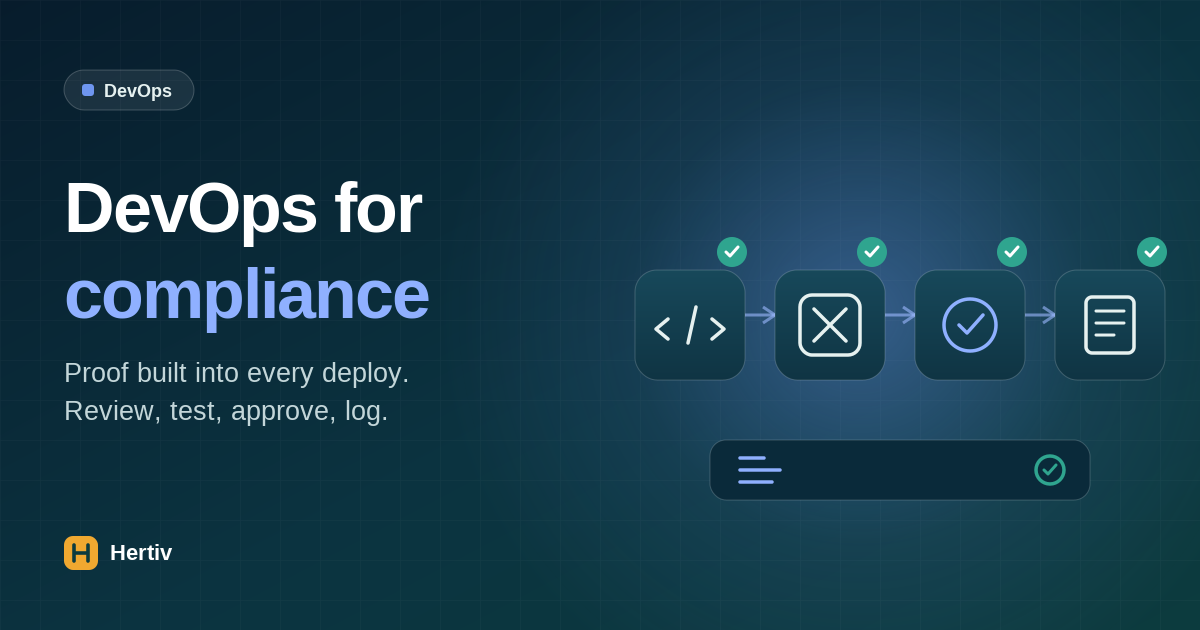
A compliance-minded pipeline adds controls at the stages where risk enters the system. The table below shows the usual controls and what each one proves.
| Stage | Control | What it proves |
|---|---|---|
| Pull request | Peer review and approval | Two people saw the change |
| Commit | Signed commits, branch rules | Who wrote it, and that it was reviewed |
| Build | Automated tests and scans | The change was tested before release |
| Infrastructure | Policy checks on templates | Settings match the approved standard |
| Deploy | Approval for production | A named person approved the release |
| Runtime | Logs and access records | What happened after it shipped |
No single control proves compliance on its own. The strength comes from the chain: a change that is reviewed, tested, approved and logged leaves a trail that an auditor can follow from the requirement to the running system.
How does infrastructure as code help compliance?
Infrastructure as code helps compliance because the system is defined in files that can be reviewed, tested and versioned like any other code. A firewall rule, a database setting or a storage policy is a line in a file, not a setting someone changed by hand in a console.
That matters for two reasons. First, every change goes through the same review and approval as application code, so a risky setting cannot slip in quietly. Second, the current state of the system can be compared against the approved files at any time, which shows drift, the settings that changed after deployment.
Policy checks add a third layer. A check can reject a template that opens a database to the internet or stores data without encryption, before it is applied. The rejection is logged, which is itself evidence that the control works. For the monitoring side, see regulatory compliance monitoring.
How do you prove compliance from delivery?
You prove compliance from delivery by keeping the records the pipeline already creates and making them easy to show. The evidence is the pull request with its approvals, the test report, the deployment log and the access record, all tied to the same change.
A practical sequence looks like this: map each requirement to the pipeline stage that enforces it, so that a rule such as separation of duties maps to the approval step and a rule such as encryption maps to the template check. Then make sure the records are kept, immutable and searchable, so an auditor can pull the history for any date.
Access control is part of the proof too. Production access should be limited, time-bound and logged, and the pipeline should be the only way to deploy. If someone can change production by hand, the pipeline evidence is worthless, because the real change happened outside it.
Example (hypothetical): a payments team prepares for audit
Example (hypothetical): a payments team of 14 people ships about 20 changes a week and faces an annual audit of its change controls. The year before, two engineers spent three weeks collecting screenshots and emails to prove that changes had been reviewed and tested.
The team adds branch rules so no change reaches production without a peer approval, requires a signed commit, and adds automated tests and a security scan to the build. Infrastructure changes go through the same review, and a policy check rejects any template that opens a database to the internet. Deployments to production need an approval from a named release manager, and the pipeline is the only way to deploy.
At audit time, the team exports the pipeline history for the period: 1,040 changes, each with its approval, test report and deployment record. The auditor samples 30 changes and finds a complete trail for all 30, so the three-week evidence hunt becomes a one-day review. The arithmetic is simple; the work was in making the controls part of the flow rather than an extra task.
What are the common mistakes?
The most common mistakes in DevOps for compliance are adding controls that nobody follows, keeping evidence that cannot be found, and letting manual changes bypass the pipeline. Each one breaks the chain that the audit depends on.
- Controls as theatre. An approval step that everyone rubber-stamps proves nothing. Approvals need a real check, such as a test report or a change summary, or they are just a click.
- Evidence nobody can find. Logs spread across five tools with a 30-day retention policy will not survive an audit. Keep the trail in one place with a retention period that matches the requirement.
- Manual changes to production. If an engineer can fix production by hand, the pipeline record is incomplete. Lock production down so the pipeline is the only route.
- One control for every rule. Not every requirement needs a pipeline check. Map the rules that matter and leave the rest to process, or the pipeline becomes unusable.
- No owner for the controls. Checks drift and break like any code. Someone must own them, review failures and fix them, or they quietly stop working.
If you are building a delivery pipeline and want the compliance controls designed in from the start, DevOps services is the place to begin.
Key takeaways
- Compliance evidence should come from the pipeline, not from a folder of screenshots.
- Every change needs review, tests, approval and a log, in that order.
- Infrastructure as code makes settings reviewable and drift visible.
- Production must be deployable only through the pipeline, or the trail is incomplete.
- Start with one requirement and one pipeline stage, then expand.
Frequently asked questions
What does DevOps for compliance mean?
It means building compliance controls into the software delivery pipeline, so that review, testing, approval and logging happen as part of shipping. The pipeline then produces audit evidence continuously instead of the team gathering it at audit time.
Which compliance controls belong in a pipeline?
Peer review and approval, signed commits, automated tests and scans, policy checks on infrastructure templates, approval for production deployment, and logs of what happened after release. Together they form a trail from requirement to running system.
How does infrastructure as code help compliance?
It defines the system in files that can be reviewed, tested and versioned like code. Every change goes through review, the current state can be compared against the approved files, and policy checks can reject risky settings before they are applied.
What is separation of duties in a DevOps pipeline?
It means the person who writes a change cannot approve it or deploy it alone. Branch rules and approval steps enforce this, so that at least two people are involved in any change that reaches production.
How long does it take to add compliance to a pipeline?
A first control, such as branch rules with peer approval, can be added in days. A full set of controls with policy checks, evidence retention and access limits usually takes a few weeks, depending on how many systems the pipeline touches.
Does DevOps for compliance replace the auditor?
No. The auditor still checks the controls and samples the evidence. What changes is where the evidence comes from: the pipeline history instead of documents assembled after the fact, which makes the audit faster and the trail harder to fake.


