Demand Forecasting AI Agents: What They Do and How They Work
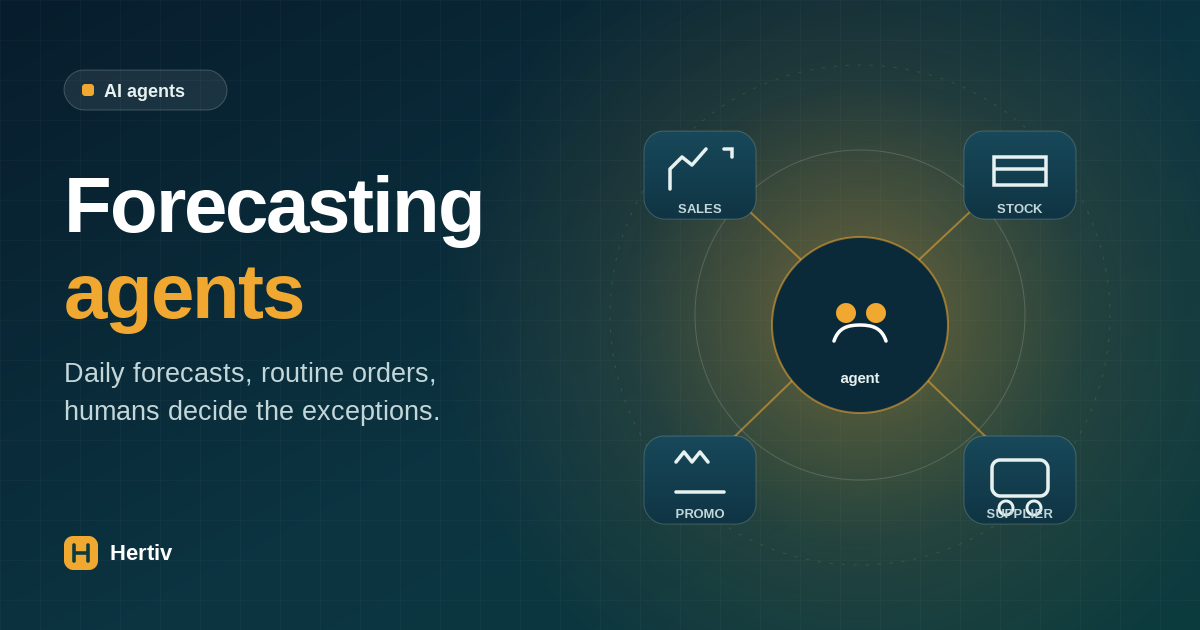
A demand forecasting AI agent watches sales, stock and outside signals, updates its forecast daily and acts on routine cases, leaving exceptions to a human.
On this page
Short answer
A demand forecasting AI agent is software that watches sales, stock and outside signals, updates its forecast without being asked, and takes the routine steps that follow, such as raising a purchase order or flagging a shortage. Unlike a forecasting tool that waits for a person to run it, the agent works on a schedule and acts within rules the team sets.
What is a demand forecasting AI agent?
A demand forecasting AI agent is software that watches sales, stock and outside signals, updates its forecast without being asked, and takes the routine steps that follow from it, such as raising a purchase order or flagging a shortage. Unlike a forecasting tool that waits for a person to run it, the agent works on a schedule and acts within rules the team sets.
The difference matters because demand changes between planning cycles. A promotion, a weather shift or a supplier delay can move sales within days, while a monthly forecast stays fixed. An agent that reforecasts daily and acts on small changes keeps stock closer to real demand than a plan reviewed once a month.
A quick summary of the job:
| What the agent does | How it works |
|---|---|
| Watches signals | Reads sales, orders, promotions and supplier data every day |
| Updates forecasts | Rebuilds the forecast when new data arrives |
| Acts on routine cases | Creates draft orders or alerts within set limits |
| Escalates the rest | Sends unusual cases to a planner with its reasoning |
How does a forecasting agent work?
A forecasting agent works in a loop: it reads fresh data, updates its forecast, compares the forecast with stock on hand, and then either acts or asks a human. The loop runs on a schedule, often daily, and every action is logged so the team can see what the agent did and why.
The agent does not replace the planner. It handles the routine cases, the products with steady demand and enough stock, and leaves the exceptions to people. A planner who used to review hundreds of products a week can then spend time on the twenty that actually need judgement. The pattern is common in logistics, where demand forecasting for logistics covers the same problem from the planning side.
Guardrails keep the agent safe. The team sets limits such as a maximum order size, a list of products the agent may not order, and a rule that any order above a value needs approval. If the data looks wrong, the agent stops and alerts a person instead of ordering on bad numbers.
What signals does the agent watch?
A forecasting agent watches more than past sales. Sales history tells it what happened, but the signals that change the forecast are usually outside the sales file.
- Promotions and price changes. A discount next week should raise the forecast now, not after the stock runs out.
- Season and weather. Summer goods, holiday lines and weather-sensitive products move with the calendar.
- Supplier lead times. A supplier that slips from 5 days to 12 changes when to order.
- Local events and trends. A new store opening nearby or a product going viral can double demand in days.
Not every signal matters for every product. A staple with steady demand needs little more than sales history, while a seasonal line needs the calendar and the weather. Start with the signals you already trust, and add new ones only when the forecast improves on your evaluation set.
Where does the agent act, and where does a human decide?
The agent acts where the decision is routine and the cost of being wrong is low. It places routine replenishment orders, moves stock between stores, and sends alerts when a product is about to run out. A human decides where the stakes are higher: large orders, new products with no history, and anything the agent has never seen before.
A simple rule works well: the agent acts when the forecast is inside its normal range and the order is below a set value, and it asks a human otherwise. The planner sees the agent's reasoning, the forecast, the stock level and the signal that triggered the action, so the review takes minutes instead of hours.
Keep a human in the loop for the first month. Review every action the agent takes, correct the ones that are wrong, and use those corrections to improve the rules. Once the agent's actions match the planner's decisions most of the time, widen the limits gradually.
How do you set up a forecasting agent in 5 steps?
Setting up a forecasting agent is a small project, and it works best when each step is finished before the next begins. For teams already using agents in operations, AI agents for operations covers the wider pattern.
- Pick one product group with clean sales and stock data. A narrow start makes the first month manageable.
- Define the agent's limits. Which products, maximum order value, and when to escalate.
- Connect the data sources. Sales, stock, promotions and supplier lead times.
- Run the agent in watch-only mode for two weeks. Compare its forecasts with what actually sold.
- Switch on actions for routine cases. Review every action for the first month.
Watch-only mode is the step teams most often skip, and the one that saves the most trouble. Two weeks of watching shows whether the forecast is good enough and whether the rules are right, before any order is placed. If the forecast is off, fix the data or the rules, not the agent's limits.
Example: a regional grocery chain
Example (hypothetical): a grocery chain sells a staple product at 700 units a week across its stores. Its old forecast is off by 15% on average, which means about 105 units a week are either missing from shelves or left over. The chain sets up a forecasting agent for this product group.
After a month of watch-only mode, the agent's forecast is off by 8% on average, or about 56 units a week. That is 49 fewer units of error each week. Over 50 trading weeks, the chain avoids about 2,450 units of overstock or stockouts for this one product group, and the planner reviews only the exceptions instead of every product.
The saving comes from daily updates, not from a cleverer model. The agent sees a promotion or a delivery delay the day it happens, while the old monthly forecast did not change until the next cycle. The chain then adds a second product group, using the same limits and the same review routine.
What are the common mistakes?
The most common mistakes with forecasting agents come from trusting the agent too soon, or feeding it data nobody checked.
- Acting on dirty data. A missing delivery or a duplicated sale becomes a wrong order.
- No limits. An agent with no maximum order size can place an order nobody can afford.
- Skipping watch-only mode. The first live order is the first test, and it is usually wrong.
- Ignoring the exceptions. The products the agent escalates are the ones that need a person, not a bigger limit.
- Measuring the wrong thing. Forecast accuracy matters less than stockouts avoided and waste reduced.
If you are comparing tools rather than agents, AI demand forecasting software lists the established products. An agent adds the daily loop and the routine actions on top of the forecast itself.
Key takeaways
- A forecasting agent reforecasts daily and acts on routine cases within set limits
- It handles steady products and escalates exceptions to a planner
- Promotions, season, weather and supplier delays matter more than sales history alone
- Run two weeks in watch-only mode before switching on actions
- Measure stockouts avoided and waste reduced, not forecast accuracy alone
Frequently asked questions
What is the difference between forecasting software and a forecasting agent?
Forecasting software produces a forecast when a person runs it. An agent runs the forecast on a schedule, watches for changes, and takes routine actions such as draft orders within limits the team sets. The agent adds the daily loop and the actions; the software on its own only adds the numbers.
Do I need an agent, or is a better forecast enough?
A better forecast helps, but it does not act. If your planners already review forecasts daily and place orders quickly, a better forecast may be enough. An agent pays off when the review itself is the bottleneck and most decisions are routine.
How much data does a forecasting agent need?
It needs clean sales and stock history, plus the signals that move demand, such as promotions and lead times. A year of weekly sales is a reasonable start for seasonal products; a few months can be enough for steady products. Dirty or missing data is the most common reason agents fail.
What happens when the agent gets it wrong?
The guardrails catch it. Orders above a set value need approval, and the agent stops and alerts a person if the data looks wrong. Every action is logged, so the team can see what happened and fix the rule that allowed it.
Can a forecasting agent handle new products?
Not well on its own, because a new product has no sales history. The usual approach is to forecast new products from similar ones and let a planner set the first orders. Once the product has a few weeks of sales, the agent can take over the routine cases.
How do you measure whether the agent is working?
Track stockouts, waste and planner hours, not forecast accuracy alone. A useful check is to compare the weeks before and after the agent went live on the same product group, and to review the exceptions the agent escalated each week.


