How to Choose a Data Science Vendor: A Selection Guide
Choosing a data science vendor comes down to proof: check past work in your domain, run a paid pilot on your own data, and agree on ownership first.
On this page
Short answer
Choosing a data science vendor means judging proof rather than promises. Check the vendor's past work in your domain, talk to its references, run a small paid pilot on your own data, and agree in writing who owns the code, the model and the documentation before you sign.
What is data science vendor selection?
Data science vendor selection is the process of choosing an outside firm to build, run or advise on data science work for your company, from a first analysis to a production model. The decision covers more than technical skill: it covers how the vendor handles your data, who actually does the work, and what you own at the end.
Vendors come in different shapes, and the right shape depends on the job. A boutique studio may suit a single focused project, while a large consultancy fits a multi-year programme. Some firms sell staff by the month, others sell fixed-scope projects, and a few run your models for you after delivery.
| Vendor type | Best for | Watch out for |
|---|---|---|
| Boutique studio | One focused project | Thin cover if staff leave |
| Large consultancy | Multi-year programmes | Senior staff on sales only |
| Staff augmentation | Filling a skills gap | Knowledge leaves with staff |
| Managed service | Running models in production | Locked-in tooling and pricing |
The common thread is that you are buying judgement as well as code. A vendor that has solved a similar problem in your industry will ask better questions in week one than a generalist team will ask in month three. That is why the selection process should test for domain fit, not just for a low day rate.
What should you check before shortlisting?
Before you shortlist, check four things: domain experience, team stability, data handling and delivery proof. A vendor that has worked in retail demand forecasting will understand your stock data faster than one whose examples are all from banking fraud detection.
Ask for references you can call, not just logos on a slide. A short call with a past client tells you how the vendor behaved when a deadline slipped or a model underperformed, which is when the relationship actually matters. Also ask who will work on your project by name, and what happens if a key person leaves mid-project.
- Domain cases. Similar problems, similar data, similar scale.
- Named team. The people in the pitch are the people on the work.
- References. At least two clients you can call directly.
- Security. Clear rules for data access, storage and deletion.
Check how the vendor handles data. Your data should stay in your own cloud account or a named environment, access should be limited to named people, and the vendor should delete its copies when the work ends. If a vendor cannot describe these controls clearly, remove it from the list. Data engineering support matters here too, since most data science projects fail on data access rather than on modelling.
How do you compare vendors fairly?
Compare vendors on the same brief and the same data sample, or the comparison will mislead you. Give every shortlisted firm the same problem statement, the same sample dataset and the same deadline, then judge the results side by side.
Score each proposal against a fixed list of criteria: understanding of the problem, approach to data quality, team experience, delivery plan, price structure and handover. Weight the criteria before you see the proposals, so a polished sales deck cannot move the goalposts.
Ask each vendor to explain what could go wrong. A firm that names real risks, such as messy source data, a metric that drifts, or a stakeholder who will not adopt the output, is showing you how it thinks. A firm that promises a clean result with no caveats is selling, not advising. The top data science companies in the USA list shows the kind of firms that typically pass this kind of test.
Should you run a pilot first?
Yes, run a small paid pilot before signing a large contract. A pilot of four to eight weeks on a real problem, using your own data, tells you more than any proposal document. It shows how the vendor communicates, how it handles messy data and whether its first model is actually useful.
Agree on the pilot's success measures before it starts. A clear measure might be forecast error below a stated level, a working dashboard your team uses weekly, or a defined number of hours saved per month. Without a written measure, a pilot can drift into a demo that nobody can judge.
Pay for the pilot. Free pilots get junior staff and little attention, and they create an awkward obligation if the work is poor. A paid pilot also tests the commercial relationship: clear invoicing, a named point of contact and honest reporting are part of what you are buying.
What should the contract cover?
The contract should cover ownership, data, exit and price, the four items that cause most disputes. Ownership means you own the code, the trained model and the documentation. If the vendor keeps the model, you are renting your own solution.
Data terms should state where data lives, who can access it and when copies are deleted. Exit terms should state what you receive if the relationship ends: code, model files, training scripts and a handover period. Without an exit clause, switching vendors later can cost more than the original project.
Price structure matters too. Fixed-price contracts suit a well-defined scope, while time-and-materials suits work where the data is still unknown. Either way, agree on how changes are priced before they happen. An AI consulting engagement usually starts with a fixed-scope assessment, which is a good way to test the commercial terms at small scale.
Example (hypothetical): a retailer picks a vendor
Example (hypothetical): a retailer with 40 shops wants a demand forecast and shortlists three vendors. Each vendor is asked to run a six-week pilot on two years of sales data for one product group, with a success measure of forecast error below 12% and a weekly review meeting.
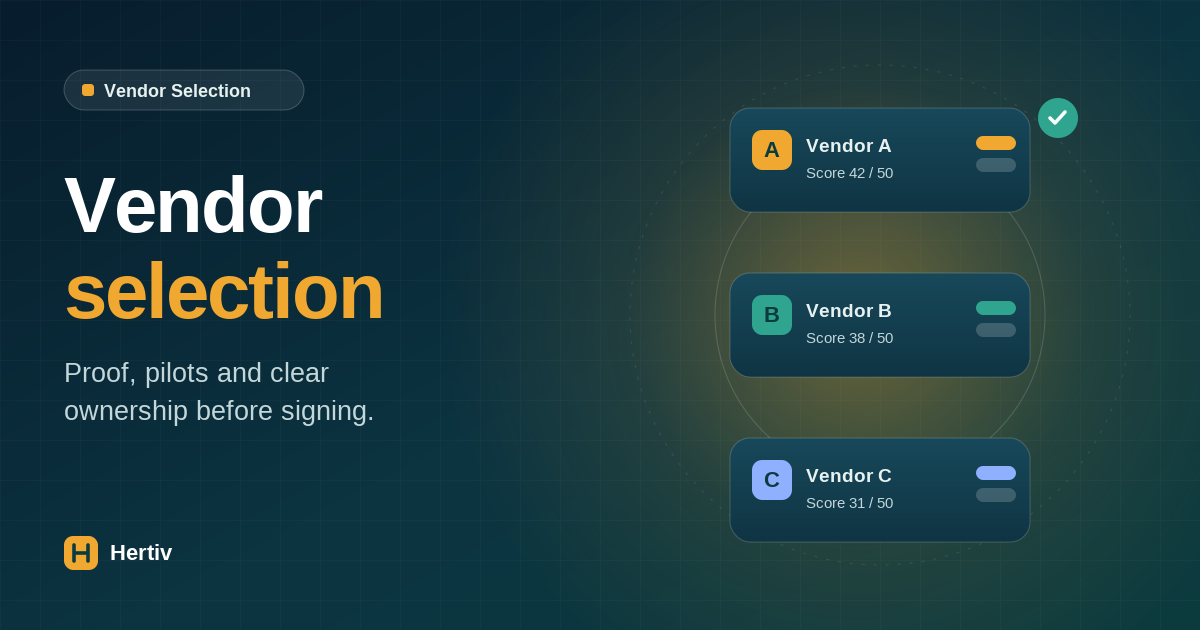
Vendor A quotes $18,000 for the pilot, Vendor B $24,000 and Vendor C $15,000. The retailer scores each pilot on the same five criteria, each out of 10. Vendor A scores 42, Vendor B 38 and Vendor C 31. Vendor A costs $3,000 more than Vendor C, but its forecast error is 9% against Vendor C's 15%, and its team answers questions within a day.
The retailer picks Vendor A and signs a fixed-price contract for the full rollout at $60,000, with a clause that the vendor hands over all code and model files. The arithmetic is simple: the pilot cost $18,000 and the rollout $60,000, so the total is $78,000. The forecast saves the retailer an estimated 10 hours of planner time a week, which is the return the contract is judged against.
What are the common mistakes?
The most common mistakes in vendor selection are choosing on price alone, skipping the pilot, and signing a contract that leaves ownership unclear. Each of these is easy to avoid if the selection process is written down before vendors are contacted.
- Choosing on price alone. The cheapest bid often means the least experienced team.
- Skipping the pilot. A proposal cannot show how a vendor handles your data.
- Vague scope. Without a written scope, every change becomes a dispute.
- No exit clause. Leaving later should not mean losing your own model.
- No named team. The pitch team and the delivery team are often different people.
- Ignoring data handling. Weak data controls become your problem, not the vendor's.
Another common mistake is letting the vendor define the problem. A good vendor will challenge your brief, but the business question must come from your team. If the vendor redefines the problem to fit its favourite tool, the result will answer a question nobody asked.
Keep the success measure in your hands, and check progress against it at every review. If you are unsure where your own data stands before you start, starting a data science project covers the groundwork that makes vendor selection easier.
Key takeaways
- Judge proof, not promises: past work in your domain matters most
- Run a small paid pilot on your own data before a large contract
- Score every vendor on the same brief and the same data sample
- Own the code, the model and the documentation in the contract
- Keep the success measure in your hands and review it at every step
Frequently asked questions
What is a data science vendor?
A data science vendor is an outside firm that builds, runs or advises on data science work, from a first analysis to a model in production. Vendors range from small studios to large consultancies, and from staff providers to firms that run your models for you after delivery.
How much does a data science vendor cost?
Pricing depends on scope, seniority and region, so ask for a written quote against a fixed brief rather than a day rate in isolation. A small paid pilot is the cheapest way to learn the real cost, since it shows how much rework your data actually needs.
Should I hire a vendor or build an in-house team?
A vendor suits a first project, a tight deadline or a skill your team lacks. An in-house team suits work that repeats every month and needs deep knowledge of your own data. Many companies start with a vendor, then hire in-house once the work is proven.
How long does vendor selection take?
A focused selection usually takes four to eight weeks: two weeks to write the brief and shortlist, two to four weeks for a pilot, and one week to agree terms. Rushing the brief is the usual cause of delay later, because vendors quote against different assumptions.
What should a data science vendor deliver at handover?
At handover you should receive the code, the trained model, the training scripts, documentation and a walkthrough for your team. If any of these are missing, the vendor has kept part of your solution, and switching providers later will cost more than it should.
What is the biggest risk when working with a vendor?
The biggest risk is a model nobody uses, usually because the business question was never agreed or the output does not fit the team's workflow. A paid pilot with a written success measure is the best protection, since it tests adoption before the budget grows.


