What Does a Cybersecurity Breach Cost in Australia?
A breach in Australia costs more than the fix: downtime, notification, legal help and lost trust add up. Here is what drives the bill, and how to keep it smaller.
On this page
Short answer
A cybersecurity breach in Australia typically costs a business across several areas at once: investigation, repair, downtime, customer notification, legal advice and lost business. The total depends on how many records were exposed, how long systems were down, and whether personal information was involved, which can trigger notification duties under Australian privacy law.
What does a cybersecurity breach cost in Australia?
A cybersecurity breach in Australia is an incident in which an attacker accesses, copies or disrupts a business's systems or data, and its cost is the total of everything the business spends and loses because of it. That includes direct spending on investigation and repair, and indirect losses such as downtime and customers who leave.
There is no single figure that fits every business. A small firm with a short outage and no customer data exposed may spend mainly on cleanup. A larger firm that loses customer records faces notification, legal and reputation costs that can run for months after the systems are back.
Australian privacy law adds a layer that does not exist everywhere. When a breach is likely to cause serious harm, the business may have to notify affected people and the privacy regulator, and that notification work itself costs time and money.
What makes up the cost of a breach?
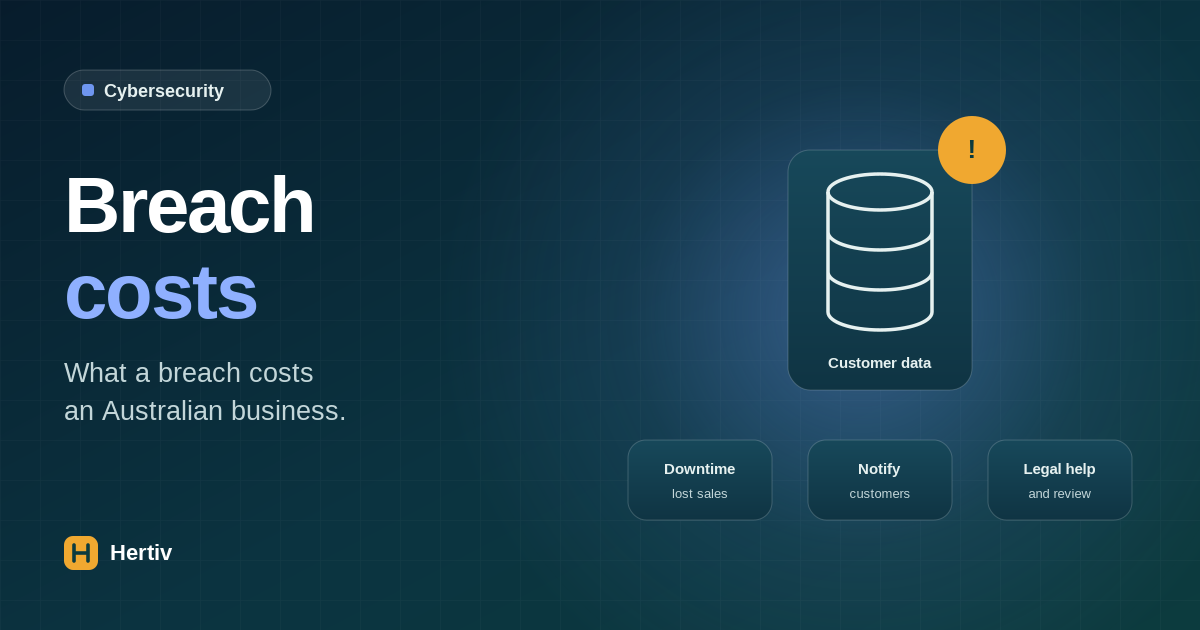
The cost of a breach is made up of several separate bills that arrive at different times, which is why the total often surprises the people paying it.
| Cost area | What it covers | When it hits |
|---|---|---|
| Detection and forensics | Finding how the attacker got in and what they touched | First days |
| Containment and repair | Closing the hole, rebuilding systems, resetting access | First weeks |
| Downtime | Lost sales and stalled work while systems are offline | During the incident |
| Notification | Telling affected customers, staff and regulators | Days to weeks after discovery |
| Legal and regulatory | Advice, regulator engagement and possible penalties | Weeks to months |
| Customer loss | Customers who leave or spend less after the breach | Months after |
The first bills are the most visible: forensic experts, system rebuilds and overtime for staff. The later bills are quieter but often larger: customers who cancel, partners who ask harder questions, and higher insurance premiums at renewal.
Downtime is usually the biggest single cost for a small business. If the booking system, store or payment flow is offline for days, every hour is lost revenue that cannot be recovered later.
Why do Australian breaches cost what they do?
Australian breaches cost what they do because of three local factors: notification duties, regulator attention, and a small market where word travels fast.
Under the Notifiable Data Breaches scheme, a business covered by the Privacy Act must notify affected individuals and the Office of the Australian Information Commissioner when a breach is likely to cause serious harm. Preparing those notices, answering questions and handling complaints takes staff time and legal review.
Regulators and customers also expect a clear account of what happened and what has changed. A business that cannot explain the cause or the fix faces harder questions from partners and, in serious cases, enforcement action. For a list of firms that can help with the response, see the top cybersecurity companies in Australia.
Which costs hit first, and which last longest?
Detection, containment and repair hit first, usually in the first days, while customer loss and higher insurance costs last longest, often for a year or more.
In the first week the money goes to stopping the attack, finding the entry point and getting systems back. These are urgent, non-negotiable costs, and they are usually paid before anyone knows the full extent of the damage.
Notification and legal costs follow over the next weeks. Customer loss is slower: some customers leave at once, others drift away when their contract ends. Insurance renewal is where the breach can cost a second time, because a business with a recent incident often pays more for cover, or finds some cover harder to obtain.
How can a business estimate its own breach cost?
A business can estimate its own breach cost by pricing the four things it would have to pay for: investigation, downtime, notification and lost customers.
- Price the downtime. Work out revenue per hour for each system, and how many hours it could be offline.
- Price the investigation. Get a rough rate for forensic help and multiply by the days it might take.
- Count the records. How many customer records hold personal information, and what would notifying them cost per person?
- Price the rebuild. List the systems that would need rebuilding, reconfiguration or new credentials.
- Add a buffer for lost business. Assume some customers leave, and put a number on it rather than hoping none do.
The point of the exercise is not a precise total. It is to find which cost dominates, so the business can spend its security budget on the risk that would hurt most. Small firms often find downtime dominates, which points to backups and fast recovery rather than more monitoring tools.
Example (hypothetical): a Melbourne retailer with 40 staff
Example (hypothetical): a Melbourne retailer with 40 staff and an online store discovers that an attacker copied its customer database, including 2,000 customer records with names, emails and addresses.
The costs add up like this. Notifying 2,000 customers at $15 each for letters, calls and support time comes to $30,000. A forensic review takes 120 hours at $180 an hour, which is $21,600. The store is offline for 3 days at $8,000 a day in lost sales, which is $24,000.
Added together, $30,000 plus $21,600 plus $24,000 gives a first-month total of $75,600, before legal advice or any customers leaving. The retailer had backups, which is why the store was back in 3 days instead of two weeks, and that single fact kept the downtime bill far lower than it could have been.
What are the common mistakes?
The most common mistakes after a breach are delaying notification, underestimating downtime, and treating the fix as a one-off project.
- Waiting too long to tell people. Delay makes the notification harder and damages trust more than the breach itself.
- No tested backups. Backups that have never been restored are not backups; test them before you need them.
- Fixing the symptom, not the cause. Resetting passwords without closing the entry point invites a repeat.
- Forgetting service accounts. Automated accounts and old API keys often have wide access and are rarely reviewed.
- No incident plan. Without a written plan, the first hours are spent arguing about who decides what.
Startups that are building their security from scratch can compare options in the cybersecurity companies for startups list.
A cybersecurity services review is the usual first step before buying tools.
Key takeaways
- A breach bill has several parts: investigation, repair, downtime, notification, legal help and lost customers
- Downtime is usually the biggest cost for a small business, so tested backups matter more than extra monitoring tools
- Australian privacy law can require notifying affected people and the regulator when serious harm is likely
- Customer loss and higher insurance costs can last a year or more after the systems are back
- Estimate your own cost by pricing downtime, investigation, notification and lost business separately
Frequently asked questions
Do Australian businesses have to report a data breach?
Businesses covered by the Privacy Act must notify affected individuals and the Office of the Australian Information Commissioner when a data breach is likely to cause serious harm. Smaller businesses may not be covered by the Act, but contracts and customer expectations often require notification anyway.
What is the most expensive part of a breach?
It depends on the business. For firms that sell online, downtime is usually the largest cost because every hour offline is lost revenue. For firms holding sensitive customer records, notification, legal advice and customer loss often cost more than the technical repair.
Does cyber insurance cover the full cost of a breach?
No. Policies usually cover some investigation and legal costs, but they rarely cover all lost revenue, and they do not restore lost customers. Cover also depends on the business having met the policy conditions, such as multi-factor authentication, so read the policy before an incident.
How long does it take to recover from a breach?
Technical recovery can take days to weeks depending on backups and the extent of the damage. The full recovery, including notification, legal work and rebuilding customer trust, often takes months. Planning for that longer tail matters more than the first week.
What should a business do in the first hour of a breach?
Contain the damage first: isolate affected systems, preserve evidence, and change credentials that may be compromised. Then call the people in the incident plan, including legal and technical help. Avoid wiping systems before a forensic review, because the evidence is needed to find the cause.
Can a small business afford breach preparation?
Yes, and the cheapest preparation is usually the most useful: tested backups, multi-factor authentication, patched systems and a one-page incident plan with names and phone numbers. These cost far less than a single week of downtime.


