How Much Does Custom Software Development Cost?
Custom software development costs depend on scope, team, location and how the work is priced. This guide shows how a quote is built, phase by phase.
On this page
Short answer
Custom software development costs are the price of designing, building, testing and launching software made for one business, rather than bought off the shelf. The total depends on the scope of the features, the size and seniority of the team, where the team is based, and whether the work is priced as a fixed quote or by time and materials.
What is custom software development cost?
Custom software development cost is the price of building software for one business, shaped to its own processes, rather than buying a ready-made product. A custom build includes discovery, design, coding, testing and launch, and then the ongoing cost of keeping it running. The price is set by the work involved, not by a licence fee.
The reason to build custom software is that no ready-made product fits: the workflow is unusual, the data must stay in your own systems, or the software itself is the product. That fit is also why the price varies so much. A simple internal tool with a few screens costs far less than a customer-facing platform with payments, user accounts and integrations.
Think of the cost in two parts: the build, which is paid once, and the running cost, which is paid every year. A build that costs 100,000 dollars will usually need 15,000 to 20,000 dollars a year to keep running, fixing bugs and updating it as systems change. Software development cost factors cover the forces that move the price up or down.
What does a custom software quote include?
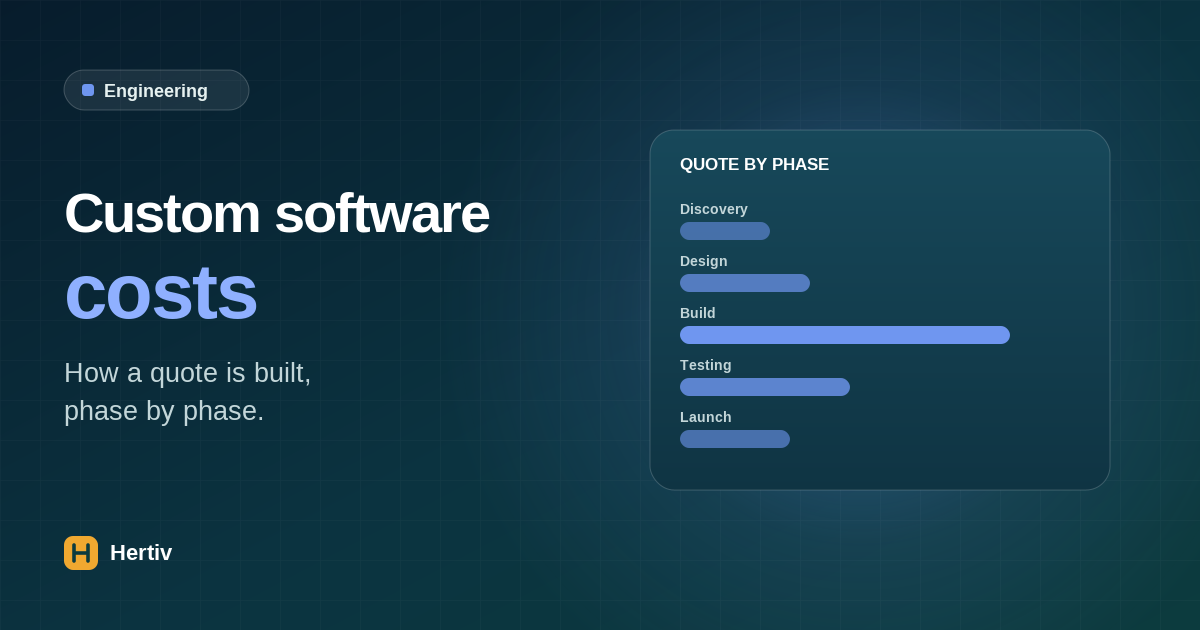
A proper quote lists the work by phase, so you can see what you are paying for. Discovery is the first phase: workshops, a written specification and a plan. Design covers the screens and the user journey. The build is the coding itself, usually the largest part. Testing checks the software against the specification, and launch covers deployment, training and the first weeks of support.
| Phase | What happens | Share of the build |
|---|---|---|
| Discovery | Workshops, specification, plan | Small |
| Design | Screens, user journey, prototypes | Small to medium |
| Build | Coding, integrations, data setup | Largest |
| Testing | Checking against the specification | Medium |
| Launch | Deployment, training, early support | Small |
Ask for the quote to show the hours and the rate for each phase, not just a single total. A single total hides where the money goes, and you cannot compare two quotes that hide their workings. A quote that shows hours and rates also makes it easy to see what happens if the scope changes: more features mean more hours at the same rate.
How is custom software priced: fixed quote or time and materials?
Custom software is usually priced in one of two ways. A fixed quote sets one price for a written specification: the team agrees to build what is written for that price. Time and materials means you pay for the hours worked at an agreed rate, and the total depends on how long the work takes. Each suits a different kind of project.
A fixed quote suits a project with a clear, stable specification, such as a small internal tool where the features are known in advance. It gives budget certainty, but any change to the specification needs a new quote, and the team will price the risk of the unknown into the total. A fixed quote for a vague specification is usually a bad sign: it means the team has guessed.
Time and materials suits a project where the scope will change as the team learns, such as a new product where the features are still being tested with users. It gives flexibility, but the total is open-ended, so it needs a clear process for tracking hours and a regular review of what has been spent. Many teams use a mix: a fixed price for discovery, then time and materials for the build.
How do team size and location change the price?
Team size is the main driver of cost, because software is priced in hours. A small team of two or three people costs less per week than a large team, but it also takes longer, so the total may be similar. The right team size depends on the deadline: a team that is too small will miss it, and a team that is too large will spend its time coordinating instead of building.
Seniority matters too. A senior developer costs more per hour but often finishes a task faster and with fewer errors than a junior developer, so the total cost can be lower. A team that is all juniors may look cheap per hour and expensive in total, because the work takes longer and needs more fixing.
Location changes the hourly rate, because rates reflect local salaries. A team in a high-cost city will charge more per hour than a team elsewhere, but the total depends on the hours as well as the rate. When comparing quotes from different places, compare the total hours and the rate together, not the rate alone. Custom software development companies show how teams are usually structured.
What does it cost after launch?
After launch, custom software needs maintenance: fixing bugs, updating libraries and services it depends on, and changing features as the business changes. A common planning figure is 15 to 20 percent of the build cost per year, though a simple tool with few users may need less and a busy platform with many integrations may need more.
Hosting is a separate cost, and it depends on usage: a tool used by twenty people costs little to host, while a platform with thousands of users needs more capacity and monitoring. The team should quote hosting separately from maintenance, so you can see which one is growing if the bill rises.
Plan for change as well as upkeep. A business that is growing will want new features, and each one is a small project of its own. Budgeting a fixed amount each quarter for small improvements keeps the software useful, instead of letting it fall behind until a large rebuild is needed. Building an MVP is one way to keep the first build small and learn what users need before spending more.
Example (hypothetical): pricing a small internal tool
Example (hypothetical): a company wants a custom tool for tracking equipment across three sites. Discovery takes 80 hours at 120 dollars an hour, or 9,600 dollars. The build takes 600 hours at 120 dollars an hour, or 72,000 dollars. Testing takes 120 hours at 100 dollars an hour, or 12,000 dollars. Total build cost is 9,600 + 72,000 + 12,000 = 93,600 dollars.
Maintenance at 15 percent of the build cost is 93,600 x 0.15 = 14,040 dollars a year. Hosting is 200 dollars a month, or 2,400 dollars a year. First-year total is 93,600 + 14,040 + 2,400 = 110,040 dollars.
The company compares this with the off-the-shelf tools it tried, which cost 30,000 dollars a year in licences but did not fit its workflow. The custom tool costs more in year one, but the team expects it to pay for itself in three years by cutting the manual work the off-the-shelf tools left behind.
Common mistakes
The most common mistake is starting the build without a written specification. A project that begins with a vague idea will change direction many times, and each change costs hours. Write the specification first, even for a small tool, and agree what is in scope and what is not.
Another mistake is choosing the cheapest quote without checking the hours. A low total can hide a team that has underestimated the work, and the project will either run over budget or be delivered incomplete. Compare the hours and the rate, not just the total, and ask what happens when the scope changes.
A third mistake is forgetting the running cost. A build that costs 100,000 dollars needs 15,000 to 20,000 dollars a year to maintain, and a team that budgets only for the build will be surprised in year two. Budget for maintenance and hosting from the start, and review both each year.
Key takeaways
- Custom software cost is the build plus the yearly cost of keeping it running.
- A quote should show hours and rates by phase, not just a single total.
- Fixed quotes suit a clear specification; time and materials suits changing scope.
- Seniority and team size matter as much as the hourly rate.
- Budget 15 to 20 percent of the build cost a year for maintenance.
Frequently asked questions
How much does custom software development cost?
It depends on scope, team and location, but a small internal tool often costs tens of thousands of dollars to build, while a customer-facing platform can cost several times more. Ask for a quote that shows hours and rates by phase, not just a single total.
What is the difference between fixed price and time and materials?
A fixed price sets one price for a written specification, which suits a clear, stable project. Time and materials means paying for the hours worked at an agreed rate, which suits a project where the scope will change as the team learns.
How much does custom software cost to maintain?
A common planning figure is 15 to 20 percent of the build cost per year, covering bug fixes, updates and small changes. Hosting is usually separate and depends on how many people use the software.
Is custom software cheaper than off-the-shelf software?
Rarely in year one, because a custom build is paid up front while off-the-shelf software is a licence fee. Custom software can pay for itself over a few years when the off-the-shelf tools do not fit the workflow and leave manual work behind.
How do I compare quotes from different companies?
Compare the hours and the rate for each phase, not just the total, and ask what happens when the scope changes. A low total can hide a team that has underestimated the work.
Should I start with an MVP?
Often yes. A minimum viable product keeps the first build small, lets real users try it, and shows what to build next before more money is spent. It is a good way to control the cost of a new product.


