How Much Does a Travel App Like Visit Dubai Cost?
A travel app like Visit Dubai needs attraction listings, bookings, itineraries and offline maps. A first version usually costs $70,000 to $200,000.
On this page
Short answer
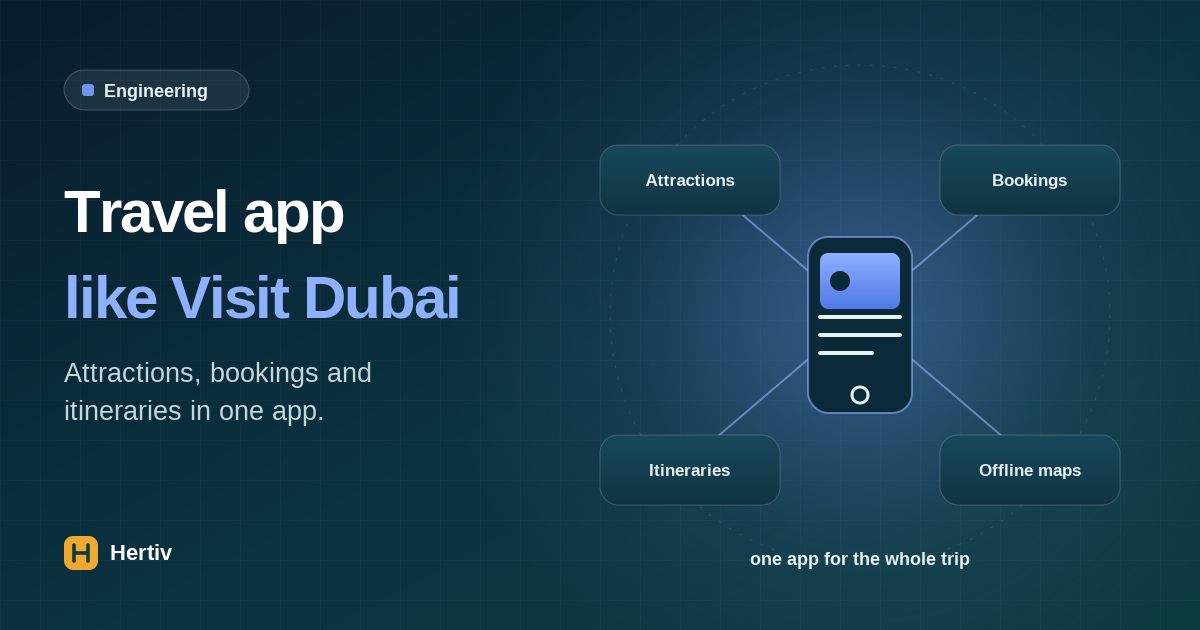
Visit Dubai is the official tourism app of Dubai's Department of Economy and Tourism, with attraction guides, ticket booking, itineraries and offline maps. Building a similar travel app usually costs $70,000 to $200,000 for a first version, and $200,000 to $500,000 for a full app with bookings, live deals and personalised recommendations.
What is a travel app like Visit Dubai?
A travel app like Visit Dubai is a city guide that helps visitors plan, book and explore a destination in one place. Visit Dubai is the official tourism app of Dubai's Department of Economy and Tourism, and it covers attractions such as the Dubai Mall and Global Village, ticket booking for events and tours, hotel deals, custom itineraries and AI-powered recommendations.
The app works as a trip companion, not just a list of places. A visitor can browse attractions, save the ones they like, build a day-by-day itinerary, book tickets, and navigate the city with offline access and transit tips. That combination is what makes it useful during the trip, not only before it.
For a team building a similar app for another city or region, the model is the same: a content layer of places and events, a booking layer for tickets and hotels, a planning layer for itineraries, and a maps layer for getting around. Each layer can be built in stages, and the first version usually covers the content and planning layers before bookings.
The audience matters too. Visit Dubai serves tourists, families and digital nomads, so the app needs simple navigation, clear prices and content in more than one language. An app built for one city should be designed the same way: for a visitor who has never been there before.
What does the first version cost?
A first version of a travel app like Visit Dubai usually costs $70,000 to $200,000, depending on how much content and booking it includes. The range is wide because the content work and the booking integrations are the two biggest cost drivers.
| Version | What it includes | Indicative cost |
|---|---|---|
| First version | Attraction listings, search, saved places, simple itineraries, offline maps | $70,000 - $200,000 |
| Full app | Ticket and hotel booking, live deals, AI recommendations, events calendar | $200,000 - $500,000 |
| City platform | Multiple cities, partner dashboards, offers engine, analytics, loyalty | $400,000 - $900,000 |
| Running costs | Hosting, maps, booking fees, content updates, support | $4,000 - $12,000 per month |
Content is the hidden cost. Each attraction needs photos, opening hours, ticket prices, a description and a map pin, and that content must be updated when prices or hours change. A city with 200 attractions needs a content process, not just a database.
Booking integrations are the other large cost. Each ticket or hotel provider has its own API, its own commission rules and its own failure modes. Teams usually start with one or two providers and add more after launch, rather than integrating five at once. A partner for mobile app development can help sequence the build so the first version ships while bookings are still being negotiated.
What drives the cost up or down?
Five factors move the cost of a travel app more than any others. Knowing them before you ask for a quote keeps the estimate honest.
- Content volume. An app with 50 attractions costs far less to fill and maintain than one with 500. Content writing, photos and updates are real work.
- Booking depth. Showing ticket prices is cheap; taking payment, issuing tickets and handling refunds is not. Each booking provider adds integration and testing time.
- Maps and offline mode. Offline maps need a mapping SDK, downloaded map packs and a sync process. Live-only maps are simpler and cheaper.
- Personalisation. AI recommendations need user data, a recommendation model and a feedback loop. A simple "popular near you" list is much cheaper.
- Languages. Each extra language multiplies the content work and the testing. One language first, more after launch.
The cheapest way to cut cost is to cut scope, not quality. A first version with 100 well-described attractions and a working itinerary planner beats a first version with 500 thin listings and a broken booking flow. Travellers notice content quality before they notice feature count.
What features belong in the first version?
The first version should cover the trip itself: finding places, planning days, and getting there. Bookings and recommendations can wait until the core works well.
| Feature | First version | Later |
|---|---|---|
| Attraction listings | Yes, with photos, hours and prices | Reviews and user photos |
| Search and filters | Yes, by area, type and price | Personalised ranking |
| Itinerary planner | Yes, day-by-day with map pins | AI recommendations |
| Offline maps | Yes, for the main city area | Full offline city packs |
| Ticket booking | Links to providers | In-app payment and tickets |
| Events calendar | Basic list | Live deals and alerts |
Offline maps deserve a place in the first version. Visitors often have no data plan when they arrive, and an app that only works online is useless at the airport. Even a simple offline map of the main areas changes how the app is used.
The itinerary planner is the feature that keeps people in the app. A list of attractions is easy to copy, but a planner that groups places by area and day, shows travel time between them, and saves the plan is the reason a traveller opens the app each morning.
Should you build, buy or white-label?
There are three ways to get a travel app, and the right one depends on how much of the product is unique to your city or brand.
| Route | Best when | Trade-off |
|---|---|---|
| Custom build | Your content and brand are the product | Highest cost, longest build |
| White-label platform | You need a guide app fast | Less control over design and features |
| Buy and adapt | An existing travel app fits your needs | Licensing and adaptation work |
A custom build suits a tourism board or a large operator whose brand and content are the reason people download the app. The design, the content model and the booking flow are all yours to shape.
A white-label platform suits a smaller city or a hotel group that needs a guide app quickly and does not need a unique design. You trade control for speed and a lower upfront cost, but check the monthly fee and what happens to your content if you leave.
Buying an existing app is the least common route, and it only works when the app's content and structure already fit your destination. In most cases the adaptation work costs almost as much as a fresh build. For a custom build, a partner for custom software development can help with the content model and the booking integrations together.
Example (hypothetical): a first version for one city
Example (hypothetical): a tourism board wants a first version for a city with 120 attractions, aimed at visitors who stay three days. The team scopes a first version with attraction listings, search, a day-by-day itinerary planner and offline maps, and leaves bookings as links to providers.
The build costs $110,000: $30,000 for design, $45,000 for the app, $20,000 for the backend and content tools, and $15,000 for testing and launch. The numbers add up: 30,000 + 45,000 + 20,000 + 15,000 = 110,000. Running it costs $4,000 a month, which is $48,000 a year, so the first year totals $110,000 + $48,000 = $158,000.
Content is a separate line. Writing and photographing 120 attractions takes a small team about eight weeks, and the board budgets for that as content work, not as app work. The content is loaded through an admin tool, so the board can update prices and hours without a developer.
At launch the app has 120 attractions, an itinerary planner and offline maps for the city centre. Bookings come in the second release, once the team has one provider integrated and tested. The first version ships in 14 weeks because the scope stayed small.
What are the common mistakes?
The most common travel app mistakes are launching with thin content, adding bookings too early, and building for the tourism board instead of the traveller.
- Thin content. Listings with one photo and no opening hours do not help a visitor. Fewer, better listings beat many empty ones.
- Bookings before the core works. If the itinerary planner is weak, nobody reaches the booking step. Build the trip first, sell the tickets second.
- No offline mode. Visitors without a data plan cannot use an online-only app. Offline maps belong in the first version.
- Stale prices and hours. Out-of-date prices destroy trust fast. Budget for content updates from day one.
- Too many languages at launch. Each language multiplies content and testing work. Launch in one or two, then add more.
Teams that compare similar builds often look at how much an app like Airbnb costs, but a travel guide app is a different product: the content and the itinerary planner matter more than the booking engine at first.
Key takeaways
- Visit Dubai is the official tourism app of Dubai's Department of Economy and Tourism
- A first version usually costs $70,000 to $200,000; a full app with bookings costs $200,000 to $500,000
- Content and booking integrations are the two biggest cost drivers
- The itinerary planner and offline maps are what travellers use every day
- Launch with strong content in one or two languages, then add bookings and languages later
Frequently asked questions
Is Visit Dubai free to use?
Yes, the Visit Dubai app is free to download with no in-app purchases. It is published by Dubai's Department of Economy and Tourism. A similar app built for another city would usually be free too, with income coming from booking commissions, featured listings or advertising rather than from the download.
What features does Visit Dubai have?
Visit Dubai offers attraction guides for places such as the Dubai Mall and Global Village, ticket booking for events and tours, hotel deals, custom itineraries, AI-powered recommendations, real-time deal updates and offline navigation with transit tips. The app covers planning, booking and getting around in one place.
How long does it take to build a travel app like Visit Dubai?
A first version with attraction listings, search, an itinerary planner and offline maps usually takes 12 to 16 weeks. A full app with in-app booking, live deals and AI recommendations takes longer, often 6 to 9 months, because each booking provider needs its own integration and testing.
Do I need offline maps in a travel app?
Yes, for a travel app they are close to essential. Visitors often arrive without a local data plan, and an app that only works online is useless at the airport or on the metro. Even a simple offline map of the main areas, with saved places and itineraries, changes how the app is used.
How do travel apps make money?
Most travel apps earn through booking commissions, featured listings for attractions and hotels, and advertising. Some add premium features such as offline city packs or guided audio tours. The app itself is usually free, because a free app reaches far more travellers than a paid one.
What content does a travel app need per attraction?
Each attraction needs photos, a short description, opening hours, ticket prices, a map pin and practical notes such as how long to allow and how to get there. That content must be updated when prices or hours change, so the app needs an admin tool and a content owner from day one.


