How Much Does a Retail App Like Walmart Cost?
A retail app like Walmart costs roughly $80,000 to $200,000 for a first version, and a full marketplace with pickup and delivery costs far more.
On this page
Short answer
A retail app like Walmart is a shopping app for a large store chain, with a product catalogue, search, a shopping list, payment, and pickup or delivery options. Walmart itself is a US retailer founded in 1962 in Rogers, Arkansas, and its app lets shoppers browse groceries and general goods, order for pickup, and arrange delivery. A similar app costs roughly $80,000 to $200,000 for a first version.
What is a retail app like Walmart?
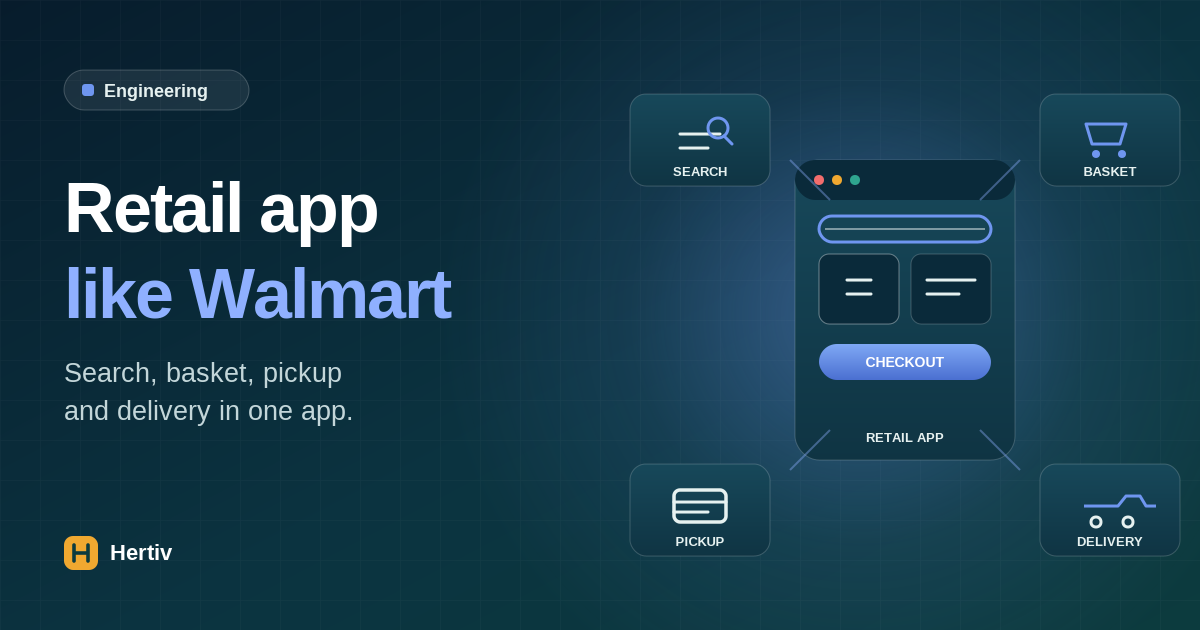
A retail app like Walmart is a mobile app that lets shoppers buy from a large store chain without walking the aisles. Shoppers search the catalogue, add items to a basket, pay in the app, and then pick the order up at the store or have it delivered to their home.
Walmart, founded in 1962 in Rogers, Arkansas, runs one of the best-known examples: its app covers groceries, household goods, electronics and more, with store pickup and same-day delivery in many areas.
The app is the shop front, but it only works when the store behind it is ready. Stock levels must be accurate, prices must match the shelf, and someone must pick and pack each order on time. An app that shows an item as available when the shelf is empty creates more complaints than an app that never existed.
Most retail apps share the same core: a catalogue, search and filters, a basket, payment, order tracking, and a way to handle returns. The parts that cost the most are the ones that touch the store itself, such as live stock, pickup slots, delivery routes and payments. The design can be simple, but the stock and fulfilment work cannot be skipped.
What does a retail app like Walmart cost?
The cost of a retail app like Walmart depends on how much of the store it has to cover. The figures below are indicative ranges for a single chain, not quotes from any vendor, and they assume the app is built from scratch by a hired team.
| Version | Indicative range | What it includes |
|---|---|---|
| First version | $80,000 - $200,000 | Catalogue, search, basket, payment, store pickup |
| Full store app | $200,000 - $500,000 | Delivery, loyalty, offers, barcode scanning, in-store mode |
| Marketplace version | $400,000 - $900,000 | Third-party sellers, seller tools, ads, advanced search |
| Running costs | $4,000 - $12,000 a month | Hosting, payment fees, support, fixes, updates |
A first version for one city or a small group of stores sits at the low end. A version that covers hundreds of stores, with delivery, a loyalty scheme and a marketplace for other sellers, sits at the high end. The biggest cost driver is usually live stock: keeping the app in step with what is actually on the shelves takes real work in every store.
Running costs are easy to forget. Payment providers take a fee on every order, servers and support staff cost money every month, and the app needs updates whenever phone systems change. Budget for at least $4,000 a month from launch, and compare that with what a retail or ecommerce app build costs in general before you commit.
What drives the cost up or down?
Four things move the price most: catalogue size, fulfilment, payments and the number of stores. A catalogue of 5,000 products is far cheaper to build than one of 500,000, because every product needs a photo, a description, a price and a stock record. A chain that sells groceries also needs weight-based pricing and substitution rules, which a clothing chain does not.
Fulfilment is the second driver. Simple store pickup is the cheapest option: the shopper collects the order from a counter. Delivery costs more, because it needs driver apps, route planning and live tracking. Same-day delivery costs the most of all, because it needs stock checks in real time and a fleet that can respond within the hour.
Payments add cost through fees and through the work of handling refunds, failed cards and fraud checks. A chain that already takes cards in store can reuse much of that setup. A chain that also wants a membership scheme, gift cards or buy-now-pay-later needs extra work for each one, and each one needs testing before it goes live.
What should the first version include?
A first version should cover the shopping trip a customer actually makes, and nothing else. For most chains that means browsing the catalogue, searching, a basket, payment, and pickup from one store. Delivery can wait until pickup works well, because pickup proves the stock, picking and payment all work together.
The features that shoppers notice first are search that finds the right product, clear prices, and honest stock. A shopper who cannot find a product will leave, and a shopper who orders a product that is out of stock will not come back. Spend the budget on search, stock accuracy and a short checkout before adding extras.
Extras worth adding later include a shopping list, barcode scanning in the store, loyalty points, and personalised offers. Each of these is useful, but none of them matters if the basic order does not arrive correctly. Launch with the basics, measure how many orders fail, and fix those failures before adding new features.
Build, buy or white-label?
There are three ways to get a retail app: build it from scratch, buy a ready-made retail platform and shape it to fit, or use a white-label app with your own branding. Each one suits a different kind of chain, and the cheapest starting price is not always the cheapest over three years.
| Option | Indicative cost | Best for |
|---|---|---|
| Build from scratch | $80,000 - $500,000 | A chain with unusual stock or fulfilment needs |
| Ready-made platform | $40,000 - $150,000 setup | A chain that can accept standard features |
| White-label app | $25,000 - $70,000 | A small chain that wants to launch fast |
A ready-made platform is often the sensible middle path. It already handles the catalogue, basket and payment, and the chain only pays to connect it to its own stock and stores. The trade-off is that the chain must accept the platform's way of doing things, and changing that later can be slow or costly.
A white-label app is the fastest way to launch, but it offers the least control. If the chain later wants a feature the white-label app does not have, the only options are to wait for the vendor or to rebuild. Chains that expect to grow usually outgrow a white-label app within a few years, so treat it as a starting point, not a final answer.
Example (hypothetical): a 12-store chain launches an app
Example (hypothetical): a regional grocery chain with 12 stores wants a first-version app with catalogue, search, basket, payment and store pickup, plus a simple loyalty card. The team prices the build at $28,000 for the catalogue and search, $24,000 for the basket and payment, $18,000 for pickup slots and order management, $16,000 for the store stock connection, $12,000 for design, and $12,000 for testing and launch. The build total is $110,000.
Running the app costs $5,000 a month, which is $60,000 a year, so the first year costs $170,000 in total. In the first year the app takes 60,000 orders, so the first-year cost per order is $170,000 divided by 60,000, which is about $2.83. If the average order is $60, the app costs about 4.7% of order value in its first year, before payment fees.
The chain also measures failed orders. In the first month 6% of orders have a missing item, so the team adds a substitution step where shoppers pick a replacement in advance. By month six the failure rate is 2%, and repeat orders rise, because shoppers trust that what they order is what they get.
Common mistakes
The most common mistake is launching with stock that is not accurate. Shoppers forgive a plain design, but they do not forgive ordering an item that never arrives. Test stock accuracy in one store for a month before rolling the app out to the rest of the chain.
Another mistake is copying every feature of a big retailer's app at once. Walmart's app grew over many years, with a large team behind it. A small chain that tries to match it in one build will run out of money before it launches. Pick the features your own shoppers ask for, and add the rest one at a time.
A third mistake is forgetting the staff who pick the orders. If pickers have to use a slow screen or walk the whole store for every order, picking takes too long and orders go out late. Give pickers a fast, simple screen, put popular items close together, and measure picking time every week.
Finally, do not launch without a plan for returns and refunds. Shoppers return groceries and goods for many reasons, and a refund that takes a week to arrive will cost you the customer. Decide the refund rules before launch, and make the refund button easy to find in the app.
Key takeaways
- A retail app like Walmart needs a catalogue, search, basket, payment and pickup or delivery.
- A first version costs roughly $80,000 to $200,000; a full marketplace version costs far more.
- Live stock accuracy is the biggest cost driver and the most common reason shoppers leave.
- Launch with pickup first, then add delivery, loyalty and offers once orders run smoothly.
- Build, buy or white-label: the right choice depends on how unusual the chain's stock and fulfilment are.
Frequently asked questions
How much does a retail app cost?
A first version for one chain costs roughly $80,000 to $200,000, while a full store app with delivery and loyalty costs $200,000 to $500,000. Running costs add $4,000 to $12,000 a month for hosting, payment fees, support and updates.
How long does it take to build a retail app?
A first version usually takes four to seven months, including design, build, testing and a pilot in one store. The stock connection and pickup workflow take the longest, because they depend on how each store already works.
Does a retail app need delivery from day one?
No. Store pickup is the cheapest fulfilment option and it proves the stock, picking and payment all work together. Delivery can be added later, once pickup orders run with few failures.
What is the hardest part of a retail app?
Keeping the app's stock in step with the shelves is the hardest part. It needs accurate stock records in every store, a picking process that works, and a clear rule for substitutions when an item is out of stock.
Can a small chain use a white-label retail app?
Yes, a white-label app is the fastest and cheapest way to launch, at roughly $25,000 to $70,000. The trade-off is less control, so a chain that expects to grow should plan to move to its own build later.
What does Walmart's app offer shoppers?
Walmart's app lets shoppers browse groceries and general goods, order for pickup, arrange delivery, and use a paid membership called Walmart+. It also runs a marketplace where third-party sellers list products next to its own stock.


