How Much Does a Parking App Like RingGo Cost?
A parking app like RingGo lets drivers pay by phone and extend a session. A first version costs $70,000 to $180,000; a full city app, $180,000 to $450,000.
On this page
Short answer
A parking app like RingGo usually costs $70,000 to $180,000 for a first version and $180,000 to $450,000 for a full app with payments, zone maps, session extensions, enforcement tools and operator dashboards. The final figure depends on the number of cities, the payment and enforcement systems it connects to, and whether you build from scratch or start from a white-label base.
What is a parking app like RingGo?
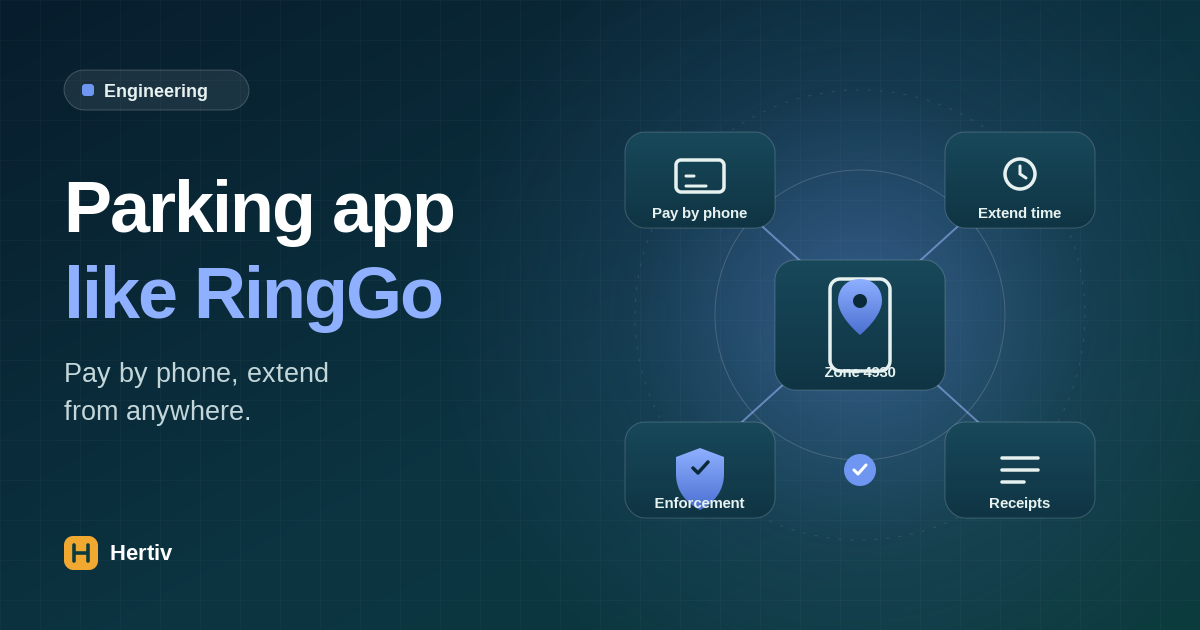
A parking app like RingGo is a pay-by-phone parking service that lets a driver pay for parking from a phone instead of feeding coins into a machine. RingGo is a UK service of this kind: drivers register a vehicle and a payment card, enter the location code shown on a sign at the parking area, choose how long to stay, and pay by app, phone call, text message or online.
Once a session is running, the driver can extend it from anywhere without walking back to the car, and enforcement officers check the vehicle registration on their handheld devices, so no paper ticket is needed. RingGo is free to register and free to download, and in some areas a small convenience fee of 20p is added to the parking charge. It also offers a corporate service for businesses and VAT receipts for expenses.
That model is the template for any parking app of this kind: find the zone, pay for a session, extend it, and prove payment by registration number. A new app that copies this flow needs the same four parts, plus the operator tools that manage zones, prices and enforcement. For a general view of parking app costs, see the cost of car parking app development.
How much does a parking app like RingGo cost?
A parking app like RingGo costs $70,000 to $180,000 for a first version, $180,000 to $450,000 for a full city app, and more again for a multi-city platform. The bands below show what each stage usually covers.
| Stage | Indicative cost | What it covers |
|---|---|---|
| First version | $70,000 - $180,000 | Zone search, pay by card, session timer, extend, receipts |
| Full city app | $180,000 - $450,000 | Multi-zone pricing, enforcement tools, operator dashboard, reminders |
| Multi-city platform | $400,000 - $900,000 | Several cities, operator accounts, reporting, integrations |
| White-label base | $25,000 - $70,000 | Licence and setup of an existing parking app, branded for you |
The first version is the right scope for one city or one operator. It proves that drivers will pay by phone and that enforcement can work from registration numbers. A full city app adds the tools the operator needs every day, and a multi-city platform adds the accounts, reporting and integrations that let several operators run side by side.
What features drive the cost?
Four features drive most of the cost, and each one is harder than it looks. The table below shows what each one adds and why it costs what it does.
| Feature | First version | Full app |
|---|---|---|
| Zone search and maps | List of zones with location codes | Map search, nearest zone, live availability |
| Payments | Card payment and receipts | Stored cards, wallets, corporate billing, refunds |
| Session management | Pay and extend a session | Reminders, auto-extend, multi-vehicle accounts |
| Enforcement | Registration lookup for officers | Officer app, penalty workflow, appeals |
Payments and enforcement are the expensive parts. Payments need card handling, refunds and reconciliation with the operator's accounts, and enforcement needs a reliable lookup that officers can use on the street with poor signal. Zone data is the other hidden cost: every zone needs its code, price, hours and rules kept up to date, and that data usually comes from the operator, not from the app team.
Should you build, buy or white-label?
You can build a parking app from scratch, buy a white-label app, or start from a white-label base and customise it. Each route fits a different situation.
| Route | Best for | Trade-off |
|---|---|---|
| Build from scratch | One operator with its own rules and integrations | Slowest and most expensive, but full control |
| White-label | A quick launch in one city | Fast and cheap, but limited to the vendor's features |
| White-label plus custom work | An operator that needs one or two special features | Middle cost, but custom work can be hard to maintain |
White-label fits when the operator's rules match the vendor's app: standard zones, standard prices, card payments and registration-based enforcement. Build from scratch fits when the operator needs its own pricing rules, its own enforcement workflow, or an integration with a city system that no vendor supports. If you need help weighing the routes, a partner for custom software development can compare them against your requirements.
What does it cost to run each year?
Running a parking app costs $30,000 to $120,000 a year for a single city, and more for several cities. The main lines are hosting and support, payment fees, and keeping zone data current.
Hosting and monitoring usually cost $500 to $2,000 a month for a single-city app, depending on how many sessions it handles. Compare cloud hosting companies before you pick a provider, because the price gap between them is wide.
Payment processing takes a share of every transaction, so it grows with use rather than staying flat. App store accounts, push notification services and text message reminders add smaller monthly lines that are easy to forget in a budget.
Support is the line teams underestimate. Drivers call when a payment fails or a session will not extend, and officers call when a lookup fails on the street. Budget for a support rota from the first month, and for someone to update zone prices and hours whenever the operator changes them. An app whose zone data is out of date will charge drivers the wrong price, which is worse than a missing feature.
Example (hypothetical): a one-city launch
Example (hypothetical): a parking operator in one city wants a RingGo-style app for 40 zones. The first version covers zone search, card payment, session extensions and receipts, plus a simple enforcement lookup for officers.
The build costs $95,000: $55,000 for the driver app and back end, $25,000 for payments and the enforcement lookup, and $15,000 for zone data setup and testing. Running it costs $3,000 a month, or $36,000 a year, for hosting, support and message reminders. The first year therefore costs $95,000 plus $36,000, which is $131,000.
The operator charges drivers a 25-cent convenience fee on each session. With 8,000 sessions a month, that brings in $2,000 a month, or $24,000 a year. The fee alone does not cover the running cost in the first year, so the operator budgets the gap from its parking income and reviews the fee once sessions pass 12,000 a month, when the fee income reaches $36,000 a year and matches the running cost.
What are the common mistakes?
The most common mistakes in parking app builds are stale zone data, a payment flow that fails on the street, and an enforcement lookup that officers cannot trust.
- Stale zone data. Prices, hours and location codes change, and an app that shows old data charges drivers wrongly. Give one person ownership of zone data from day one.
- A fragile payment flow. Drivers pay in car parks with poor signal. If a payment fails silently, the driver gets a fine. Test payments on a weak connection, not only on office wifi.
- An enforcement lookup officers distrust. If the lookup is slow or wrong, officers go back to paper tickets. Test it with real officers before launch.
- No reminder system. Without reminders, drivers overstay and blame the app. Reminders before a session ends are a core feature, not a nice extra.
- Launching in too many zones at once. Each zone needs correct data and a tested enforcement flow. Start with a small set of zones and add more once the first ones work.
Key takeaways
- A parking app like RingGo lets drivers pay by phone using a zone location code
- A first version costs $70,000 to $180,000; a full city app, $180,000 to $450,000
- Payments and enforcement are the most expensive parts to build well
- White-label fits a standard launch; building from scratch fits unusual operator rules
- Budget $30,000 to $120,000 a year to run a single-city app, including support and zone data
Frequently asked questions
How much does a parking app like RingGo cost to build?
A first version usually costs $70,000 to $180,000, and a full city app with enforcement tools and an operator dashboard costs $180,000 to $450,000. The final figure depends on the number of zones, the payment and enforcement systems it connects to, and whether you build from scratch or start from a white-label base.
How does RingGo work?
RingGo is a UK pay-by-phone parking service. A driver registers a vehicle and a payment card, enters the location code shown on a sign, chooses how long to stay, and pays by app, phone call, text or online. Sessions can be extended remotely, and officers check the registration on handheld devices.
Do drivers pay a fee to use RingGo?
Registration and the app are free, but in some areas a 20p convenience fee is added to the parking charge. Text reminders and other optional services can carry small extra charges, and business users can get VAT receipts for their sessions.
Can I white-label a parking app?
Yes. White-label parking apps exist and are the fastest way to launch in one city, usually costing $25,000 to $70,000 for licence and setup. They fit when your rules match the vendor's features, and they struggle when you need unusual pricing or enforcement workflows.
What does it cost to run a parking app each year?
A single-city app usually costs $30,000 to $120,000 a year to run, covering hosting, payment fees, support and keeping zone data current. Payment fees grow with use, and support is the line teams most often underestimate.
What is the hardest part of a parking app?
Keeping zone data correct and making payments and enforcement work on the street. Prices, hours and location codes change often, and a payment that fails on a weak signal can leave a driver with a fine, so both need testing in real conditions.


