How Much Does a Fitness App Like Hevy Cost?
A fitness app like Hevy costs roughly $70,000 to $200,000 for a first version, and $200,000 to $500,000 for a full app with routines, social features and wearables.
On this page
Short answer
A fitness app like Hevy costs about $70,000 to $200,000 for a first version that covers workout logging, routines and progress charts, and $200,000 to $500,000 for a full app with a social feed, wearable apps, offline mode and a trainer feature. Hevy is a free workout tracker for iOS and Android, and the price depends on how many of those features you build at launch.
What is a fitness app like Hevy?
A fitness app like Hevy is a workout tracker that helps people log strength training sessions and watch their progress over time. Hevy is a free app for iOS and Android, with no ads, that lets lifters build routines, record weight, reps, duration and effort for each set, and see what they lifted last time next to each exercise.
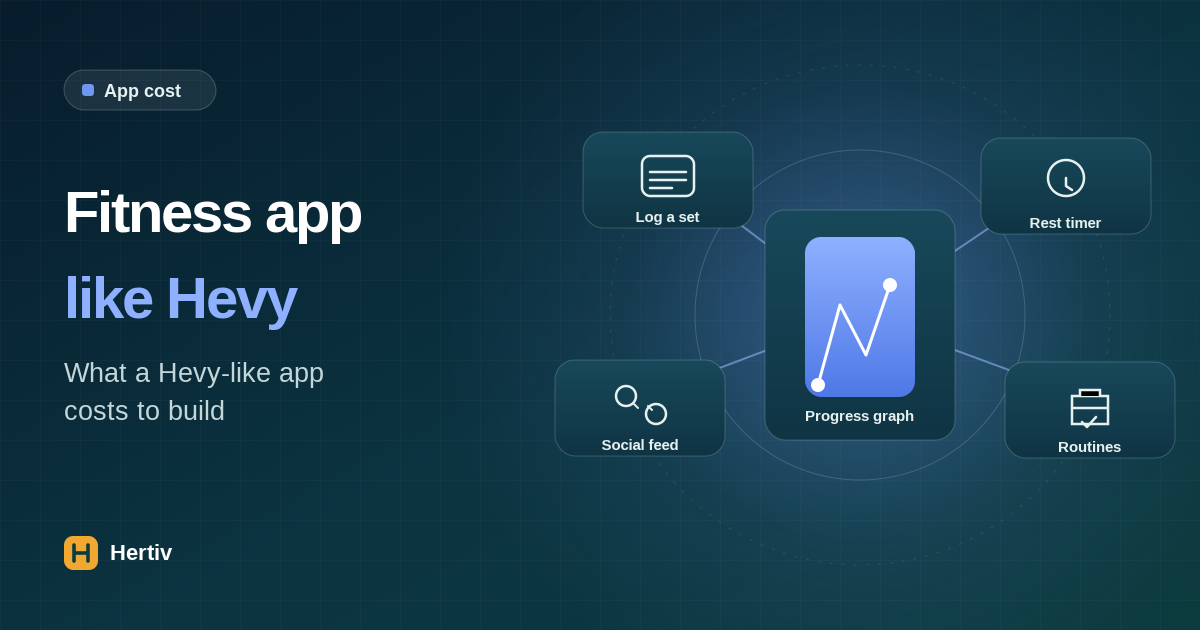
Hevy keeps logging fast. Adding a set takes one tap, a rest timer starts automatically after each set, and the app shows graphs for every lift, plus body weight and measurements. It also has an exercise library with videos, a social feed where friends share workouts, Apple Watch and Wear OS apps, offline workouts, and sync with Strava.
The free version caps routines at four, custom exercises at seven, and history at three months. Hevy Pro is a paid upgrade that removes those caps and adds a trainer feature that builds a program from your experience, goal and equipment. For pricing, see the vendor site, since app store prices vary by region and change over time.
What does a Hevy-like app cost to build?
The cost of a Hevy-like app depends mostly on scope. A first version that logs workouts and shows progress is the cheapest path. A full app with a social feed, wearable apps, offline sync and a trainer feature costs several times more, because each of those is a product on its own.
| Version | What it includes | Indicative cost |
|---|---|---|
| First version | Workout logging, routines, rest timer, progress charts, exercise library | $70,000–$200,000 |
| Full app | Social feed, Apple Watch and Wear OS apps, offline mode, Strava sync | $200,000–$500,000 |
| Full platform | Trainer feature, programs, coach tools, web dashboard, admin panel | $400,000–$900,000 |
| White-label | A ready-made fitness app rebranded for your market | $25,000–$70,000 |
These are indicative ranges for design, development and testing, not quotes. Server costs, app store fees and ongoing maintenance sit on top of the build price and recur every year. A team that builds the trainer feature first, before the logging works well, will spend far more than a team that nails the log and adds the trainer later.
What drives the cost up or down?
The exercise library is the first cost driver. A library with hundreds of exercises, each with a video and written instructions, needs filming, editing and a content system. You can start with a smaller library of the most common lifts and add more over time, which keeps the first version cheap.
Wearable apps are the second driver. An Apple Watch app and a Wear OS app each need their own design, testing and store review, and they must sync with the phone even when the phone is in a locker. Offline mode adds more work: the app must store workouts locally and sync them later without losing a set.
The social feed is the third driver. A feed needs user accounts, following, privacy controls, moderation and notifications, and it needs servers that can handle many users at once. A first version can skip the feed and let users share a workout link instead, which gives most of the value for a fraction of the cost. For a similar app cost, see how much a fitness app like Strava costs.
What features go in the first version?
A first version should do one job well: log a workout in seconds, in the middle of a set, without breaking the lifter's focus. That means routines, one-tap set logging, a rest timer, and the previous session's numbers next to each exercise. Everything else can wait.
Pick features that make lifters come back daily. Progress graphs are the core loop: a lifter sees a personal record, comes back to beat it, and the app gets better with every session. A rest timer that starts on its own and a library with form videos are useful, but they do not create the habit on their own.
Leave out the social feed, the trainer feature and the wearable apps at first. Those need moderation, content and extra testing, and they distract from the logging experience. Launch with a clean log, learn what lifters actually track, and add the next layer only when the first one works.
Should you build, buy or white-label?
There are three ways to get a fitness app: build it from scratch, buy a ready-made fitness platform and build your app on top of it, or take a white-label fitness app and rebrand it. Most teams should build from scratch or take the middle path, because the logging experience is the product.
| Option | Best for | Trade-off |
|---|---|---|
| Build from scratch | A team with a clear logging vision | Full control, highest cost, slowest launch |
| Platform plus own app | Teams that need content and sync ready-made | Faster launch, monthly fees, less control |
| White-label | Testing demand in one market | Cheapest start, hard to stand out |
The middle path keeps your budget on the parts users notice: fast logging, clear graphs and a rest timer that works. The platform handles accounts, sync and content. If the app grows, you can move parts in-house later, starting with the logging flow, which is where your own data becomes an advantage. For health app costs in general, see the cost of a health monitoring app like MyChart.
Example (hypothetical): a one-city gym launch
Example (hypothetical): a team launches a fitness app with three gyms in one city. The build costs $95,000 and the first-year running costs are $24,000 for servers, app store fees and support, so the first year totals $119,000.
Two thousand lifters download the app in the first year, and 200 of them pay $3 a month for the Pro upgrade, which is $600 a month or $7,200 a year. The three gyms also pay $200 a month each for a branded version of the app, which is another $7,200 a year, so total income is $14,400 a year.
After the $24,000 running cost, the app loses $9,600 a year before the build is repaid. At that rate the team needs more paying users or more gyms before the app pays for itself, which is why most fitness apps plan a second revenue stream, such as coach tools or sponsored programs, before they launch.
The numbers show the real problem with fitness apps: the build is not the hard part, getting lifters to log every session is. Logging only works when it is faster than a notebook, so the launch plan matters more than any single feature.
What are the common mistakes?
The most common mistakes are building the trainer feature first, making logging slow, and launching a social feed before anyone logs a workout. Each of these wastes budget and delays the moment lifters form a habit.
- Building the trainer first. A program builder is useless if logging is slow. Nail the log, then add the trainer.
- Slow logging. If adding a set takes more than a few seconds, lifters go back to a notebook. Speed is the feature.
- Social feed too early. A feed with no users is an empty room. Wait until lifters log daily, then add sharing.
- Too many exercises at launch. A huge library with poor videos is worse than a small library done well. Start with the common lifts.
- Ignoring offline mode. Gyms have poor signal, so an app that needs the network to log a set will fail in the place it matters most.
Keep logging fast by keeping the screen simple. One screen for the workout, one tap per set, and the last session's numbers in view. A fitness app earns its place on a lifter's phone one fast set at a time. The mobile app development team can help if you want a first version scoped around logging speed.
Key takeaways
- A first version costs roughly $70,000 to $200,000, and a full app $200,000 to $500,000
- Fast logging is the core feature: one tap per set, rest timer, last session in view
- Wearables, offline mode and a social feed each add a full work package
- Launch with a clean log and add the trainer and feed after lifters form a habit
- Offline mode matters, because gyms often have poor signal
Frequently asked questions
How much does a fitness app like Hevy cost to build?
A first version costs roughly $70,000 to $200,000, and a full app with a social feed, wearable apps, offline mode and a trainer feature costs $200,000 to $500,000. Server costs, app store fees and maintenance sit on top of the build price every year.
What is Hevy?
Hevy is a free workout tracker for iOS and Android, with no ads, that logs strength sessions, tracks progress with graphs, and lets friends share workouts. It has an exercise library with videos, a rest timer, Apple Watch and Wear OS apps, offline workouts and Strava sync.
Is Hevy free?
Yes, Hevy is free with no ads. The free version covers workout logging, the exercise library, a rest timer and the social feed, with caps of four routines, seven custom exercises and three months of history. Hevy Pro is a paid upgrade that removes the caps and adds a trainer feature.
Do I need a social feed in a fitness app?
Not at launch. A feed needs accounts, moderation and servers, and it is empty until lifters log daily. Start with fast logging and progress graphs, then add sharing once users have a reason to open the app every day.
How long does it take to build a fitness app like Hevy?
A first version with logging, routines and charts usually takes three to five months with a small team. A full app with a social feed, wearable apps and offline mode takes longer, because each of those is a separate build with its own testing.
How do fitness apps like Hevy make money?
Hevy earns money from a paid Pro upgrade that removes limits and adds a trainer feature. Other options include gym partnerships, coach tools, sponsored programs and branded versions of the app for gym chains.


