How Much Does EV Charging Management Software Cost to Build?
EV charging management software costs about $60,000 to $180,000 for a first version and $180,000 to $450,000 for a full platform.
On this page
Short answer
EV charging management software is the platform that runs a charging network: it talks to the chargers, sets prices, takes payments, manages drivers and reports on energy use. Building a first version costs about $60,000 to $180,000, while a full platform with payments, roaming and fleet tools costs about $180,000 to $450,000.
What is EV charging management software?
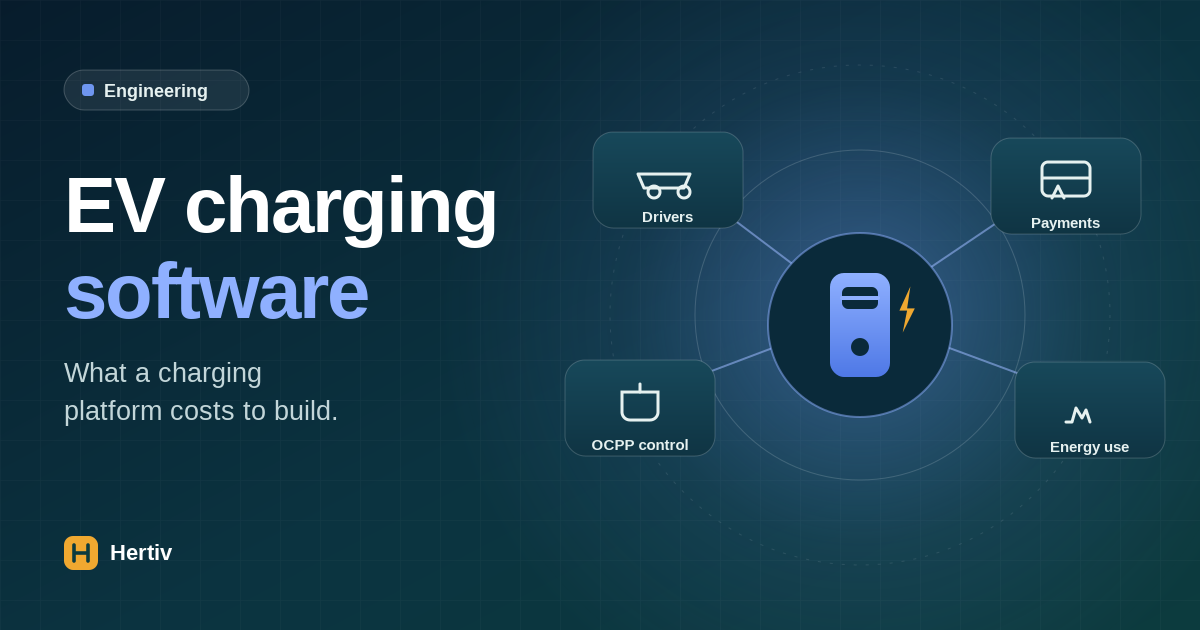
EV charging management software is the system that operates a network of electric vehicle chargers. It connects to the chargers, usually through the OCPP protocol, and handles the work around a charging session: starting and stopping a charge, setting the price, taking payment, and recording how much energy was used.
The software has three audiences. Drivers use an app or a card to find a charger, start a session and pay. Operators use a dashboard to watch charger status, set prices, fix faults and see revenue. Fleet managers use the same platform to control which vehicles charge, when they charge and what it costs per vehicle.
It is different from the charger hardware. The charger is the physical unit on the wall or the post; the software is the service that makes the charger bookable, billable and visible. A network can use chargers from several makers, as long as they all speak OCPP, which is the open protocol most chargers support.
The core value is control. Without management software, a charger is a socket that anyone can use for free. With it, the operator can price by time or by energy, limit access to members, run off-peak discounts, and see which chargers earn money and which sit idle. For a related view of connected fleets, see IoT in fleet management.
How much does it cost to build?
A first version costs about $60,000 to $180,000. It covers the charger connection, a driver app, payments and an operator dashboard for one site or a small group of chargers. A full platform costs about $180,000 to $450,000, adding roaming, fleet tools, energy management and integrations with billing and accounting systems.
| Scope | Typical cost | What it includes |
|---|---|---|
| First version | $60,000-$180,000 | OCPP connection, driver app, payments, operator dashboard |
| Full platform | $180,000-$450,000 | Roaming, fleet tools, energy management, reports, integrations |
| Enterprise build | $350,000-$800,000 | Multi-site, white-label, custom billing, SLA support, compliance |
| White-label option | $20,000-$60,000 | Licensed platform rebranded, setup and basic customisation |
These are indicative ranges for a build by a software team, not vendor prices. The final figure depends on how many charger models must be supported, whether payments run through a third party, and how much of the work is custom rather than bought. The ranges also assume the team builds the software only, not the charger hardware or the electrical installation.
A white-label platform is the cheaper path for a small operator. The operator pays a setup fee and a monthly licence, and gets a working platform under its own brand. The trade-off is less control: features, pricing rules and integrations are limited to what the vendor offers.
What drives the cost up or down?
Five factors move the cost most: charger compatibility, payments, energy features, integrations and the number of sites. Each one adds work that is easy to underestimate at the start.
Charger compatibility is the first. Supporting one OCPP charger model is simple; supporting five makers with different firmware versions means testing each one, handling quirks and keeping the connection stable when a charger drops offline. Some makers also need a custom driver instead of plain OCPP, which adds weeks of work.
Payments are the second. Taking card payments needs a payment provider, tax handling, receipts and refunds, and each market has its own rules. Adding roaming, where drivers from other networks can charge at your stations, needs agreements and a clearing process that settles money between operators.
Energy features are the third. Smart charging, which slows or delays charging when the grid is busy, needs live data from the site and rules for when to charge. Load balancing across several chargers at one site is a smaller version of the same problem, and both need careful testing because a fault can trip a breaker.
Integrations and scale are the last two. Connecting to accounting, CRM or fleet systems adds an integration per system, and a platform that must run hundreds of sites needs multi-site roles, permissions and reporting that a single-site build does not. A platform for energy and utilities shows the kind of service layer that sits around this software.
What features does a first version need?
A first version needs five things: charger control, a driver app, payments, an operator dashboard and basic reports. Everything else can wait until the first chargers are live and earning.
Charger control is the foundation. The platform must connect to each charger, show whether it is free, in use or faulty, and start and stop sessions remotely. If the connection drops, the charger should keep working in a safe mode and sync its records when it reconnects.
The driver app needs a map of chargers, live availability, session start and stop, and a payment method. Drivers care most about finding a working charger and paying without a fuss, so the app should be simple. A card or RFID option helps drivers who do not want an app.
Payments need a clear price shown before the session starts, a receipt after it ends, and a way to handle failed payments. The operator dashboard needs charger status, session history, revenue by charger and a fault list, plus alerts when a charger goes offline. Basic reports cover energy used, sessions per day and revenue per site, which is enough to decide where to add chargers next.
How is it built, step by step?
Building the platform takes about four to nine months for a first version, in six steps. The order matters, because the charger connection and the payment flow are the parts that fail most often in testing.
- Define the network. Decide how many chargers, which makers, which sites and which payment methods the first version must support.
- Pick the protocol stack. Confirm the chargers speak OCPP and agree on the version, then test the connection with a real charger before writing the app.
- Build the charger service. Write the service that holds connections, sends start and stop commands, and records meter values for billing.
- Build the driver app and payments. Add the map, session control and payment flow, with the price shown before a session starts.
- Build the operator dashboard. Add charger status, alerts, session history, revenue reports and price controls.
- Test on real chargers. Run sessions on the actual hardware, test offline behaviour, failed payments and fault alerts, then pilot at one site.
The pilot is the step teams most often skip. A platform that works in a demo can still fail when a charger loses its connection mid-session or a driver unplugs early. A small pilot at one site finds those faults while they are cheap to fix.
Example (hypothetical): a 50-charger network
Example (hypothetical): a company runs 50 chargers across 10 sites and wants a first version of its own platform. The build is quoted at $120,000, covering the charger service, driver app, payments and dashboard for the chargers it already owns.
Running costs are about $36,000 a year: hosting and support at $2,000 a month, plus payment processing. The network sells about 60,000 kWh a month at an average margin of $0.10 per kWh after energy costs, which is $6,000 a month, or $72,000 a year.
After running costs, the platform earns about $36,000 a year, so the $120,000 build pays for itself in about 40 months at current use. If use grows by half, the margin rises to $108,000 a year and the payback drops to about 17 months. The numbers are assumptions, not a promise, but they show the point: the payback depends on charger use, not on the build price alone.
The same arithmetic also shows why idle chargers hurt. If only half the chargers are used, the margin falls to $36,000 a year, which just covers the running costs. Choosing sites with real demand matters more than adding features to the platform.
What are the common mistakes?
The most common mistakes are skipping real-charger testing, underestimating payments, and building features before the first chargers earn money.
- Testing only in a demo. A simulator does not drop connections or report faults the way real chargers do. Test on the actual hardware early.
- Treating payments as simple. Card payments, refunds, tax and roaming each add rules and edge cases. Budget real time for them.
- Supporting too many charger models. Each extra maker adds testing and maintenance. Start with one or two and add more later.
- Ignoring offline behaviour. Chargers lose their connection. The platform must handle sessions that end offline and sync the records later.
- Building fleet and roaming first. A first version should prove that drivers can find, use and pay for a charger. Fleet tools and roaming can follow.
- No plan for faulty chargers. A charger that is offline for a week earns nothing and annoys drivers. Alerts and a repair process belong in the first version.
Key takeaways
- EV charging management software runs a charger network: control, pricing, payments and reporting
- A first version costs about $60,000-$180,000; a full platform costs about $180,000-$450,000
- Charger compatibility, payments and energy features drive the cost most
- Test on real chargers early: simulators hide the faults that cost money later
- Payback depends on charger use, so site choice matters more than extra features
Frequently asked questions
What is EV charging management software?
It is the platform that operates a network of EV chargers. It connects to the chargers, usually through the OCPP protocol, and handles session control, pricing, payments, driver access and reports on energy use and revenue.
How much does it cost to build?
A first version costs about $60,000 to $180,000, covering the charger connection, driver app, payments and operator dashboard. A full platform with roaming, fleet tools and energy management costs about $180,000 to $450,000.
What is OCPP?
OCPP is the open protocol most chargers use to talk to management software. It lets one platform control chargers from different makers, instead of needing a separate system for each brand.
Can I buy it instead of building it?
Yes. White-label platforms cost about $20,000 to $60,000 to set up, plus a monthly licence. They are cheaper and faster, but offer less control over features, pricing rules and integrations.
How long does a build take?
A first version takes about four to nine months, including testing on real chargers. The charger connection and payment flow take the most time, and a pilot at one site is the step that finds the costly faults.
Do drivers need an app to charge?
Not always. Most platforms offer an app, but many also support RFID cards or contactless payment at the charger, which helps drivers who do not want to install another app.


