How Much Does an Ecommerce Website Cost to Build?
An ecommerce website costs from a few thousand dollars for a template store to six figures for a build. The price depends on design, features and integrations.
On this page
Short answer
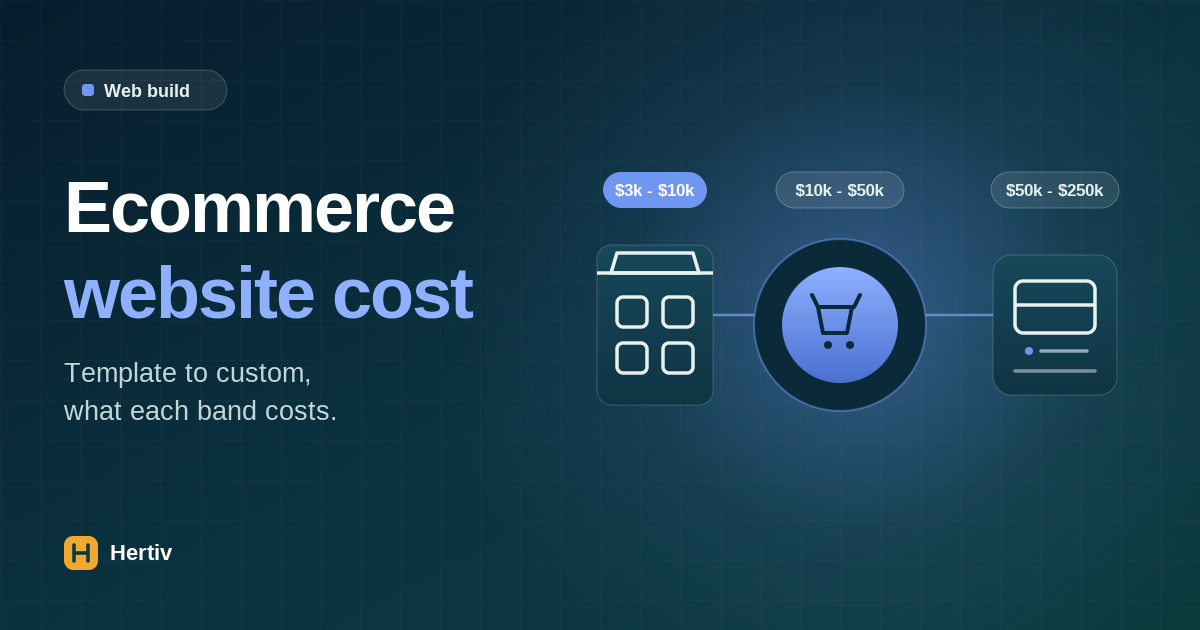
Building an ecommerce website costs roughly $3,000 to $10,000 for a template-based store, $10,000 to $50,000 for a custom design on a platform such as Shopify or WooCommerce, and $50,000 to $250,000 or more for a fully custom build with complex integrations. These are planning ranges from published agency guides, not quotes. Monthly running costs for hosting, apps, payment fees and maintenance usually add $100 to $2,000 a month.
What does an ecommerce website cost to build?
The cost of building an ecommerce website is the total spend on design, development, product content, payment and shipping integrations, and launch, and it ranges from a few thousand dollars for a template store to six figures for a fully custom build.
Most of the gap comes from scope. A template store with standard checkout is a configuration job. A custom store with its own design, a product configurator, ERP integration and multi-currency checkout is a software project, and it is priced like one.
Use the ranges in this guide as planning figures. A real quote depends on your catalogue size, your design needs and the systems the store must connect to, so treat any number here as a starting point for a conversation with a builder, not as a price.
What drives the cost up or down?
Five factors drive most of the price: design, catalogue size, features, integrations and who builds it. Change any one of them and the quote moves.
| Factor | Low cost | High cost |
|---|---|---|
| Design | Template with your branding | Custom design system, art direction |
| Catalogue | Under 100 products | Thousands of SKUs, variants, bundles |
| Features | Standard checkout, search, filters | Configurators, subscriptions, B2B pricing |
| Integrations | Payment gateway only | ERP, warehouse, CRM, accounting |
| Builder | Freelancer or small studio | Agency team with QA and project management |
The factor teams underestimate most is content. Product photos, descriptions and category pages take real time, and a store with weak product pages converts poorly no matter how good the code is. Budget for content as a line item, not as an afterthought.
How much does each build type cost?
Build types fall into three bands, and each band buys a different level of control. Pick the band that matches how different your store needs to be from a standard shop.
| Build type | Planning range | Best for |
|---|---|---|
| Template store | $3,000 - $10,000 | Small catalogue, standard checkout |
| Custom design on a platform | $10,000 - $50,000 | Branded experience, some custom features |
| Fully custom build | $50,000 - $250,000+ | Complex rules, integrations, scale |
Template stores are the right call when your products fit a standard shape and speed matters more than uniqueness. Custom platform builds suit brands that need their own design and a few custom features. Fully custom builds are for stores where the buying flow itself is the product, such as configurators, B2B pricing or complex fulfilment.
For a comparison of the platforms themselves, the best ecommerce website platforms shows what each one offers.
If you are weighing an app instead, ecommerce app development cost covers the mobile side.
What are the monthly running costs?
The build is only the first cost. A store also needs hosting, platform fees, apps, payment processing and maintenance, and these recur every month for as long as the store runs.
| Running cost | Typical monthly range |
|---|---|
| Platform and hosting | $30 - $400 |
| Apps and plugins | $50 - $500 |
| Payment processing | 2 - 3% of sales |
| Maintenance and fixes | $100 - $1,000 |
Payment fees are usually the largest recurring cost once sales grow, because they scale with revenue. Apps are the cost that creeps: each one is small, but five or six add up, and unused apps are easy to forget. Review the app list every quarter and remove what you do not use.
How do you plan the budget in steps?
Plan the budget in steps so the money follows decisions, not the other way round. Each step produces something you can check before the next spend.
- List the products, categories and buying flows the store must support on day one.
- Choose the build type that fits that list, and get two or three quotes for the same scope.
- Set aside 15 to 20 percent of the build budget for content: photos, descriptions and category pages.
- Budget the first year of running costs, not just the launch, including payment fees at your expected sales level.
- Hold back 10 percent of the build budget for fixes and small changes in the first month after launch.
Getting two or three quotes for the same written scope is the single best way to compare builders fairly. Quotes for different scopes are not comparable, and the cheapest quote for a smaller scope is often the most expensive outcome.
Example (hypothetical): a mid-size fashion store
Example (hypothetical): a fashion retailer with 400 products wants a custom design on Shopify, with Instagram shopping, a size guide and a loyalty programme. The quotes come in at $28,000 for design and build, $6,000 for product photography and descriptions, and $2,000 for launch and testing, which is $36,000 in total.
Running costs are $79 a month for the platform, $180 a month for apps and $400 a month for maintenance, which is $659 a month before payment fees. At $40,000 a month in sales and a 2.5 percent payment fee, processing adds $1,000 a month, so the first-year total is $36,000 plus 12 times $1,659, or about $55,900.
The store breaks even on the build when the extra margin from online sales passes $36,000. At a 40 percent gross margin, that needs $90,000 of online sales, or just over two months at the expected run rate. The arithmetic only works if the sales forecast holds, so the retailer should test it with a small launch before spending on the full catalogue.
What are the common mistakes?
The most common mistakes with ecommerce budgets are underestimating content, forgetting running costs and choosing the wrong build type for the scope.
- No content budget. A store with thin product pages converts poorly. Budget photos and descriptions as a line item.
- Forgetting payment fees. At 2 to 3 percent of sales, processing is often the largest recurring cost once the store grows.
- Overbuilding on day one. Features nobody asked for cost money twice: once to build, once to maintain. Launch with the core flow and add features after real orders arrive.
- Comparing quotes for different scopes. Write the scope first, then get quotes for the same scope, or the numbers mean nothing.
- No launch reserve. Every store needs fixes in the first month. Hold back 10 percent for them.
Teams planning the wider build can start from web application development, which covers the engineering side.
If the store needs an app as well, mobile app development covers the mobile side.
Key takeaways
- A template store costs roughly $3,000 to $10,000; a custom build can pass $50,000
- Design, catalogue size, features, integrations and the builder drive the price
- Content is a real budget line, not an afterthought
- Running costs add $100 to $2,000 a month plus 2 to 3 percent in payment fees
- Get two or three quotes for the same written scope
- Hold back 10 percent of the build budget for first-month fixes
Frequently asked questions
How much does a basic ecommerce website cost?
A basic template-based store usually costs $3,000 to $10,000 to build, including design tweaks, payment setup and launch. Monthly running costs add roughly $100 to $300 for the platform, apps and maintenance, plus payment fees of 2 to 3 percent of sales.
Is Shopify or WooCommerce cheaper to build on?
It depends on the store. Shopify is usually cheaper to launch because hosting and checkout are included, while WooCommerce can be cheaper over time if you already run WordPress and manage hosting yourself. Compare total cost over two years, not just the build price.
What costs the most in an ecommerce build?
Custom design and integrations usually cost the most, followed by content. A store with thousands of products, a configurator or an ERP integration will cost far more than a standard shop, because each of those is a separate piece of work.
Do I need a custom website or a template?
A template is enough when your products fit a standard shape and speed matters. Choose custom when your brand, buying flow or integrations are genuinely different from a standard shop. If the template covers 90 percent of what you need, it is usually the right call.
How long does it take to build an ecommerce website?
A template store can launch in two to four weeks. A custom design on a platform usually takes six to twelve weeks, and a fully custom build takes three to six months, depending on integrations and content. Catalogue size is often the longest part of the schedule.
What are the hidden costs of an ecommerce website?
The usual surprises are product content, payment fees, apps that pile up, and maintenance. Budget content as a line item, estimate payment fees at your expected sales level, review the app list every quarter, and keep a maintenance reserve.


