How Much Does a Delivery App Like Mrsool Cost to Build?
A delivery app like Mrsool costs about $70,000 to $450,000 to build, depending on scope. Here is what drives the price and what a first version needs.
On this page
Short answer
Building an on-demand delivery app like Mrsool costs $70,000 to $180,000 for a first version covering one city, and $180,000 to $450,000 for a fuller product with payments, courier bidding and admin tools. Mrsool, founded in Riyadh in 2015, lets customers type any request and couriers bid on the job. Your final price depends on platforms, features and whether you build from scratch or start from a white-label base.
What is an on-demand delivery app like Mrsool?
An on-demand delivery app like Mrsool is a marketplace that connects customers who need something delivered with nearby couriers who can do the job. Mrsool, founded in Riyadh in 2015, works differently from a food delivery app: the customer types a free-text request for anything from any shop, and couriers reply with a price offer for the delivery.
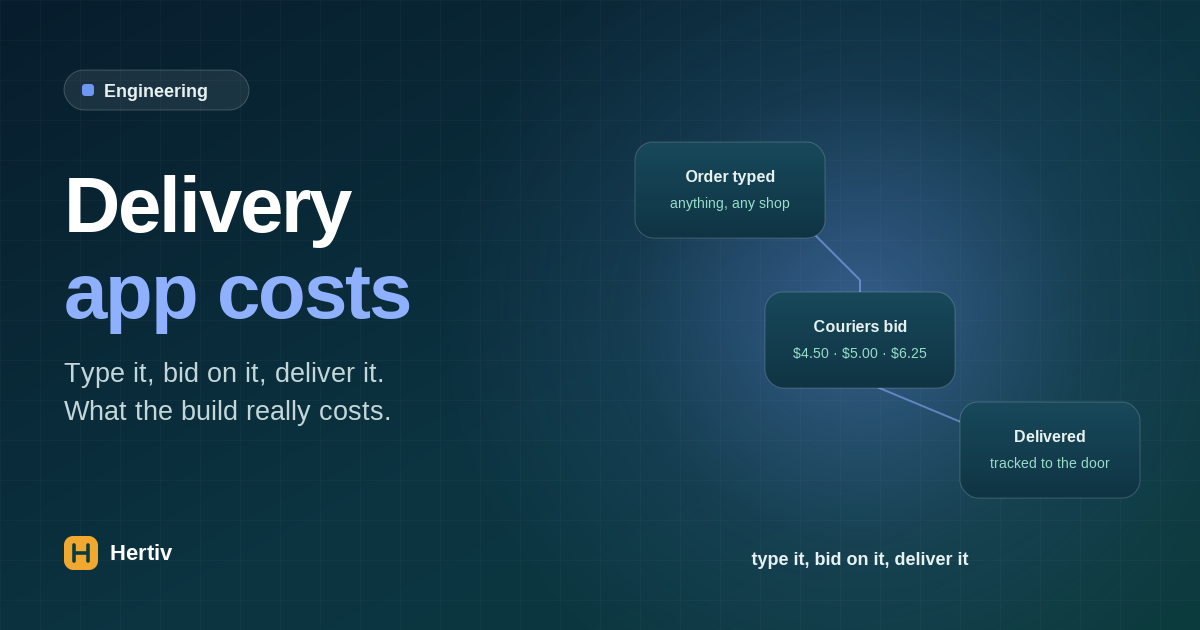
The customer picks an offer, the courier buys or collects the items, and the app tracks the job to the door. Ordering happens by chat, with text, voice notes and photos, and the service now covers Saudi Arabia, Egypt and Bahrain. That “deliver anything” model is what makes the app harder to build than a single-restaurant ordering app.
A clone of Mrsool needs three apps in one product: a customer app, a courier app and an admin panel, plus payments, live tracking and a bidding system. Each of those is a separate build, which is why the cost is higher than a simple ordering app.
How much does a delivery app like Mrsool cost?
The cost depends on scope: one city or many, one platform or two, and whether courier bidding and chat are in the first version. Use these bands as a starting point, and treat them as indicative ranges, not quotes.
| Scope | What it includes | Indicative cost |
|---|---|---|
| First version, one city | Customer and courier apps, bidding, tracking, payments | $70,000–$180,000 |
| Full city app | Above plus chat, promos, admin panel, ratings | $180,000–$450,000 |
| Multi-city platform | Above plus city management, analytics, fraud checks | $400,000–$900,000 |
| White-label base | Licensed base app, branded and configured | $25,000–$70,000 |
The bands assume a professional team and apps for iOS and Android. A single-platform test build costs less, and a team in a high-cost market charges more. Get a quote for your scope rather than budgeting from a band alone. An on-demand home service app shows a similar cost shape, since its price also follows scope.
What drives the cost up or down?
Five factors set most of the price: the number of platforms, the bidding and chat system, the payment setup, the admin tools and the launch scope. Each one adds screens, server work and testing.
- Platforms. iOS and Android together cost more than one platform, though a cross-platform build narrows the gap.
- Courier bidding. Offers, counter-offers and expiry rules are custom logic, not a standard feature.
- Chat. Text, voice notes and photos need storage, moderation and push notifications.
- Payments. Card payments, wallets and courier payouts each need a provider and reconciliation.
- Admin tools. Dispute handling, refunds and courier verification take more time than teams expect.
Two costs hide in the second year: keeping the apps working as iOS and Android change, and handling more orders per courier without breaking the bidding rules. Budget for both from the start, since an app that stops working after a phone update loses couriers fast.
The cheapest way to cut cost is to cut scope, not quality: launch in one city, with one platform, and add the second platform after the model works. A food delivery app like Glovo shows the same pattern, since its cost also follows scope rather than a fixed price.
What does a first version need?
A first version needs everything required to complete one paid delivery end to end, and nothing else. If a feature is not needed for that first delivery, it can wait for the second release.
- Customer app: sign-up, free-text order, courier offers, live tracking, payment, rating.
- Courier app: job list, offer bidding, navigation, earnings, availability toggle.
- Admin panel: user and courier management, order monitoring, refunds, support.
- Payments: cards and wallets for customers, payouts for couriers.
- Chat: in-app messages with photos and voice notes between customer and courier.
- Safety: courier verification, order proof and a way to report problems.
Leave out loyalty programmes, subscriptions, multi-city management and advanced analytics at first. They are real features, but they add weeks of work before you know whether customers will use the core service.
A rating system for both sides also belongs in the first version: customers rate couriers, couriers rate customers, and the admin team sees both. Without it, bad behaviour on either side goes unnoticed until it becomes a complaint.
How to build it in stages
Build in stages so each release proves something before the next one is funded. A staged build also lets you change direction when real orders show what customers actually want.
- Define the first city, the first order types and the courier supply you can recruit.
- Build the customer app, courier app and admin panel for one city and one platform pair.
- Add payments, bidding and chat, then test with real couriers on real orders.
- Fix the top five problems from the pilot, then add the second platform.
- Expand to the next city only after the first city runs without daily fixes.
A mobile app development team can run this in stages with you, or you can hire a team per stage. Either way, agree the scope of each stage in writing before it starts, so the budget follows the plan.
Example (hypothetical): a one-city launch
Example (hypothetical): a team launches in one city with a build cost of $120,000 and running costs of $4,000 a month, or $48,000 a year. The first-year total is $168,000.
The app reaches 6,000 orders a month, and the platform keeps $2.00 per order. That is $12,000 a month, or $144,000 a year. After $48,000 of running costs, $96,000 a year is left to pay back the build, so the $120,000 build is paid back in 15 months.
The numbers only work if courier supply keeps up with orders. If couriers are scarce, delivery times rise, customers stop ordering, and the order count the model depends on falls away.
What are the common mistakes?
The most common mistakes are copying every Mrsool feature at once, launching in several cities before the first one works, and treating courier supply as an afterthought.
- Building every feature before the first paid delivery
- Launching in several cities while the first city still needs daily fixes
- Recruiting couriers late, so orders wait and customers leave
- Skipping payout and refund flows until a dispute arrives
- Choosing a white-label base that cannot add bidding or chat later
If you are comparing app ideas, an app like Airbnb shows a different cost shape, since a marketplace without live couriers has no bidding or tracking to build.
Key takeaways
- A first version for one city usually costs $70,000 to $180,000; a fuller product reaches $450,000
- Mrsool's model is free-text orders with courier bidding, which is custom logic, not a standard feature
- Three apps ship together: customer, courier and admin, plus payments and chat
- Cut scope to cut cost: one city, one platform pair, then expand on evidence
- Courier supply decides whether the numbers work, so recruit couriers before launch
Frequently asked questions
How much does an app like Mrsool cost to build?
A first version for one city usually costs $70,000 to $180,000, and a fuller product with chat, promos and an admin panel costs $180,000 to $450,000. A white-label base costs less, at $25,000 to $70,000, but it limits how far you can change the app later.
What makes Mrsool different from a food delivery app?
Mrsool lets customers type a free-text request for anything from any shop, and couriers bid on the job with a price offer. Food delivery apps show a fixed menu with a fixed delivery fee, so they need no bidding system and no free-text order flow.
How long does it take to build a delivery app like Mrsool?
A first version for one city usually takes four to seven months with a small professional team, including design, both apps, the admin panel and testing. Adding a second platform, more cities or advanced features extends that, so plan the stages before you start.
Do I need separate apps for customers and couriers?
Yes. Customers need ordering, offers, tracking and payment, while couriers need job lists, bidding, navigation and earnings. One app can hold both roles, but separate apps keep each workflow simpler and easier to test.
Can I start from a white-label delivery app instead?
Yes, if the base supports the features you need, especially courier bidding and chat. Check what you can change before you buy: a base that cannot add bidding later will force a rebuild when the model needs it.
What is the biggest cost after launch?
Courier payouts, payment fees, server costs and support usually dominate the monthly bill, along with fixes and small features after launch. Budget for running costs from the first month, since the app needs couriers, support and maintenance even while order volume is still growing.


