How Much Does an App Like Qiwa Cost to Build?
Qiwa is Saudi Arabia's official labour platform, run by the Ministry of Human Resources. Here is what a similar app costs and what drives the price.
On this page
Short answer
An app like Qiwa, Saudi Arabia's official labour platform, costs roughly $150,000 to $400,000 for a first version and $400,000 to $900,000 for a full version with contracts, work permits, transfers and compliance dashboards. The price depends on how many government services it covers, how deep the compliance rules go, and whether it must integrate with national identity and payment systems.
What is Qiwa?
Qiwa is Saudi Arabia's official digital platform for labour and workforce services, operated by the Ministry of Human Resources and Social Development and found at qiwa.sa. It is the main online channel through which private-sector employers and employees handle employment matters in the Kingdom.
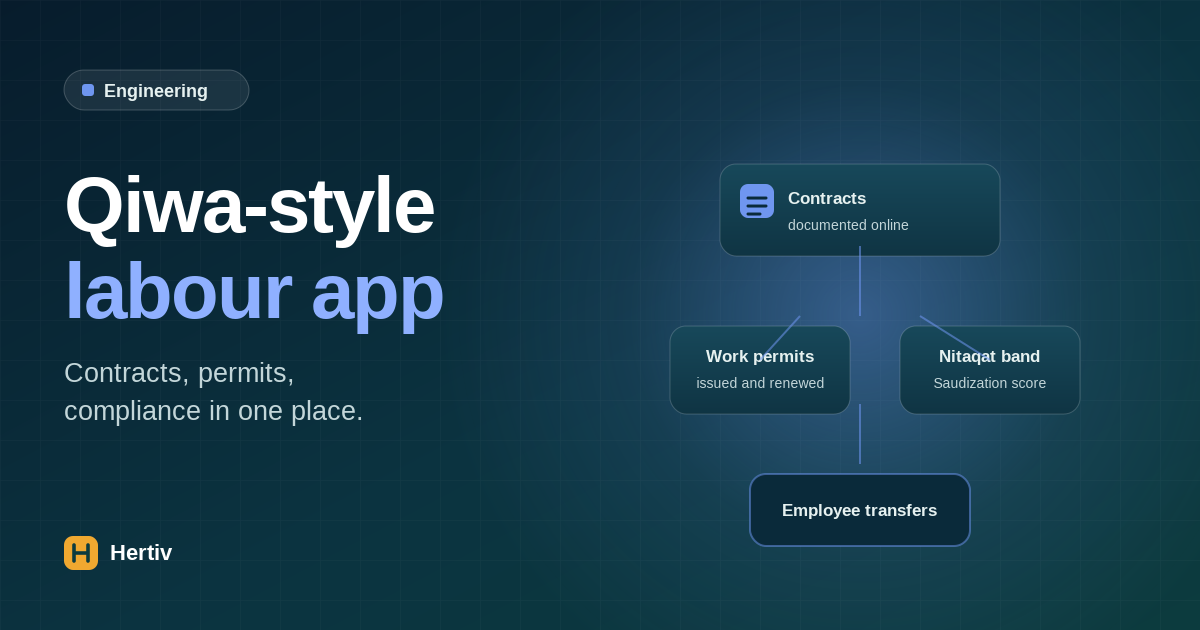
The platform was launched in April 2019 to replace paper contracts and scattered government counters with a single online system. It now offers more than 130 services, including employment contract documentation, work permit issuance and renewal, employee transfers between employers, Saudization tracking under the Nitaqat programme, and salary and service certificates.
Employers log in through the national single sign-on service, Nafath, and manage their establishment's workforce from one dashboard. Employees have their own portal to view, approve or reject contracts and access their employment records.
Qiwa matters because it is not an optional HR tool. Ministerial rules require establishments to document employment contracts through the platform, so it sits at the centre of legal hiring in Saudi Arabia.
What does an app like Qiwa need to do?
An app like Qiwa is not a simple HR tool. It is a government service platform, so its feature list is driven by regulation rather than by what users find convenient.
| Feature | What it does | Why it matters |
|---|---|---|
| Contract documentation | Creates and authenticates employment contracts | Required by ministerial rules |
| Work permits | Issues and renews permits for expat workers | Core hiring service |
| Employee transfers | Moves sponsorship between employers | Common request, needs approval flow |
| Nitaqat dashboard | Shows Saudization band and scores | Drives hiring decisions |
| Certificates | Salary and service certificates | Official proof for employees |
| Establishment data | Company records and authorisations | Base for every other service |
Each service needs its own workflow: who can request it, who approves it, what documents are needed, and what happens when a rule is broken. That approval logic is where most of the development effort goes.
For a simpler comparison, the cost of an app like Airbnb shows how a marketplace app prices out, with far less regulatory logic.
How much does an app like Qiwa cost to build?
An app like Qiwa costs more than a normal HR app, because the compliance logic and the government integrations are the product, not an extra.
| Version | Scope | Indicative cost |
|---|---|---|
| First version | Contracts, permits, basic dashboard | $150,000–$400,000 |
| Full version | All core services, transfers, Nitaqat | $400,000–$900,000 |
| Enterprise version | Multi-region, full integrations, audit | $900,000–$1,500,000 |
| Running costs | Hosting, support, compliance updates | $60,000–$150,000 a year |
These are indicative ranges for planning, not quotes. The real price depends on the number of services, the depth of the compliance rules, and the integrations required.
A private HR app that copies Qiwa's look without its regulatory depth costs far less, but it cannot do Qiwa's job. The compliance layer is what makes the platform expensive and what makes it useful.
What drives the cost up or down?
Four factors decide most of the price of an app like Qiwa, and they are all about rules and integrations rather than screens.
- Number of services. Each service needs its own workflow, approval chain and documents. Qiwa offers more than 130 services; a first version with ten costs far less than a full build.
- Compliance rules. Nitaqat bands, contract rules and work permit rules change over time. The system must encode them, show them to users, and update when the rules change.
- Government integrations. Identity checks through Nafath, payments through SADAD, and data checks against other government systems all need secure, tested integrations.
- Scale and security. A platform used by millions of employers and employees needs strong security, audit logs and uptime. That infrastructure costs more than a small app's hosting.
The cheapest way to cut cost is to cut scope: launch with contracts and permits only, then add transfers and dashboards later. The most expensive mistake is to build all services at once without a clear priority.
How to build an app like Qiwa
You build an app like Qiwa by starting with the regulatory model, then the core services, then the integrations, and only then the polish.
- Map the rules first. List every service, who can use it, what documents it needs, and what the approval flow is. Get this signed off by a labour-law expert before you write code.
- Design the data model. Employers, employees, contracts, permits and certificates all link together. A wrong data model here is expensive to fix later.
- Build contracts and permits first. These are the two services every employer needs, so they prove the platform works before you spend on the rest.
- Add identity and payments. Integrate national identity login and the payment system, with proper security review, before you open the platform to real users.
- Add transfers and dashboards. Once the core works, add the services that make the platform useful day to day, such as transfers and the Nitaqat dashboard.
- Test with real employers. Run a pilot with a small group of real establishments, including edge cases such as rejected contracts and failed payments.
For the development side, custom software development covers how a regulated platform is scoped and built in stages rather than all at once.
Example: a first version for one country's labour services
Example (hypothetical): a team wants to build a first version of a labour services platform for one country, covering contracts, work permits and a basic dashboard for employers.
The build is planned at $250,000 over eight months, with a team of six: two backend developers, two frontend developers, one designer and one tester. Hosting and third-party services are planned at $4,000 a month, which is $48,000 a year.
In the first year the platform serves 500 establishments. Each one pays a subscription of $600 a year, so revenue is 500 x 600 = $300,000 a year. Less $48,000 in running costs, the net is $252,000 a year, so the $250,000 build pays back in about a year.
The numbers are illustrative and the subscription price is a planning figure, not a market quote. The point is the shape of the costs: a large upfront build, modest running costs, and revenue that depends on how many establishments adopt the platform.
What are the common mistakes?
The most common mistakes with a platform like Qiwa are treating it as a normal HR app, underestimating the compliance work, and building all services at once.
- Treating it as a normal HR app. A government labour platform is a regulatory system first and an HR tool second. The rules are the product.
- Underestimating compliance work. Encoding labour rules, keeping them updated and proving compliance takes more effort than the screens around them.
- Building all services at once. Launching with 130 services is a multi-year project. Launch with contracts and permits, then add the rest.
- Skipping security review. A platform holding employment records needs a proper security review before launch, not after.
- Ignoring the employee side. Employees need their own portal to view and approve contracts. A platform that only serves employers misses half its users.
- No plan for rule changes. Labour rules change. If the system cannot update its rules without a rebuild, it will fall behind within a year.
Key takeaways
- Qiwa is Saudi Arabia's official labour platform, run by the Ministry of Human Resources
- A first version costs roughly $150,000–$400,000; a full version $400,000–$900,000
- Contracts and work permits are the core services to build first
- Compliance rules and government integrations drive most of the cost
- Launch with a few services, then add the rest in stages
Frequently asked questions
Is Qiwa a private HR app?
No. Qiwa is the official digital labour platform of Saudi Arabia, operated by the Ministry of Human Resources and Social Development. It is the main channel for employment contracts, work permits and Saudization tracking, and private-sector establishments are required to use it.
What services does Qiwa offer?
Qiwa offers more than 130 services, including employment contract documentation, work permit issuance and renewal, employee transfers, Saudization tracking under the Nitaqat programme, and salary and service certificates for employees.
Can a private company build its own version of Qiwa?
A private company can build a similar labour services platform, but it cannot replace Qiwa for official purposes. A private version can serve internal HR needs or another country's rules, but Saudi establishments still need Qiwa for the official services.
How long does it take to build an app like Qiwa?
A first version covering contracts and permits takes roughly six to nine months with a team of five or six. A full version with all core services takes a year or more, because each service needs its own workflow, approvals and testing.
What integrations does an app like Qiwa need?
It needs identity login, payment processing, and data checks against government systems. In Saudi Arabia that means Nafath for identity and SADAD for payments. Each integration needs a security review and a test phase before it goes live.
Why is an app like Qiwa more expensive than a normal HR app?
The extra cost comes from compliance logic, government integrations and scale. Encoding labour rules, keeping them updated, and serving millions of users securely costs far more than the screens and forms that sit on top.


