How Much Does an App Like Hertz Cost to Build?
A car rental app like Hertz needs booking, fleet search, loyalty rewards and payments. Here is what each part costs and what a first version usually runs to.
On this page
Short answer
An app like Hertz — the car rental company's booking app — typically costs $150,000–$300,000 for a first version with car search, booking, payments and loyalty rewards, and $300,000–$600,000 for a full product. The final figure depends on fleet size, integrations with booking and payment systems, and how much of the loyalty and fleet work is included.
What is an app like Hertz?
An app like Hertz is a car rental app modelled on the one run by Hertz, the car rental company that has rented cars since 1918. It lets customers find a car, book it, pay for it and pick it up, mostly without standing in a line at a counter.
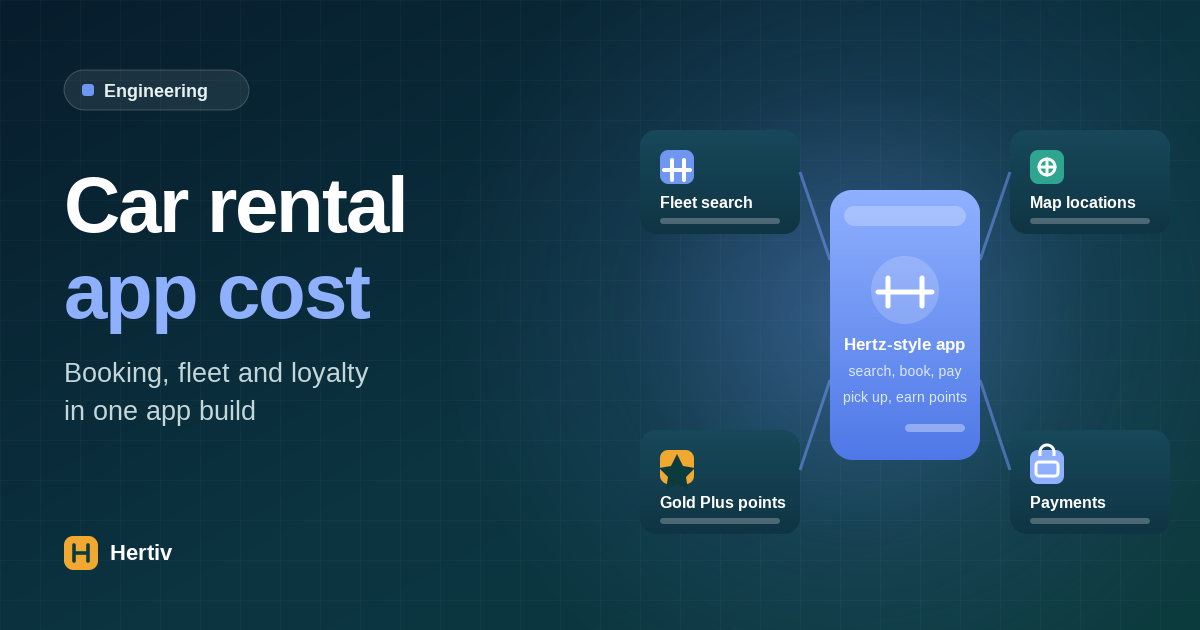
The Hertz app lets customers search for rental cars and locations, browse availability on a map, book and check out, and view, modify or review reservations. Hertz Gold Plus Rewards members can earn points, see upcoming reservations and rental history, and redeem or exchange points to pay for rentals in the app. Membership in the programme is free, and free rental days start at 950 points.
That mix is what makes it a useful model. It is not just a booking screen: it combines fleet search, map browsing, reservations, payments, loyalty and receipts in one place. A team copying it needs to build all of those parts, not just the checkout.
What features does an app like Hertz need?
The table below sets out the features a Hertz-style app needs, split into what a first version must have and what can wait for a later release.
| Feature | First version | Later release |
|---|---|---|
| Car search | Yes, by date, class and price | Filters for EV, size and extras |
| Location finder | Yes, list and map view | Availability at each location |
| Booking and checkout | Yes, with dates and times | One-touch booking for repeat users |
| Payments | Cards and wallets | Saved cards, split payment |
| Loyalty rewards | Points balance and redemption | Tiers, upgrades and offers |
| Reservation changes | Yes, modify and cancel | Extend a rental in the app |
| Receipts and history | Yes, past rentals listed | Expense report export |
| Pick-up and return | Directions and hours | Keyless pick-up, damage photos |
Loyalty deserves more care than most teams expect. Hertz Gold Plus Rewards is the reason many customers open the app at all, so the points balance, the status and the redemption flow need to be right from the start. A points ledger needs rules for earning, expiry and redemption, plus fraud checks, and it must work across booking channels.
Fleet data is the second feature that shapes the build. Each car needs a location, a class, a price, availability rules and a condition record, and the app must show only cars that are actually rentable at that time. A fleet feed that drifts out of date produces bookings for cars that are not there, which is the fastest way to lose a customer.
How much does an app like Hertz cost?
A first version with car search, booking, payments, basic loyalty and reservation changes usually lands in the $150,000–$300,000 range. A full product with map browsing, loyalty tiers, keyless pick-up and fleet tools usually lands in the $300,000–$600,000 range, and a large-scale build across many locations with deep integrations can pass $600,000. These are indicative ranges, not quotes, and the final figure depends on scope.
| Build | Indicative cost | What is included |
|---|---|---|
| First version | $150,000–$300,000 | Search, booking, payments, basic loyalty, receipts |
| Full product | $300,000–$600,000 | Map search, loyalty tiers, pick-up tools, admin panel |
| Large scale | $600,000–$1,200,000+ | Many locations, fleet systems, telematics, personalisation |
Platform choice moves the figure more than any single feature. One shared codebase for iOS and Android costs less than two native apps, and a web booking page adds a third surface. Most teams start with one shared mobile codebase and add native work only where the shared code falls short.
For a comparable like-app build, see the cost of a car rental app like Ekar.
For the delivery-app side of the same pattern, see how much an app like Grab costs to build.
For the development route, see mobile app development.
What drives the cost up or down?
Five drivers decide where in the range a Hertz-style app lands. The first is integrations: a standalone booking app is one build, while an app wired into fleet management, pricing, insurance and payment systems is several builds joined together.
The second is loyalty depth. Basic points and redemption are straightforward, but tiers, upgrades, free-day rules and expiry need a rules engine and careful testing, because a wrong reward costs real money. The third is fleet data: keeping availability, prices and locations accurate across a changing fleet is ongoing work, not a one-off task.
The fourth is payments. Cards and wallets are standard, but deposits, refunds, damage charges and split payments each add edge cases. The fifth is location count: one depot needs one fleet list, while a hundred locations need per-location fleets, prices, hours and availability, plus an admin tool to manage them.
The drivers that push cost down are a single shared codebase, a small launch fleet, and a first version that skips keyless pick-up and personalised offers. The drivers that push it up are deep integrations, complex loyalty rules and a large location count at launch.
How to build an app like Hertz, step by step
Building a Hertz-style app takes a team through seven steps, from the fleet data to the launch. The data work comes early, because the search, the pricing and the loyalty rules all depend on it.
- Map the fleet data. List every car, its class, location, price, availability rules and condition. Fix the data before building screens around it.
- Design the booking flow. Sketch searching, choosing a car, checkout and pick-up, and test the flow with real customers.
- Build the booking core. Search, cart, checkout and payments come first, with location and date handling built in rather than added later.
- Add loyalty and rewards. Build the points ledger, reward rules and expiry handling, and connect rewards to booking so they work at checkout.
- Connect the fleet systems. Wire the app into fleet management, pricing and insurance so bookings flow without staff retyping them.
- Add pick-up and admin tools. Build directions, hours, pick-up instructions and a location admin panel for fleets, prices and hours.
- Pilot in a few locations. Launch in a small group of depots, watch the failure points, fix them, then roll out to the rest.
The pilot step matters more for rental apps than for most products. A bug in a shopping app is an annoyance; a bug in a rental app sends a customer to a depot where the car they booked is not there. Pilot with a few locations, keep the phone booking channel open, and expand only when the failure rate is low.
Example (hypothetical): a 40-car fleet launch
Example (hypothetical): a rental company with 40 cars builds an app like Hertz for $180,000. In the first year the app brings 600 extra rental days a month across the fleet, and each extra rental day adds $18 of margin after fuel, cleaning and payment costs.
The extra margin is 600 x $18 = $10,800 a month. At that rate the build pays for itself in $180,000 / $10,800 = about 17 months, if the booking volume holds.
The figure changes fast if the assumptions move. If the app brings only 400 extra rental days a month, the margin is 400 x $18 = $7,200 a month and the payback stretches to $180,000 / $7,200 = 25 months. If the margin per rental day is $24 instead of $18, the payback shortens to $180,000 / $14,400 = about 13 months.
The lesson is to model the payback on rentals the app actually adds, not on all app bookings. Rentals from customers who would have phoned in anyway do not pay for the build; only the extra rental days do.
What are the common mistakes?
The most common mistakes teams make with a Hertz-style app are treating loyalty as a setting, bolting fleet data on late, and launching in every location at once.
- Loyalty as an afterthought. Wrong points or a failed redemption at checkout will lose a repeat customer faster than a slow screen. The ledger needs the same care as the payments code.
- Fleet data added late. Availability that is not live produces bookings for cars that are not there. The fleet feed must be live from the first release.
- Launching everywhere at once. A bug that hits one depot is a fix; the same bug across a hundred locations is a crisis. Pilot first.
- No location admin tool. Without a panel for fleets, prices and hours, every change needs a developer, and the listings drift out of date.
- Ignoring pick-up. An app that books well but leaves the customer guessing at the depot has only done half the job. Directions, hours and pick-up instructions matter.
- Copying the brand, not the model. Hertz works because of fleet breadth, loyalty and easy pick-up, not because of its name. Copy the model, not the brand.
Key takeaways
- A first version runs $150,000–$300,000
- Loyalty is the reason customers open the app
- Fleet data must be live from the first release
- Integrations decide the real cost
- Pilot in a few locations before rolling out
Frequently asked questions
How much does a car rental app cost to build?
A first version with car search, booking, payments, basic loyalty and reservation changes usually costs $150,000–$300,000, and a full product with map search, loyalty tiers and pick-up tools usually costs $300,000–$600,000. These are indicative ranges, and the final figure depends on fleet size and integrations.
What is Hertz Gold Plus Rewards?
Hertz Gold Plus Rewards is Hertz loyalty programme. Membership is free, members earn points for every dollar spent, and free rental days start at 950 points. Members can skip the line at select locations, see their points balance in the app, and redeem points to pay for rentals.
Do I need iOS and Android apps?
Most teams start with one shared codebase for both platforms, which costs less than two native apps. Native work is added only where the shared code falls short, such as keyless pick-up or deep payment features.
How long does it take to build an app like Hertz?
A first version usually takes three to six months, depending on scope and integrations. Deep links into fleet management, pricing and insurance systems add time, as does a complex loyalty programme.
Can customers pay with loyalty points in the app?
Yes. Hertz Gold Plus Rewards members can redeem or exchange points to pay for rentals directly in the app. A similar app needs a points ledger, redemption rules and a checkout step that applies points before charging the card.
What is the hardest part of a car rental app?
Keeping fleet availability accurate. Each car needs a live location, class, price and availability record, and the app must show only cars that are actually rentable. A stale fleet feed produces bookings for cars that are not there.


