How Much Does an App Like Grill'd Cost to Build?
An app like Grill'd needs ordering, delivery, loyalty rewards and dietary filters. Here is what each part costs and what a first version usually runs to.
On this page
Short answer
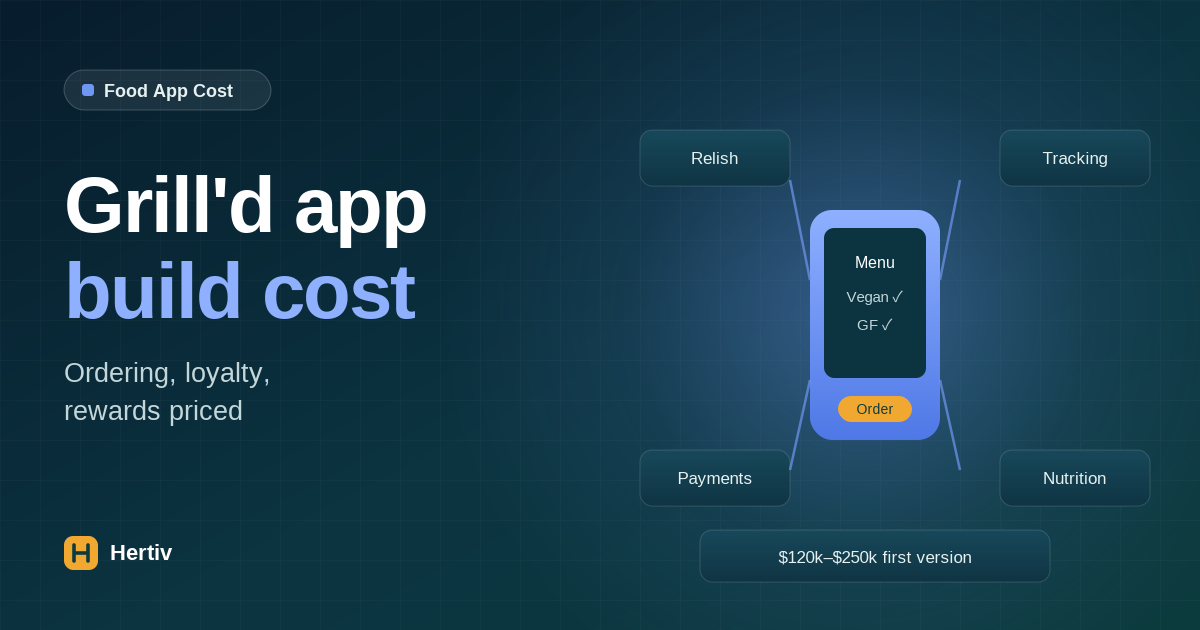
An app like Grill'd — the Australian burger chain's ordering app — typically costs $120,000–$250,000 for a first version with ordering, payments, loyalty rewards and dietary filters, and $250,000–$500,000 for a full product. The final figure depends on platforms, integrations with kitchen and delivery systems, and how much of the loyalty and personalisation work is included.
What is an app like Grill'd?
An app like Grill'd is a restaurant ordering app modelled on the one run by Grill'd, the Australian burger chain founded in 2004 by Simon Crowe in Hawthorn, Melbourne. The chain now runs 172 locations across Australia and one in Seminyak, Bali, and its app is the main way regular customers order.
The app lets customers order at the table, for delivery and for takeaway, filter the menu for dietary needs, check nutritional information, pay securely and track their orders. It also carries the Relish rewards programme, so customers earn benefits as they order, and lets them vote for Local Matters community groups.
That mix is what makes it a useful model. It is not just an ordering screen: it combines menu browsing, dietary filters, payments, order tracking, loyalty and community voting in one place. A team copying it needs to build all of those parts, not just the checkout.
What features does an app like Grill'd need?
The table below sets out the features a Grill'd-style app needs, split into what a first version must have and what can wait for a later release.
| Feature | First version | Later release |
|---|---|---|
| Menu browsing | Yes, with photos and prices | Seasonal menus and bundles |
| Dietary filters | Yes, vegetarian, vegan, gluten-free | Allergen warnings per item |
| Nutritional information | Yes, per item | Custom nutrition goals |
| Ordering | Takeaway and delivery | Order at table, dine-in |
| Payments | Cards and wallets | Saved cards, split payment |
| Order tracking | Yes, status updates | Live map tracking |
| Loyalty rewards | Points and rewards | Tiers, personalised offers |
| Community voting | Basic voting | Donation tracking, group pages |
Dietary filters deserve more care than most teams expect. Grill'd built its name on burgers for different diets, so the filters are part of the product, not a setting. Each item needs reliable dietary tags and nutritional data, and the kitchen needs to see the same tags so a filtered order is made correctly.
Loyalty is the second feature that shapes the build. Relish-style rewards need a points ledger, reward rules, expiry handling and fraud checks, and they must work across ordering channels. A loyalty system bolted on after launch costs more than one designed in from the start.
How much does an app like Grill'd cost?
A first version with ordering, payments, loyalty rewards and dietary filters usually lands in the $120,000–$250,000 range. A full product with order-at-table, live tracking, loyalty tiers and personalised offers usually lands in the $250,000–$500,000 range, and a large-scale build across many stores with deep integrations can pass $500,000. These are indicative ranges, not quotes, and the final figure depends on scope.
| Build | Indicative cost | What is included |
|---|---|---|
| First version | $120,000–$250,000 | Menu, ordering, payments, basic loyalty, dietary filters |
| Full product | $250,000–$500,000 | Order at table, live tracking, loyalty tiers, offers, admin tools |
| Large scale | $500,000–$1,000,000+ | Many stores, kitchen and delivery integrations, personalisation |
Platform choice moves the figure more than any single feature. One shared codebase for iOS and Android costs less than two native apps, and a web ordering page adds a third surface. Most teams start with one shared mobile codebase and add native work only where the shared code falls short.
For a comparable like-app build, see how much an app like Wattpad costs to build.
For the delivery side, see the cost of a food delivery app like Glovo.
For the development route, see mobile app development.
What drives the cost up or down?
Five drivers decide where in the range a Grill'd-style app lands. The first is integrations: a standalone ordering app is one build, while an app wired into point-of-sale, kitchen display, delivery and stock systems is several builds joined together.
The second is loyalty depth. Basic points and rewards are straightforward, but tiers, personalised offers and expiry rules need a rules engine and careful testing, because a wrong reward costs real money. The third is dietary data: keeping tags and nutrition data accurate across a changing menu is ongoing work, not a one-off task.
The fourth is payments. Cards and wallets are standard, but saved cards, refunds, split payments and delivery fees each add edge cases. The fifth is store count: one store needs one menu, while a hundred stores need per-store menus, prices, hours and availability, plus an admin tool to manage them.
The drivers that push cost down are a single shared codebase, a small launch menu, and a first version that skips live map tracking and personalised offers. The drivers that push it up are deep integrations, complex loyalty rules and a large store count at launch.
How to build an app like Grill'd, step by step
Building a Grill'd-style app takes a team through seven steps, from the menu data to the launch. The data work comes early, because the dietary filters and loyalty rules both depend on it.
- Map the menu data. List every item, its dietary tags, nutritional data, price and availability rules. Fix the data before building screens around it.
- Design the ordering flow. Sketch browsing, customisation, checkout and tracking for takeaway, delivery and order at table, and test the flow with real customers.
- Build the ordering core. Menu, cart, checkout and payments come first, with dietary filters built in rather than added later.
- Add loyalty and rewards. Build the points ledger, reward rules and expiry handling, and connect rewards to ordering so they work at checkout.
- Connect the store systems. Wire the app into point-of-sale, kitchen display and delivery so orders flow without staff retyping them.
- Add tracking and admin tools. Build order status updates and a store admin panel for menus, prices, hours and availability.
- Pilot in a few stores. Launch in a small group of stores, watch the failure points, fix them, then roll out to the rest.
The pilot step matters more for food apps than for most products. A bug in a shopping app is an annoyance; a bug in a food app sends the wrong order to a hungry customer at lunch. Pilot with a few stores, keep the old ordering channel open, and expand only when the failure rate is low.
Example (hypothetical): a 12-store launch
Example (hypothetical): a burger chain with 12 stores builds an app like Grill'd for $180,000. In the first year the app brings 1,500 extra orders a week across the 12 stores, and each extra order adds $4 of margin after food, delivery and payment costs.
The extra margin is 1,500 x $4 = $6,000 a week. At that rate the build pays for itself in $180,000 / $6,000 = 30 weeks, or about seven months, if the order volume holds.
The figure changes fast if the assumptions move. If the app brings only 1,000 extra orders a week, the margin is 1,000 x $4 = $4,000 a week and the payback stretches to $180,000 / $4,000 = 45 weeks. If the margin per order is $6 instead of $4, the payback shortens to $180,000 / $9,000 = 20 weeks.
The lesson is to model the payback on orders the app actually adds, not on all app orders. Orders from customers who would have phoned in anyway do not pay for the build; only the extra orders do.
What are the common mistakes?
The most common mistakes teams make with a Grill'd-style app are treating dietary filters as a setting, bolting loyalty on late, and launching in every store at once.
- Dietary tags as an afterthought. Wrong tags on a gluten-free or vegan order are a health risk, not a display bug. The tags need the same care as the payments code.
- Loyalty added late. A points ledger designed after launch has to be fitted around live orders, which costs more than building it in from the start.
- Launching everywhere at once. A bug that hits one store is a fix; the same bug across a hundred stores is a crisis. Pilot first.
- No store admin tool. Without a panel for menus, prices and hours, every change needs a developer, and the menu drifts out of date.
- Ignoring the kitchen. An app that does not talk to the kitchen display leaves staff retyping orders, which wipes out the speed the app was meant to add.
- Copying the menu, not the model. Grill'd works because of dietary choice, loyalty and community, not because of its burger names. Copy the model, not the menu.
Key takeaways
- A first version runs $120,000–$250,000
- Dietary filters are part of the product
- Loyalty needs a ledger, not a bolt-on
- Integrations decide the real cost
- Pilot in a few stores before rolling out
Frequently asked questions
How much does a restaurant ordering app cost?
A first version with ordering, payments, loyalty rewards and dietary filters usually costs $120,000–$250,000, and a full product with order at table, live tracking and loyalty tiers usually costs $250,000–$500,000. These are indicative ranges, and the final figure depends on platforms and integrations.
What is Grill'd?
Grill'd is an Australian burger chain founded in 2004 by Simon Crowe in Hawthorn, Melbourne. It now runs 172 locations across Australia and one in Seminyak, Bali, and is known for healthier burgers, dietary choice and its Local Matters community programme.
What is Relish in the Grill'd app?
Relish is Grill'd rewards programme inside its app. Customers earn benefits as they order, and the app also lets them vote for Local Matters community groups. A similar programme needs a points ledger, reward rules and expiry handling.
Do I need iOS and Android apps?
Most teams start with one shared codebase for both platforms, which costs less than two native apps. Native work is added only where the shared code falls short, such as deep payment or tracking features.
How long does it take to build an app like Grill'd?
A first version usually takes three to six months, depending on scope and integrations. Deep links into point-of-sale, kitchen display and delivery systems add time, as does a complex loyalty programme.
Can the app handle dietary requirements?
Yes, if the menu data is built for it. Each item needs reliable dietary tags and nutritional data, and the kitchen needs to see the same tags so a filtered order is made correctly. The tags need the same care as the payments code.


