Compliance Management Software in Australia: A Build Guide
Compliance software helps Australian firms track obligations, map controls and keep audit evidence in one place. Here is what to build and which rules shape it.
On this page
Short answer
Compliance management software is a system that records what rules apply to a business, maps controls to each rule, collects evidence and flags gaps before an audit. For Australian firms the rules include the Privacy Act, the SOCI Act, APRA CPS 234 and the Essential Eight. Building it means modelling obligations, controls and evidence as linked records, not as documents.
What is compliance management software?
Compliance management software is a system that records which rules apply to a business, maps controls to each rule, collects evidence and flags gaps before an audit. Instead of tracking obligations in spreadsheets and shared folders, a team works from one register where every rule, control, owner and piece of evidence is linked.
For an Australian firm, the rules can include the Privacy Act, the Security of Critical Infrastructure Act, APRA's CPS 234 and the Essential Eight. Each rule creates obligations, and each obligation needs one or more controls that someone owns and can prove. The software's job is to keep those links visible and current.
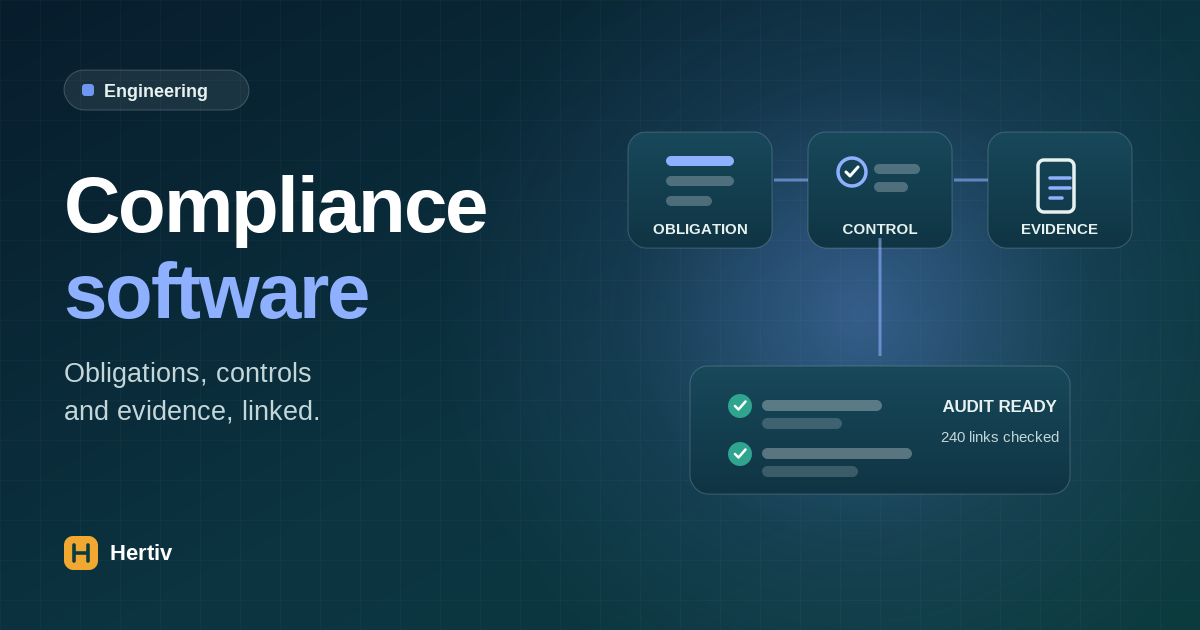
A useful way to think about it is as three linked lists. The obligation register lists what the law and standards require. The control register lists what the business does to meet each requirement. The evidence register holds the records that prove the controls run. When one of the three is missing, the firm has a gap it can see and fix.
Teams that buy or build this software usually do so after an audit finding, a new regulation or a customer questionnaire exposes how scattered their records are. The product pays for itself when the next audit starts from evidence rather than from a search.
Which Australian rules shape the product?
Australian compliance software must model the rules its customers actually face, and those rules differ by sector. A health provider, a bank and a critical infrastructure operator share some obligations and differ sharply on others, so the product needs a rule library that can be switched on per customer.
| Rule or standard | Who it covers | What the software must track |
|---|---|---|
| Privacy Act 1988 and NDB scheme | Most businesses over $3m turnover | Personal information handling, breach assessment and notification |
| Security of Critical Infrastructure Act 2018 | Critical infrastructure operators | Risk management programme, incident reporting to the ACSC |
| APRA CPS 234 | APRA-regulated entities and their suppliers | Information security controls, third-party testing, incident notification |
| Essential Eight | Government and many private firms | Eight mitigation strategies and maturity levels 0 to 3 |
| Cyber Security Act 2024 | Ransomware victims and smart device makers | Ransomware payment reporting, security standards for devices |
| PCI DSS | Businesses that handle card payments | Card data controls, network segmentation, testing |
The table is a starting point, not a legal opinion. Rules change, and a customer in a regulated sector will have more obligations than a small retailer. The product should let a compliance officer add, edit and retire rules without a developer, because the rule set is the part that changes most often.
Australian teams can read the local compliance picture in the IT compliance for Australian business guide before scoping the rule library.
What features does compliance management software need?
Compliance management software needs six features to be useful: an obligation register, control mapping, evidence collection, task tracking, reporting and an audit trail. Without any one of them, the team ends up keeping part of the work in another tool, and the register goes stale.
The obligation register is the foundation. Each obligation records the source rule, what it requires, which part of the business it applies to, and who owns it. The control mapping then links each obligation to the controls that meet it, with a status for each control: in place, partial or missing.
Evidence collection is where most products fail. Evidence should attach to a control with a date and a source, so an auditor can see not just that a control exists but that it ran last month. Screenshots, reports and test results all count, but only if they are tied to the control they prove.
Task tracking turns gaps into work. When a control is missing or evidence is out of date, the system should create a task with an owner and a due date. Reporting then rolls the register up into a dashboard: how many obligations are covered, which controls are overdue, and what changed since last quarter. The audit trail records every change, so the history itself is evidence.
How do you model obligations, controls and evidence?
You model obligations, controls and evidence as three linked records, with a control able to serve several obligations and an obligation able to need several controls. That many-to-many shape is the core design decision, and getting it wrong is the most expensive mistake in the build.
A practical model looks like this. An obligation has an id, a source rule, a plain-language requirement, an owner and a review date. A control has an id, a description, a type such as preventive or detective, an owner and a test frequency. A link record joins them with a status and a note. Evidence is a file or a record attached to a control, with a date and the person who collected it.
Keep the model simple at first. Teams are tempted to add risk scores, control families and framework crosswalks in version one, and the extra fields slow down data entry until nobody updates the register. Start with the three records and the link, then add scoring once the register is actually being used.
Permissions matter as much as the model. Control owners should be able to update their own controls and upload evidence, but they should not be able to mark their own control as compliant without a reviewer. That separation is what makes the register credible in an audit, and it is a small amount of code to add early.
Example (hypothetical): a 120-person firm rolls it out
Example (hypothetical): a 120-person professional services firm in Brisbane decides to replace spreadsheets with compliance management software. Its compliance officer lists 120 obligations from the Privacy Act, the Essential Eight and its client contracts.
Mapping takes the longest. The team links an average of two controls to each obligation, which gives 120 times 2, or 240 control links. Reviewing each link takes about 15 minutes, so the mapping work is 240 times 15 minutes, or 3,600 minutes, which is 60 hours. Spread over six weeks, that is 10 hours a week for one person.
Evidence collection follows. The team finds that 180 of the 240 control links already have evidence somewhere, usually in email or a shared drive, and 60 need new evidence. Collecting the missing 60 takes about 30 minutes each, or 30 hours. The total first build is therefore about 90 hours of staff time plus the software cost.
After launch, the firm reviews one twelfth of the register each month, so every obligation is rechecked once a year. That steady rhythm is the real product benefit: the register stays current because the work is spread out instead of piling up before an audit.
What are the common mistakes?
The most common mistakes in compliance management software are building a document store instead of a register, copying a foreign rule set, and letting the data go stale after launch.
- Storing documents instead of links. A folder of policies proves nothing. The value is in the link between an obligation, its control and its evidence.
- Copying a US or EU rule set. Australian rules differ in detail, from breach notification timing to APRA reporting. A foreign library creates false confidence.
- No owner per obligation. An obligation without a named owner is nobody's job, and its evidence will be the first to go out of date.
- Over-scored version one. Risk scores and maturity ratings look impressive but mean little until the underlying data is trustworthy.
- No review rhythm. A register that nobody reviews monthly will be wrong by the time the audit starts, however good the software is.
- Ignoring the auditor's view. If an auditor cannot export the register with its evidence in an afternoon, the team will rebuild the whole thing in spreadsheets.
Most of these are process mistakes, not software mistakes. The software can make the right behaviour easy, but it cannot force a team to review its obligations. Budget for the operating rhythm, not just the build.
How do you start building compliance management software?
You start building compliance management software by modelling the register with real obligations from one customer, then adding the workflow around it. A prototype built on invented rules will look finished and fail on first contact with a real audit.
- Pick one customer and one rule set. The Privacy Act plus the Essential Eight is a good first scope for an Australian product.
- Build the three-record model. Obligations, controls and evidence, with the link between them, and nothing else in version one.
- Import a real register. Take the customer's spreadsheet and load it, so the design is tested against real data from day one.
- Add the review workflow. Owners update controls, reviewers approve, and overdue items raise tasks automatically.
- Build the auditor export. One report that shows each obligation, its controls, its evidence and its history.
- Add the rule library last. Once the register works for one customer, package the rules so the next customer can switch them on.
That order keeps the build honest. Each step is tested against a real register, and the features that auditors actually ask for arrive before the features that only look good in a demo. For the broader security picture, data security and compliance services covers how firms run the programme the software supports.
Key takeaways
- The register links obligations, controls and evidence, so gaps are visible
- Australian rules differ by sector: Privacy Act, SOCI Act, CPS 234, Essential Eight
- Evidence must attach to a control with a date, or it proves nothing
- Start with the three-record model and add scoring only once it is used
- A monthly review rhythm keeps the register current between audits
Frequently asked questions
What is the difference between compliance software and a policy library?
A policy library stores documents. Compliance software links each rule to the controls that meet it and the evidence that proves the controls run. The link is the difference: it lets a team see which obligations are covered, which are not, and what is overdue.
Which Australian rules should the software cover first?
Start with the Privacy Act and the Essential Eight, which apply to most firms, then add the SOCI Act and CPS 234 for critical infrastructure and APRA-regulated customers. Add sector rules per customer rather than trying to cover every rule in version one.
How much does compliance management software cost to build?
That depends on scope, integrations and the rule library, and prices vary too much to quote here, so ask vendors for a written quote or see vendor site. The bigger cost is usually staff time for mapping obligations and collecting evidence, which the example above puts near 90 hours for a mid-size firm.
Do small firms need compliance management software?
Most small firms manage with a spreadsheet and a calendar until obligations grow past what one person can hold in their head. A useful trigger is the first customer questionnaire or audit finding that takes more than a day to answer from scattered records.
What is CPS 234 and who must follow it?
CPS 234 is APRA's information security standard. It applies to APRA-regulated entities such as banks, insurers and superannuation funds, and to their suppliers. It requires controls for information assets, third-party testing and prompt notification of security incidents to APRA.
Can the software replace a compliance officer?
No. The software keeps the register current and makes gaps visible, but someone must still decide what each rule means for the business, judge whether a control is adequate, and answer the auditor. The product removes the admin work so the officer can do the judgement work.


