How Companies Are Actually Using Generative AI
Generative AI shows up in companies as coding assistants, support copilots, document processing, marketing drafts and internal knowledge search. Here is where it pays off.
On this page
Short answer
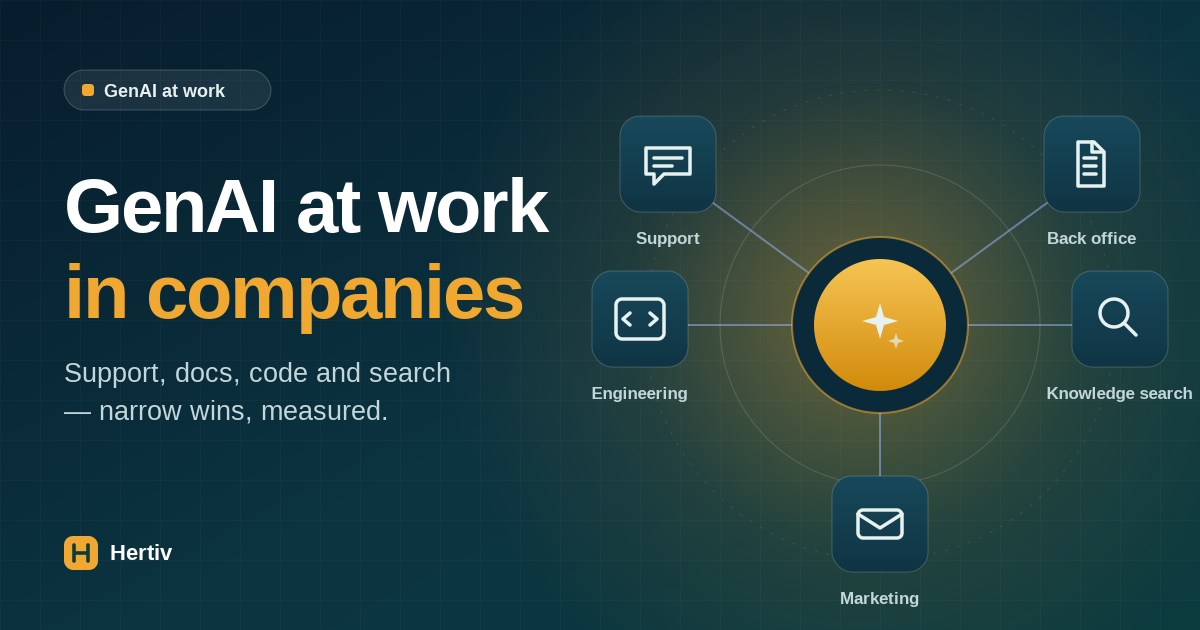
Companies use generative AI mainly in five places: software engineering, customer support, document-heavy back-office work, marketing content and internal knowledge search. The successful deployments are narrow, tied to a measurable workflow, and keep a human in the loop for anything customer-facing or regulated.
Where generative AI actually shows up in companies
Generative AI is used in companies wherever a person reads, writes or summarises text as part of a defined workflow. That is a wide net, but the deployments that survive contact with production are narrow and tied to a measurable task.
The pattern across industries is consistent. Teams start with an assistant that drafts, extracts or answers from approved sources, then add automation only after the output is trusted. The table below maps the common areas, what the model does and the effort involved.
| Area | What the model does | Typical data needed | Effort |
|---|---|---|---|
| Software engineering | Suggests code, tests and explanations inside the IDE | Codebase context, style guides | Low to medium |
| Customer support | Drafts replies from help-centre content and past tickets | Knowledge base, ticket history | Medium |
| Finance and accounting | Extracts fields from invoices, reconciles, drafts summaries | ERP data, invoice archives | Medium to high |
| Legal and contracts | Summarises clauses, flags deviations, drafts first passes | Contract repository, playbooks | Medium to high |
| Procurement | Reads quotes, compares suppliers, drafts RFQs | Supplier documents, spend data | Medium to high |
| Marketing | Writes first drafts, generates variants, localises | Brand guides, product data | Low |
| HR | Answers policy questions, drafts job descriptions | Policy documents, role frameworks | Low to medium |
| Internal knowledge search | Answers questions across wikis and documents | Indexed internal content | Medium |
Effort depends on how clean the source data is and how strict the review step must be. Regulated workflows take longer because every output needs an audit trail.
Software engineering: the most mature use case
Coding assistants are the most widely deployed generative AI use case in companies because the feedback loop is immediate: a developer accepts or rejects the suggestion in seconds. Tools that suggest completions, explain unfamiliar code and draft tests have become standard in engineering teams.
The value is not that the model writes whole systems. It is that it removes small frictions: boilerplate, unfamiliar APIs, test scaffolding and translation between languages. Teams that measure adoption usually look at how often suggestions are accepted and whether review time drops, not at lines of code generated.
Beyond the IDE, engineering teams use generative AI to draft documentation, summarise incident timelines and turn logs into readable postmortems. These are lower-risk because a human edits the output before it is shared.
If you are adding coding assistance to a regulated codebase, pair it with clear rules about what can be pasted into a hosted model and what must stay local. Our AI governance work covers that policy layer.
Customer support: copilots before chatbots
Support teams get the fastest return from a copilot that drafts a reply for an agent to review, not from a fully automated chatbot. The copilot retrieves the relevant help-centre article and past tickets, writes a draft, and lets the agent edit and send.
This design keeps the risk low. A wrong draft is caught before the customer sees it, and the agent learns from the correction. Over time, teams route the most repetitive, well-documented questions to a fully automated path and keep the rest human.
What the system needs to work:
- A clean, current knowledge base; the model is only as good as what it retrieves.
- Retrieval that cites the source article so the agent can check it.
- A logging layer so you can review drafts and catch drift.
Companies in telecoms, e-commerce and SaaS are the heaviest users, because their support volume is high and their answers are repeatable. If your support content is outdated, fix that before building the assistant. Hertiv's AI agents for customer support page describes how these systems are scoped.
Back office: finance, legal and procurement
Finance, legal and procurement teams use generative AI for document-heavy work where a person would otherwise read and retype. Invoice extraction, clause summarisation, supplier quote comparison and RFQ drafting are the common patterns.
The model does the first pass; a human approves. That approval step is not a weakness, it is the design. In finance, an extracted invoice field must be checked against the ERP; in legal, a flagged clause must be reviewed by a lawyer. The value is time saved per document, not full automation.
Example (hypothetical): a finance team processes 2,000 supplier invoices a month. If an extraction model pre-fills fields and an analyst only confirms exceptions, and exceptions run at roughly one in five invoices, the analyst reviews 400 documents instead of 2,000. That is a real reduction in manual work, but the analyst is still in the loop.
Procurement teams use the same pattern on quotes and contracts: the model reads, the buyer decides. Our AI agents for finance and AI agents for procurement pages cover the workflow design.
Marketing and content: drafts, not final copy
Marketing teams use generative AI to produce first drafts, variants and localised versions of content that a person then edits. Product descriptions, ad copy, email subject lines, social posts and landing-page variants are the usual targets.
The teams that get value treat the model as a fast first writer, not a publisher. They give it brand guidelines, tone examples and approved product facts, then review the output. Teams that skip the review step produce generic copy that reads the same as every competitor's.
Common patterns:
- Generate several variants for a campaign, pick one, edit it.
- Draft product descriptions from structured catalogue data.
- Localise existing copy into other languages, with a native reviewer.
- Summarise research and customer feedback into briefs.
Internal knowledge: the low-risk starting point
Internal knowledge search is one of the most common first generative AI projects because the risk is contained: the users are employees, and a wrong answer is caught before it reaches a customer. A retrieval system indexes policies, wikis, tickets and handbooks, then answers questions with citations to the source.
The reason it works is that companies already have the content; they just cannot find it. A new hire asking about expense policy, a salesperson checking a discount rule, a manager looking up parental leave: all of these are answered faster when the system retrieves the right paragraph and cites it.
What makes it succeed:
- Index only content that is current and owned by someone.
- Show the source document with every answer.
- Give content owners a way to retire stale pages.
How to pick the right first project
Pick a workflow that is frequent, text-heavy, has a clear owner and a way to check the output. That combination is what separates a project that ships from a pilot that stalls.
- List candidate workflows and estimate volume and time per task. High-volume, repetitive tasks are better first targets than rare, complex ones.
- Check the source data. If the policy, help article or contract template is missing or outdated, fix that first.
- Define the review step. Decide who checks the model output and what happens when it is wrong.
- Choose a narrow scope for the first version: one team, one document type, one channel.
- Set a success measure before building, such as time per ticket, documents reviewed per day or answer accuracy on a sample.
If you want a structured way to decide, an AI readiness assessment usually surfaces the two or three workflows worth doing first. Many teams also run a short proof of concept before committing to a full build.
Common mistakes
Most failed generative AI projects in companies fail for organisational reasons, not model quality. The model was good enough; the workflow around it was not.
- Starting with a broad "AI strategy" and no specific workflow.
- Building a chatbot before the knowledge base is accurate.
- Skipping the review step in a customer-facing or regulated process.
- Treating the model as a source of facts instead of a writer over retrieved facts.
- No logging, so nobody can tell whether output quality is drifting.
- No owner after launch, so the system quietly rots.
For teams planning beyond single assistants, agentic workflows that call tools and take actions need stricter controls. Hertiv's agentic AI development practice covers that boundary.
Key takeaways
- The highest-adoption area is software engineering, where coding assistants are embedded in the IDE and reviewed by developers.
- Support teams get the clearest ROI from retrieval-based copilots that draft replies from approved knowledge, not free-form chat.
- Back-office wins come from document extraction and summarisation in finance, legal and procurement, always with human approval.
- Marketing uses generative AI for first drafts and variant generation, with brand and legal review before publishing.
- Internal knowledge search over wikis, policies and tickets is a common early project because risk is low and value is easy to measure.
- Failures usually share one trait: no defined workflow, no owner, and no way to check whether output is correct.
Frequently asked questions
Which industries use generative AI the most?
Software, customer support, financial services, legal, e-commerce, marketing and professional services are the heaviest users. The common factor is a high volume of text-based work with a clear review step, not the industry label itself.
Are companies replacing staff with generative AI?
In most deployed systems, the model drafts or extracts and a person reviews. Full replacement is rare in customer-facing or regulated workflows because errors are costly. The measurable effect is usually time saved per task, not headcount removal.
What is the most common first generative AI project?
Internal knowledge search and support-draft copilots are the most common first projects. Both use content the company already has, keep a human in the loop, and produce a result that is easy to check.
How do companies measure whether generative AI is working?
They measure the task, not the model: time per ticket, documents reviewed per day, draft acceptance rate, or accuracy on a fixed sample. A success measure should be set before the build starts, with a baseline from the current process.
What data do companies need before starting?
You need the source content the model will read or retrieve: help articles, policies, contracts, invoices or product data. It should be current and owned by someone. Cleaning that content is often the largest part of the project.
Where does generative AI usually fail in companies?
It fails when there is no specific workflow, no owner, no review step and no measurement. Model quality is rarely the limiting factor in production; process design and content quality usually are.


