Choosing Machine Learning Solutions That Fit Your Business
Machine learning solutions range from pre-built APIs to custom models and ML platforms. Compare the main types, what each is best for, and how to pick one.
On this page
Short answer
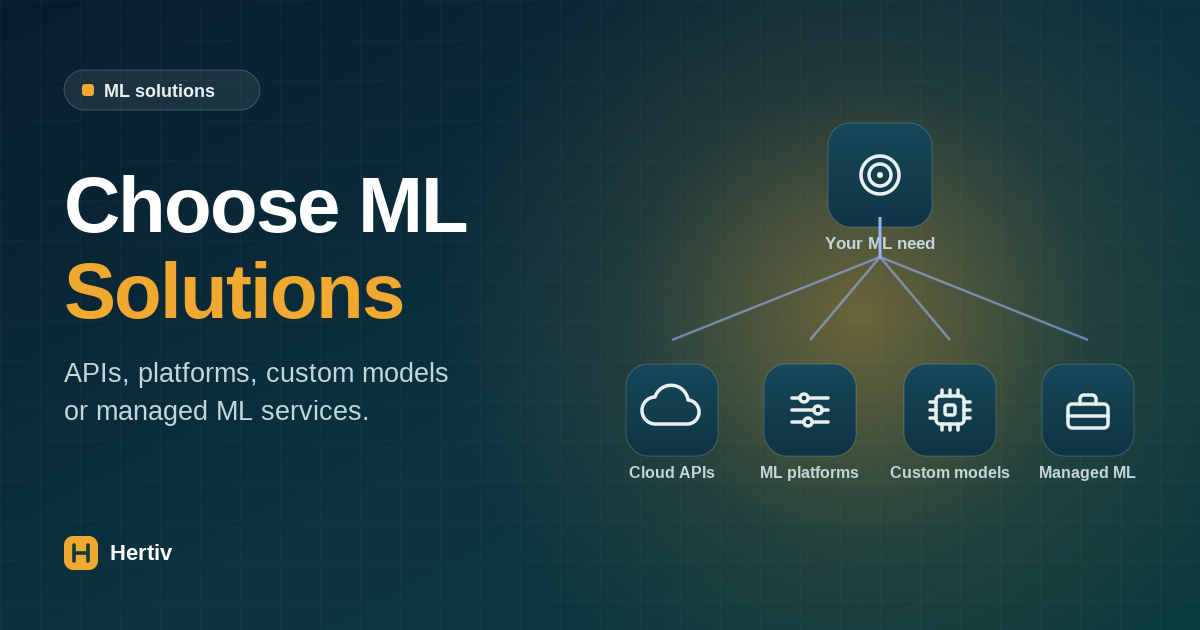
Machine learning solutions fall into four main types: pre-built cloud APIs, low-code ML platforms, custom model development, and end-to-end managed ML services. The right pick depends on how unique your data and workflow are, how much engineering capacity you have, and how tightly the model must fit your process.
What counts as a machine learning solution?
A machine learning solution is any product or service that uses trained models to make predictions, classify content, rank results or generate output from data. It can be an API you call, a platform you train on, or a model you build and operate yourself.
The label covers a wide range. At one end sit off-the-shelf APIs for tasks such as OCR or sentiment scoring. At the other end sit bespoke models trained on your own data and run inside your own cloud account. In between are low-code ML platforms, managed ML services and vertical ML products aimed at a specific function, such as demand forecasting or fraud scoring.
The practical question is not which type is technically best. It is which type matches how much of your advantage lives in the model, how much engineering time you can spare, and what your compliance team will accept. Many teams end up with a mix: an API for speech-to-text, a trained classifier for their own taxonomy, and a managed platform for the rest.
Hertiv's machine learning development services are built around that mixed reality rather than a single vendor stack.
How the main solution types compare
The table below groups the options a CTO is most likely to be pitched, with the kind of data needed and the effort involved.
| Type | What it does | Typical data needed | Effort |
|---|---|---|---|
| Pre-built cloud API | Runs a fixed model for OCR, speech, translation, vision or embeddings | None to start; some labelled samples for tuning | Low |
| Low-code ML platform | Lets analysts train, evaluate and deploy models through a UI | Labelled tabular or text data | Low to medium |
| AutoML | Searches model types and hyperparameters for you | Clean labelled dataset and a clear metric | Low to medium |
| Custom model development | Builds and tunes a model for your specific task | Domain data, labels, evaluation set | Medium to high |
| Managed ML service | Vendor runs training, deployment and monitoring | Your data plus a data-sharing agreement | Low internal, higher dependency |
| LLM-based solution | Uses a large language model, often with retrieval, for text tasks | Documents, prompts, evaluation examples | Medium |
| Open-source model stack | Self-hosted models you control end to end | Data, GPUs, MLOps team | High |
| Vertical ML product | A packaged model for one job such as fraud or forecasting | Integration access to your systems | Low to medium |
None of these rows is universally better. A pre-built API is often the right answer for a commodity task, while a custom model pays off only when the decision is close to the core of the product.
Pre-built APIs and low-code platforms
These are the fastest route from idea to a working feature, and they are usually the right first step unless your task is genuinely unusual.
Cloud AI APIs: best for commodity tasks
Every major cloud provider, plus several specialist vendors, offers ready-made models for vision, speech, language and document parsing. You send data, you get a result, and you pay per call.
Pros - Live in days, not months - No ML team needed to operate them - Regular model updates handled by the vendor
Cons - Limited control over model behaviour - Data leaves your environment unless you negotiate a private deployment - Accuracy on your specific domain may be acceptable but rarely excellent
Low-code ML and AutoML platforms: best for analysts with data
These tools train models through a graphical interface. They suit teams with labelled data and a clear prediction target, such as churn or lead scoring, but without deep ML engineers.
Pros - Analysts can ship models without a full engineering project - Built-in evaluation, versioning and deployment - Good fit for tabular problems
Cons - Ceiling appears quickly on complex text, image or ranking tasks - Easy to produce models nobody monitors - Vendor lock-in on the training pipeline
Custom models, LLM systems and managed services
When the task is close to your product's value, off-the-shelf stops being enough. This is where custom work and LLM-based systems come in.
Custom model development: best for unique data or decisions
A custom model is trained, evaluated and tuned on your own data. It is justified when the signal lives in your data, when latency or cost per call matters at scale, or when the output feeds a decision you must be able to explain.
Pros - Higher accuracy on your specific domain - Full control over hosting, latency and cost - The model becomes an asset you own
Cons - Needs labelled data, evaluation discipline and MLOps - Takes longer and costs more than an API - Requires ongoing retraining
LLM-based solutions: best for text-heavy workflows
Large language models, often combined with retrieval over your documents, handle summarisation, classification, extraction and drafting. For many teams this is the pragmatic middle path between an API and a bespoke model.
Pros - Handles messy natural-language input well - Fast to prototype with retrieval - Improves as you refine prompts and evaluation sets
Cons - Needs guardrails, evaluation and cost control - Hallucination risk must be managed explicitly - Data privacy and residency need care
Managed ML services: best when you lack MLOps capacity
A vendor trains, deploys and monitors models on your behalf. It reduces internal load but concentrates risk with one supplier.
Pros - Low operational burden - Faster time to production - Monitoring is often included
Cons - Data-sharing and residency questions - Hard to move later - You still own the outcome if the model fails
For teams building agents or copilots on top of these models, agentic AI development covers the orchestration and safety layer.
How to choose the right solution
Start from the decision, not the model. A short, disciplined sequence beats a broad platform comparison.
- Write the decision down. State the prediction or action the system must produce, who uses it and what happens when it is wrong. If you cannot describe the error cost, you are not ready to build.
- Set the evaluation metric first. Choose one primary metric and one guardrail metric before any model is tried. Agree what a useful result looks like in business terms.
- Test the cheapest option first. Try a pre-built API or a small LLM-based prototype against a labelled sample. If it clears the metric, stop there.
- Escalate only on evidence. Move to custom training or fine-tuning when the cheap option misses the metric for a reason you can name, such as domain vocabulary or class imbalance.
- Plan operations before launch. Decide who monitors drift, who retrains, who reviews errors and how the model is rolled back. A model without an owner is a liability.
A short AI readiness assessment can cover steps one and two before any build spend is committed.
Common mistakes when buying ML solutions
Most failed ML projects fail on framing and operations, not on model quality.
- Starting with the model. Picking a platform before defining the decision leads to a solution looking for a problem.
- No labelled evaluation set. Without a fixed test set, every vendor demo looks good and no comparison is real.
- Ignoring data quality. Labels, duplicates and changing definitions sink more models than algorithm choice.
- Skipping monitoring. A model that worked at launch decays quietly as inputs shift.
- Underestimating integration. The model is often the smaller half of the work; the surrounding workflow is larger.
- Treating governance as paperwork. Data residency, audit trails and human review need to be designed in, not bolted on.
Example (hypothetical): a support team wants to route tickets automatically. A pre-built classifier reaches 78% accuracy on a sample of 2,000 labelled tickets. The team decides that is below the target of 90%, trains a custom classifier on the same labels and reaches 91%. The extra cost was justified because the gap was measured, not assumed.
What to ask before signing with an ML vendor
The questions below separate a serious partner from a demo.
- Where does the model run, and can it run in our cloud or region?
- What happens to our data during training, and can we opt out of model improvement?
- How is accuracy measured on our data, and on what test set?
- Who owns the model weights, prompts and evaluation sets?
- What monitoring, drift detection and retraining are included after launch?
- What is the exit path if we want to move to another provider?
A good vendor answers these in writing before the contract. For text and document-heavy workflows, ask specifically how retrieval and evaluation are handled, because that is where most LLM systems succeed or fail. If the solution involves autonomous actions rather than predictions, review the security model early; our AI security work covers prompt injection, tool access and data boundaries.
For broader programme design, AI consulting can help turn the answers into a funded plan.
Key takeaways
- Pre-built APIs are fastest for generic tasks such as OCR, speech-to-text, translation and image tagging
- Low-code platforms suit teams that want to train models on their own data without building MLOps from scratch
- Custom model development is worth the cost when your data or decision logic is a real differentiator
- Managed ML services shift the operational burden but add vendor dependency and data-residency questions
- Start with a narrow prediction or classification problem and an evaluation metric agreed before build
- Always plan for monitoring, retraining and drift detection from day one, not after launch
Frequently asked questions
Are pre-built machine learning APIs accurate enough for production?
Often yes for commodity tasks such as OCR, speech-to-text and translation. They are usually a reasonable baseline for classification too. The only reliable test is your own labelled sample: measure the API against it before deciding, and keep a test set for later comparison.
When is a custom machine learning model worth the cost?
When the decision is central to your product, your data carries signal that generic models miss, or per-call cost and latency matter at scale. If a pre-built option already meets your target metric, a custom model adds cost and operational burden without clear benefit.
Do we need a dedicated ML team to run a solution?
Not for pre-built APIs or low-code platforms, though someone must own monitoring. Custom models and self-hosted LLMs do need engineering capacity for deployment, evaluation and retraining. Many mid-market teams start with a small team and add as scope grows.
How long does a typical machine learning project take?
It depends on data readiness more than model choice. A scoped proof of concept on prepared data can run in a few weeks, while a production system with integration, monitoring and governance usually takes months. Data cleaning is often the longest step.
How do we keep model accuracy from decaying after launch?
Monitor input distributions and prediction quality against a held-out sample, set alert thresholds, and schedule retraining. Assign a named owner for the model and keep a rollback path. Drift is normal; the failure is not noticing it.
Should we build on a large language model or a classical ML model?
Use classical models for structured prediction, scoring and ranking where you have labelled data. Use LLMs for unstructured text and document workflows. Many production systems combine both, with a classical model making the final decision and an LLM handling extraction or summarisation.


