How to Choose an AI Development Company in Dubai
AI development companies in Dubai range from vendors that resell model APIs to teams that ship production agents. Here is how to tell them apart and pick one.
On this page
Short answer
Choose an AI development company in Dubai by checking whether it can show production AI systems it owns end to end, how it handles your data and regulators such as DIFC and ADGM, and who stays on after launch. Ask for architecture decisions, not demo videos.
What does an AI development company in Dubai actually do?
An AI development company in Dubai designs, builds and operates AI systems for other organisations, from data pipelines and retrieval layers to agents, copilots and voice channels. The work usually runs from a scoping phase through to a live system with monitoring and a named owner.
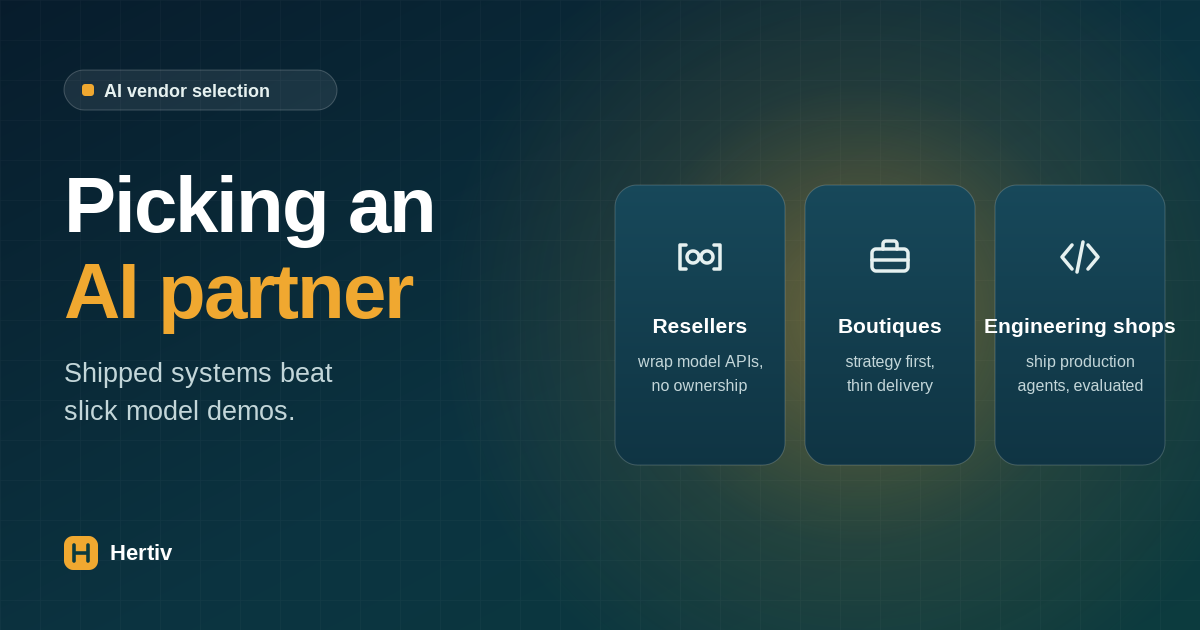
The label covers very different companies. A rough split helps before you shortlist:
| Supplier type | Typical strength | Typical limit |
|---|---|---|
| Global system integrator | Large programmes, enterprise procurement, ERP tie-ins | Slow discovery, AI often subcontracted |
| Regional software studio | Local presence, app and web delivery, Arabic-language UX | Shallow AI depth, thin evaluation practice |
| AI-native engineering team | Retrieval, agents, evaluation, model operations | Smaller bench, fewer legacy integrations |
| Offshore team with a Dubai front | Lower day rates | Data handling and time zone risk |
Most mid-market buyers in the UAE end up with either the regional studio or the AI-native team, because the first delivers broadly and the second delivers deeply. The important question is not which type is better but which one owns the part of the build that will actually be hard for you.
If the hard part is connecting a model to your documents, contracts or ticketing system, depth wins. If the hard part is a multi-country rollout across existing enterprise systems, breadth wins.
Which questions separate real AI builders from resellers?
The fastest filter is to ask how a system behaves when the model is wrong. Real builders have an answer; resellers talk about the model choice.
Ask these in the first call:
- Show the retrieval design for a live system. Chunking, metadata filters, re-ranking and how stale documents are handled.
- How do you evaluate answers? Expect a named evaluation set, a scoring method and a regression check before every release.
- What happens when the confidence is low? Expect a fallback to a human, a clarifier question, or a refusal, not a confident guess.
- Who holds the API keys and where do prompts and logs live? The answer should be specific about regions and vendors.
- What is still manual in the last system you shipped? An honest answer is a good sign.
The same set of questions applies whether you are buying a support assistant, a finance agent or an internal copilot. A longer version lives in our guide to choosing an AI development company.
How do data residency and UAE regulation affect the choice?
Regulation narrows the supplier list more than buyers expect. Where your data can sit, and which vendor can touch it, is decided before the model is chosen.
Three layers usually apply:
- Free-zone rules. If your entity sits in DIFC or ADGM, its data protection regime governs transfers and processor agreements, and it is not identical to the mainland position.
- Sector regulators. Financial firms, health providers and telecoms carry extra obligations on customer data and record keeping.
- Your own customers. Enterprise buyers in the region often ask for data residency commitments in the contract, regardless of the law.
In practice this means the vendor must be able to run models in a region you accept, including through cloud providers that host UAE regions, and must be able to keep prompts and logs out of third-party training. Ask for the data flow diagram, not a policy page.
What does a realistic first engagement look like?
A realistic first engagement is a paid, fixed-scope build with a production decision at the end, not a discovery phase followed by an open-ended programme.
A pattern that works well for mid-market teams:
- Two-week scoping. One workflow, success measures, data access confirmed.
- Four-week build. A working system on real data for a limited user group.
- Two-week evaluation. Accuracy against a labelled sample, latency, cost per interaction, and the failure cases written down.
- Decision. Proceed to production, change scope, or stop.
Example (hypothetical): a 400-person logistics firm budgets USD 25,000 for a scoping and pilot phase, then decides on a production build quoted as a typical range of USD 60,000 to 120,000 depending on integrations. The pilot spend is small enough to stop without a board debate, and large enough that the vendor has to do real work. Our AI proof of concept development page describes a four-week version of this.
Treat cost conversations as architecture conversations. A quote that cannot explain what drives the number is a number you cannot manage later.
How should you compare proposals from Dubai AI vendors?
Compare proposals on what is testable, not on what is promised. Four dimensions cover most of the decision.
- Scope and definition of done. Does the proposal name the workflow, the users and the acceptance criteria? "AI assistant for operations" is not a scope.
- Architecture. Model choice, retrieval, tool access, guardrails and hosting region. You want a one-page diagram you can defend internally.
- Team and continuity. Named engineers, their time commitment, and who is on call after launch.
- Commercials and exit. Milestones, payment tied to acceptance, and what you receive if you leave: code, prompts, evaluation sets, infrastructure as code.
A practical test: ask two vendors to price the same change request after the pilot. The one who can answer quickly has a system they understand.
On ownership, insist that everything lives in your cloud accounts or can be migrated to them. Vendors that keep the intelligence layer on their own platform create a dependency that is expensive to unwind.
Which build do you actually need first?
Start with the workflow that has the clearest input, the clearest output and a person who already does it today. That is usually a document-heavy or message-heavy process.
Common first builds we see requested in the region:
- Support and sales chat grounded in product and policy documents, with handover to staff. See AI chatbot development.
- Internal copilots over contracts, tenders or policy libraries, used by a named team.
- Operations and finance agents that draft, reconcile or route, with a human approving each action.
- Voice agents for inbound calls and booking, where Arabic and English handling matters.
Avoid starting with an agent that takes irreversible actions across many systems. Sequence matters: get retrieval and evaluation right on one workflow, then widen the tools the system can call.
If you are unsure where to start, a short readiness review of data access, process documentation and owner availability usually saves more than it costs.
What should you insist on after launch?
Production is where AI projects quietly fail, so the launch contract matters as much as the build. Insist on monitoring, evaluation and a named owner on both sides.
Minimum after-launch expectations:
- Quality monitoring. A sample of real interactions reviewed on a schedule, with a score you agree on.
- Regression tests. Every prompt, model or data change runs against the evaluation set before release.
- Cost and latency dashboards. Token or API spend per workflow, and response time percentiles.
- Incident path. Who is called when the model returns wrong answers at scale, and how fast the system can fall back to humans.
- Change log. Model versions pinned, with a record of when they change.
Model providers update and deprecate models on their own schedule. A vendor that pins versions and tests upgrades is protecting your service level, not just their code.
Ask also for a short handover pack: architecture, data sources, prompts, evaluation data and runbook. It is the cheapest insurance you can write into a contract.
Key takeaways
- Dubai has three distinct supplier types: system integrators, regional software studios and AI-native teams; each fits a different problem.
- Ask for the architecture of a live system, including retrieval, evaluation and fallback paths, not a chatbot demo.
- Data residency and sector rules matter: DIFC, ADGM and UAE federal guidance shape where models and logs can live.
- Fixed-scope pilots with a paid production decision beat large commitments signed before any code exists.
- Confirm who owns the code, prompts, evaluation sets and model adapters at the end of the engagement.
Frequently asked questions
How long does it take to build an AI system with a Dubai vendor?
A focused pilot on one workflow typically takes four to eight weeks including scoping. A production system with integrations, monitoring and staff training usually runs two to four months. Timelines depend more on data access and internal approvals than on the vendor's coding speed.
Should the AI company be based in Dubai?
Not necessarily, but local presence helps with procurement, data residency conversations and time zone overlap. What matters more is whether the team has shipped comparable systems and can work inside your cloud and compliance boundaries. Many buyers combine a local lead with remote engineering capacity.
What does AI development cost in Dubai?
Typical ranges vary widely by scope. A scoping and pilot phase often falls in the tens of thousands of US dollars, while a production build with several integrations is usually a six-figure range. Ask vendors to break the price into phases tied to acceptance criteria.
How do we protect our data with an AI vendor?
Agree the data flow in writing: which data leaves your systems, which model providers process it, where prompts and logs are stored, and whether they are used for training. Prefer vendors that run inside your cloud accounts and sign a processor agreement under the regime that applies to your entity.
Do Dubai AI companies build with local language support?
Many do, and it is worth testing early. Ask for evaluation results in Arabic and English on your own content rather than a generic demo. Retrieval and tone behave differently across languages, so the evaluation set should include both.
What if the pilot does not work?
That is the point of a pilot. Agree in advance what result would stop the project, keep the spend bounded, and require the vendor to hand over the code, prompts and evaluation data even if you do not continue. A stopped pilot with clear findings is a useful outcome.


