8 LLM Evaluation Tools Startups Can Shortlist
LangSmith, Langfuse, Phoenix, TruLens and four more cover most LLM evaluation needs. Compare them by what they score and where the checks run.
On this page
Short answer
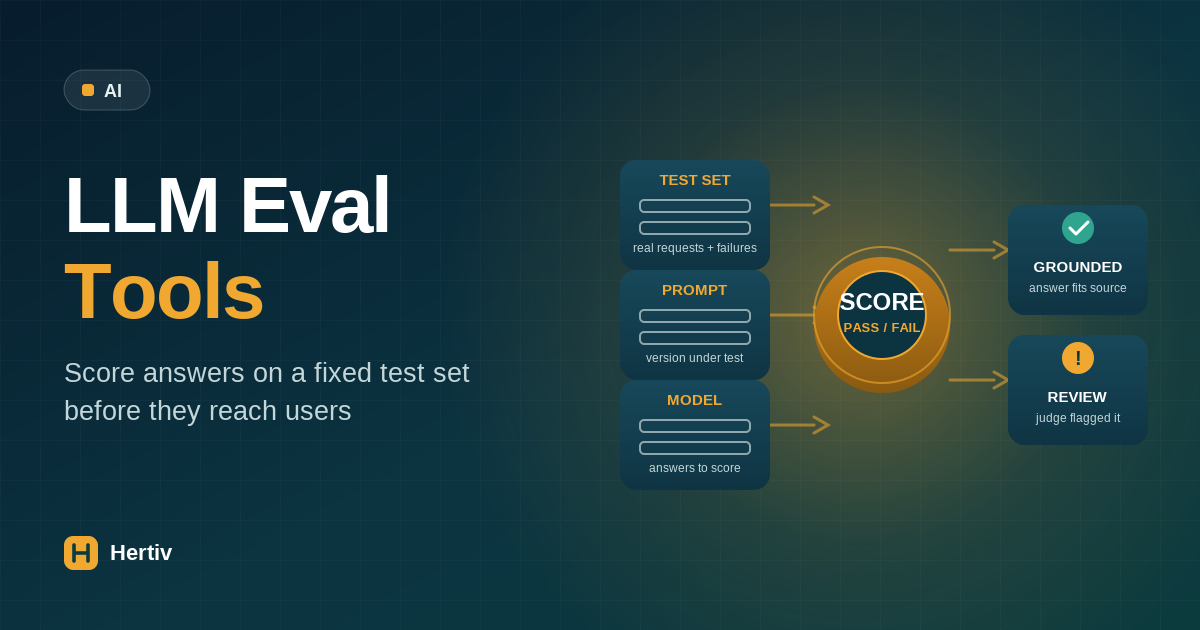
The LLM evaluation tools worth comparing for a startup are LangSmith, Langfuse, Arize Phoenix, TruLens, DeepEval, Ragas, Braintrust and Weights & Biases Weave. Each scores model answers against a fixed test set, but they differ in what they measure, whether they run in CI or on live traffic, and whether they can be self-hosted.
Which LLM evaluation tools should startups compare?
The LLM evaluation tools worth comparing for a startup are LangSmith, Langfuse, Arize Phoenix, TruLens, DeepEval, Ragas, Braintrust and Weights & Biases Weave. Each one scores model answers against a fixed test set, but they differ in what they measure and where the checks run.
Use this comparison to shortlist. All eight are in active use today, and several have a free tier or an open source version a small team can start with. Check the vendor's pricing page for current plans; prices change, so this article does not quote them.
| Tool | Best for | Open source | What it scores |
|---|---|---|---|
| LangSmith | Testing LangChain apps | Partly | Correctness, traces, feedback |
| Langfuse | Tracing and scoring in production | Yes | Quality scores, costs, traces |
| Arize Phoenix | Open source tracing and evals | Yes | Retrieval, hallucinations, traces |
| TruLens | RAG evaluation | Yes | Groundedness, retrieval, relevance |
| DeepEval | Evals in continuous integration | Yes | Correctness, hallucination, bias |
| Ragas | RAG metrics | Yes | Faithfulness, recall, precision |
| Braintrust | Evals and prompt management for teams | Partly | Scores, datasets, prompts |
| Weights & Biases Weave | Experiment tracking with evals | Partly | Scores, traces, model versions |
Start from the job, not the tool. A team shipping a retrieval-based assistant needs different checks from a team testing a chatbot's tone, so pick the tool whose checks match the failures you most need to catch. What LLM evaluation is and how it works explains the checks themselves.
LangSmith and Langfuse
1. LangSmith: best for testing LangChain apps
LangSmith is the evaluation and tracing platform built around LangChain, so a team already building with LangChain gets tracing, datasets and eval runs with little extra setup. You can run a prompt over a test set, score each answer with a written rule or a model judge, and see exactly where a chain went wrong.
Its strength is the link between traces and evals: when a test fails, you can open the trace and see every step the chain took, which makes fixing the prompt or the retrieval step much faster. The trade-off is that it fits LangChain apps best, so a team using another framework gets less of that out-of-the-box fit.
Pros:
- Traces and evals in one place, with datasets built in
- Strong fit for teams already using LangChain
- Model judges and human feedback both supported
Cons:
- Less natural for apps built outside LangChain
- Costs grow with trace volume, so sampling matters
- Self-hosting options are limited
2. Langfuse: best for tracing and scoring in production
Langfuse is an open source platform for tracing LLM calls, scoring answers and watching costs in production. It records every prompt, answer and score, so a team can see which prompts are failing, which users are affected and how much each model call costs.
Its strength is the production view: scores are collected on live traffic, not only on test sets, which catches problems a lab test would miss. The open source version can be self-hosted, which suits teams with strict data rules. The cost is setup and care: a team must define its own scores and keep the volume of stored traces under control.
Pros:
- Open source with a self-hosted option
- Scores on live traffic, not only on test sets
- Cost tracking per prompt and per model
Cons:
- Teams must write their own scoring rules
- Trace storage needs managing as volume grows
- Less built-in help for building the test set itself
Arize Phoenix and TruLens
3. Arize Phoenix: best for open source tracing and evals
Arize Phoenix is an open source tool for tracing LLM applications and running evaluations on retrieval and generation. It shows traces, spans and evaluation scores in one view, with a focus on spotting hallucinations and weak retrieval in RAG systems.
Its strength is that it is free to run and quick to try: a small team can point it at an app and start seeing traces the same day. The trade-off is that it is a tracing and evaluation tool, not a full platform, so teams that want dataset management, prompt versioning and hosted dashboards will need to add other pieces.
Pros:
- Open source and free to run
- Clear tracing views for RAG and agent apps
- Good checks for hallucinations and retrieval gaps
Cons:
- No hosted dataset or prompt management
- Needs other tools for a full evaluation workflow
- Less help for non-technical reviewers
4. TruLens: best for RAG evaluation
TruLens is an open source library that scores RAG applications on three questions: did the answer use the retrieved text, was the retrieved text relevant, and did the answer match the question. Those three checks catch the most common RAG failure, which is a fluent answer built on the wrong source or on no source at all.
Its strength is focus: the checks are specific to retrieval, and the results are easy to explain to a team. The trade-off is scope: it does not cover general chatbot quality, tone or safety, so teams with broader needs will pair it with another evaluation tool.
Pros:
- Open source, with RAG-specific checks built in
- Results are easy to explain and act on
- Works with most Python LLM frameworks
Cons:
- Focused on RAG, not on general chat quality
- Needs a dashboard or notebook to review results
- Teams must build their own test sets
DeepEval and Ragas
5. DeepEval: best for evals in continuous integration
DeepEval is an open source framework for writing LLM evaluations as code and running them in continuous integration, so a prompt or model change that breaks quality fails the build before it ships. It includes ready-made checks for correctness, hallucination, bias and answer relevance, plus a way to write custom checks.
Its strength is the CI fit: evaluations become tests, with pass and fail thresholds, which stops regressions from reaching users. The trade-off is that it is a code-first tool, so a team without engineers running the pipeline will find it harder to use than a hosted dashboard.
Pros:
- Open source, with evals that run as code in CI
- Ready-made checks for hallucination and bias
- Pass and fail thresholds stop bad changes shipping
Cons:
- Code-first, so non-engineers need help to use it
- Needs a hosted dashboard for team review
- Model judge scores vary, so thresholds need care
6. Ragas: best for RAG metrics
Ragas is an open source library that measures RAG systems with a small set of clear metrics: faithfulness, which checks whether the answer is grounded in the retrieved text; context recall, which checks whether the right passages were retrieved; and answer relevancy, which checks whether the answer addresses the question.
Its strength is that the metrics are standard and comparable, so a team can track them over time and see whether a retrieval change actually helped. The trade-off is that it measures the pipeline, not the whole product: tone, safety and business rules need separate checks. How to evaluate an LLM application before launch covers how to combine these checks into a launch decision.
Pros:
- Open source, with standard RAG metrics
- Metrics are comparable across runs and changes
- Light to add to an existing test suite
Cons:
- Measures the pipeline, not the whole product
- No hosted review interface of its own
- Needs a test set built from real requests
Braintrust and Weights & Biases Weave
7. Braintrust: best for evals and prompt management for teams
Braintrust is a platform for running LLM evaluations and managing prompts, with datasets, scores and version history in one place. A team can test a new prompt against a dataset, compare it with the old prompt side by side, and see which cases improved and which got worse.
Its strength is the team workflow: prompts are versioned like code, and reviewers can see scores without running anything themselves. The trade-off is that it is a hosted product with a narrower open source story than the tools above, so teams that must self-host everything will need to check what fits their rules.
Pros:
- Prompt versions and eval results in one place
- Side-by-side comparison of prompt changes
- Easy for non-engineers to review scores
Cons:
- Hosted first, with limited self-hosting
- Costs grow with team size and eval volume
- Less tracing depth than LangSmith or Langfuse
8. Weights & Biases Weave: best for experiment tracking with evals
Weights & Biases Weave adds evaluation and tracing to the experiment tracking that many machine learning teams already use. It records prompts, model versions, scores and traces together, so a team can see which model and prompt combination scored best on its test set.
Its strength is the link between experiments and evals: a team that already tracks fine-tuning runs can add evaluation without a new system. The trade-off is that it is strongest as part of the wider Weights & Biases platform, so a team that wants a standalone evaluation tool may find it heavier than a focused option such as DeepEval or Ragas.
Pros:
- Scores linked to model versions and experiments
- Strong tracing and comparison views
- Familiar to teams already using Weights & Biases
Cons:
- Heaviest as part of the wider platform
- Less RAG-specific than TruLens or Ragas
- Free tier limits suit small teams, not large ones
How to choose an LLM evaluation tool
You choose an LLM evaluation tool by matching it to the failures you most need to catch, then running your own test set through two tools before committing. A tool that fits another team's stack may not fit yours.
- List the failures that would hurt most. Wrong facts, weak retrieval, unsafe answers and high costs each point to different tools.
- Check the framework you already use. A LangChain team should shortlist LangSmith; a RAG team should look at TruLens, Ragas and Phoenix first.
- Decide where the checks must run. If evals must run in CI, pick DeepEval or Ragas; if they must run on live traffic, pick Langfuse or Phoenix.
- Run the same 30-case test set through two tools. The one that finds more real failures, and explains them clearly, is the right one.
- Check hosting and data rules. Self-hosted open source tools fit strict data rules; hosted tools are faster to start but hold your traces.
The test set is the decision. A tool that scores well on a vendor demo but misses your team's real failures is the wrong tool, whatever its feature list says. LLM fine-tuning services can help when evaluation shows a model needs more than better prompts.
What are the common mistakes?
The most common mistakes are scoring answers without a fixed test set, trusting a model judge without checking it, and treating evaluation as a one-off launch task. Each of these leaves a team blind to the failures that matter.
- No fixed test set. Scores that change with the test cases cannot be compared across runs, so build the set from real requests first.
- Trusting the judge blindly. A model judge can be wrong too, so check a sample of its scores against human judgement regularly.
- Only testing in the lab. Live traffic has cases a test set misses, so score a sample of real answers every week.
- Too many metrics. Five clear metrics a team acts on beat twenty that nobody reads.
- Ignoring cost. Tracing and scoring every call costs money, so sample traces and keep the volume under control.
- Skipping the CI step. If evals do not run on every change, a prompt edit can quietly break quality.
Evaluation works when it catches real failures early and gives the team a clear next fix. MLOps consulting can help set up the scoring and CI loop around it.
Key takeaways
- Start from the failures that would hurt most, then pick the tool whose checks catch them
- LangSmith fits LangChain apps; Langfuse and Phoenix fit tracing and scoring on live traffic
- TruLens, Ragas and DeepEval are the strongest open source options for RAG and CI evals
- Braintrust and Weave suit teams that need prompt versioning and experiment tracking
- Run the same 30-case test set through two tools before committing to one
Frequently asked questions
What is an LLM evaluation tool?
An LLM evaluation tool runs a model's answers against a fixed test set and scores them with written rules or a model judge. It shows which answers passed, which failed and why, so a team can tell whether a prompt or model change helped or hurt before it reaches users.
Do startups need a paid evaluation tool?
Not always. Open source tools such as Langfuse, Phoenix, TruLens, DeepEval and Ragas cover tracing and scoring for a small team at no licence cost. Paid tools make sense when a team needs hosted dashboards, prompt versioning or support, and wants to avoid running the system itself.
How is LLM evaluation different from testing software?
Software tests usually have one right answer, while LLM answers can be right in many forms, so evaluation scores answers against rules such as correctness, groundedness and tone. A fixed test set built from real requests is what makes those scores comparable across runs.
Can one tool cover both RAG and chatbot quality?
Partly. Tools such as LangSmith and Langfuse score both, but RAG-specific checks from TruLens or Ragas are stronger for retrieval failures. Many teams use one platform for tracing and one focused library for RAG metrics, and combine the results in a single review.
How many test cases does a startup need to start?
Thirty to fifty cases built from real requests is enough to start, as long as they include hard cases and past failures. A small set that reflects real use beats a large set of easy cases, and the set should grow each time a new failure is found in production.
What is a model judge, and can it be trusted?
A model judge is a language model asked to score another model's answers against a written rule. It is fast and cheap, but it can be wrong, so teams should check a sample of its scores against human judgement regularly and keep the rule short and specific.


