Best Document AI Agencies: 6 Partners Worth Shortlisting
Document AI agencies build and run extraction and validation for invoices, contracts and claims. Compare six partners on what they deliver and how to choose.
On this page
Short answer
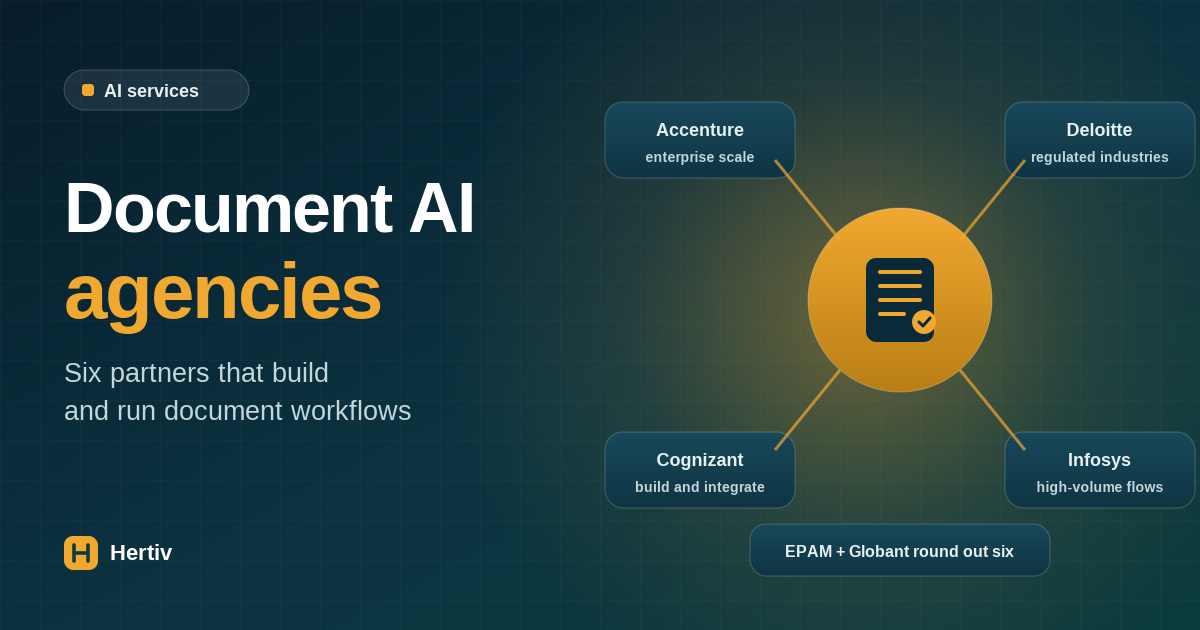
The document AI agencies worth shortlisting are service firms that design, build and run extraction, classification and validation for invoices, contracts and claims. Accenture, Deloitte, Cognizant, Infosys, EPAM Systems and Globant each suit a different size and situation, so pick on delivery fit and run a fixed pilot before committing.
Which document AI agencies are worth shortlisting?
Document AI agencies design, build and run extraction, classification and validation for invoices, contracts, claims and forms, so your team stops retyping fields by hand. The partners below are large service firms with document automation practices, not product vendors selling a single tool.
Use this comparison to shortlist. Delivery model and typical starting point matter more than size alone.
| Agency | What it delivers | Starting point | Best for |
|---|---|---|---|
| Accenture | Document automation programmes and AI operations | Process review and pilot | Large enterprises |
| Deloitte | IDP design, controls and managed operations | Discovery and compliance review | Regulated industries |
| Cognizant | Document AI build and integration | Use-case workshop | Mid-size to large teams |
| Infosys | IDP platforms and automation at scale | Assessment and pilot | High-volume processing |
| EPAM Systems | Custom document AI engineering | Technical discovery | Product-led teams |
| Globant | Document workflows and AI integration | Design sprint | Digital-first companies |
Every agency on this list can deliver a pilot. The differences sit in how they staff the work, how much they customise, and how they hand the system over to your team.
Accenture
1. Accenture: best for large enterprise programmes
Accenture runs document automation as part of larger AI and operations programmes, covering process design, model selection, integration and ongoing operations. Its teams typically start with a process review, then pilot one document type before expanding.
Because it works at enterprise scale, Accenture suits organisations with many document types, several systems and a need for governance. Smaller teams may find the engagement model heavier than they need, and the first pilot usually takes longer to set up than a small specialist would need.
Pros
- Broad delivery capability across process, data and operations
- Experience with regulated industries and complex estates
- Can run the system after build, not just deliver it
Cons
- Engagements are usually large and take time to start
- Pricing is quoted per project, so ask for a clear scope
Deloitte
2. Deloitte: best for regulated industries
Deloitte combines document AI delivery with risk, controls and compliance review, which matters when the documents are contracts, claims or financial records. Its teams usually start with discovery, then define the validation rules and audit trail before building.
That control-first approach suits banks, insurers and healthcare organisations, where a wrong extraction can create a compliance problem. Teams that want a fast, lightweight pilot may find the process slower than a pure engineering partner.
Pros
- Strong controls, audit trails and validation design
- Deep experience in finance, insurance and healthcare
- Can staff both advisory and delivery work
Cons
- Discovery and governance add time before the first pilot
- Best suited to larger budgets and longer programmes
Cognizant
3. Cognizant: best for mid-size to large teams
Cognizant builds document AI solutions and integrates them with the systems teams already use, such as ERPs, CRMs and claims platforms. Its teams usually start with a use-case workshop, then deliver a pilot on one document type.
The firm suits organisations that want a working system rather than a strategy deck, and that have enough volume to justify integration work. Very small teams may find the delivery model more than they need.
Pros
- Practical build-and-integrate delivery
- Experience across finance, healthcare and logistics
- Can support the system after go-live
Cons
- Engagements are usually scoped per project, so confirm the handover
- Less suited to very small document volumes
Infosys
4. Infosys: best for high-volume processing
Infosys delivers document AI at scale, with automation platforms, shared service models and ongoing operations for high-volume document flows. Its teams typically start with an assessment of document types and volumes, then pilot the highest-volume type first.
That scale-first approach suits organisations processing thousands of documents a month, where small accuracy gains add up. Teams with low volumes or one-off needs will get less value from a platform-led engagement.
Pros
- Built for high volumes and steady document flows
- Can run operations as a managed service
- Strong automation and platform capability
Cons
- Platform-led approach may be more than a small team needs
- Ask how the platform is handed over if you exit
EPAM Systems
5. EPAM Systems: best for product-led teams
EPAM Systems is an engineering-led firm that builds custom document AI into products and internal platforms. Its teams usually start with technical discovery, then design the extraction, validation and integration around your existing stack.
That engineering focus suits product teams that want document AI as a feature, not a back-office project. Organisations that need process redesign or managed operations may need a second partner for that part.
Pros
- Strong custom engineering and product integration
- Works well with in-house engineering teams
- Flexible engagement sizes
Cons
- Less focused on process consulting and managed operations
- Ask who owns the model and the evaluation set
Globant
6. Globant: best for digital-first companies
Globant designs document workflows and AI integration for companies that already work digitally, covering experience design, engineering and data. Its teams usually start with a design sprint, then build the workflow around the documents that cause the most friction.
The design-led approach suits teams that care about how staff and customers experience the workflow, not just the extraction accuracy. Organisations with heavy legacy systems may need extra integration work.
Pros
- Design-led approach to document workflows
- Strong engineering and data capability
- Good fit for digital-first teams
Cons
- Legacy system integration may need extra effort
- Confirm who supports the workflow after launch
How to choose a document AI agency
Choose on delivery fit, not on brand alone. A short pilot with a clear success measure will tell you more than any sales deck, and it protects both sides from a bad fit.
- Define one document type and one outcome. Pick the type that costs the most time, and state what good looks like, such as fields extracted without rework.
- Ask for a fixed pilot scope. Agree the documents, the validation rules, the evaluation set and the handover before work starts.
- Check who does the work. Ask whether the team is in-house, subcontracted, and who reviews extractions during the pilot.
- Ask about the evaluation set. A serious partner builds one from your real documents and reports accuracy against it.
- Plan the handover. Confirm who owns the models, the prompts, the validation rules and the documentation when the engagement ends.
Fees vary by scope, so ask for a written quote and treat prices as "see vendor site" until you have one in writing.
What are the common mistakes?
The most common mistakes are hiring before defining the outcome, skipping the evaluation set, and accepting a system nobody in-house can run.
- Starting with a tool, not a workflow. Extraction accuracy means little if the validated fields never reach the right system.
- No evaluation set. Without labelled examples from your own documents, accuracy claims cannot be checked.
- Ignoring validation rules. Totals, dates and required clauses need deterministic checks, not just model output.
- No handover plan. If the agency leaves and nobody in-house can retrain or fix the system, the project stalls.
- Measuring usage, not outcomes. Track time saved and error rate, not how many documents were processed.
For the product side of the same problem, document AI companies for startups covers vendors worth shortlisting.
To see how extraction and validation fit together in a working system, read the guide to document AI services.
Key takeaways
- Agencies build and run document AI; vendors sell the underlying tools
- Shortlist on delivery fit, starting point and handover, not brand alone
- Run a fixed pilot on one document type with a clear success measure
- Ask for an evaluation set built from your real documents
- Confirm who owns the models, rules and documentation at handover
Frequently asked questions
What does a document AI agency actually do?
It designs, builds and often runs the workflow that reads your documents: extraction of fields, classification by type, validation against rules, and delivery of the results into your systems. Some agencies also staff the human review queue.
How much does a document AI agency cost?
Fees vary by scope, document volume and integration work, so there is no standard price. Ask for a written quote for a fixed pilot scope, and treat any published price as a starting point only.
Should we hire an agency or buy a document AI product?
Buy a product when your documents are standard and your team can run it. Hire an agency when the workflow is custom, the integration is complex, or you need someone to run the operation.
How long does a document AI pilot take?
A narrow pilot on one document type typically takes a few weeks when sample documents are ready. Integration, validation rules and handover usually take longer than the model work itself.
What should we check before signing?
Check the pilot scope, the evaluation set, who does the work, data handling and the handover plan. Make sure you own the models, prompts, validation rules and documentation at the end.
Do agencies work with small companies?
Some do, usually with a fixed-scope pilot. Large firms may have minimum engagement sizes, so ask early. Smaller teams often start with one document type and a short pilot.


