AWS Application Modernization: A Practical Guide for CTOs
AWS application modernization means moving legacy apps to managed cloud services, usually by rehosting, replatforming or refactoring. Start with a portfolio assessment, then modernize the highest-value apps first.
On this page
Short answer
AWS application modernization is the process of moving legacy applications onto AWS managed services, often by rehosting, replatforming or refactoring them. Teams usually start with a portfolio assessment, then modernize the applications with the clearest business value and lowest migration risk first.
What is AWS application modernization?
AWS application modernization is the process of moving legacy applications onto AWS managed services and changing their architecture, delivery and operations so they are cheaper to run and faster to change. It is not just lifting servers into the cloud; it includes how the application is built, deployed and monitored.
Modernization usually covers four layers:
- Infrastructure: replacing self-managed servers with managed compute, storage and networking.
- Data: moving databases to managed engines, adding caching, and separating transactional from analytical workloads.
- Application architecture: splitting monoliths into services, adding APIs, and removing hard-coded dependencies.
- Operations: adopting infrastructure as code, CI/CD pipelines and observability.
A common misconception is that moving to AWS automatically modernizes an application. Rehosting a legacy server to EC2 changes the hosting bill but leaves the same deployment process, the same database maintenance burden and the same release risk. Real modernization changes at least one of those layers in a measurable way.
For teams that need engineering capacity to run this work alongside product delivery, software staff augmentation is a practical way to add AWS and platform skills without pausing the roadmap.
Which modernization path should you choose?
Choose the path per application based on business value, technical debt and risk, not as a single company-wide decision. AWS commonly describes six options, often called the 6 Rs, and most portfolios end up using three or four of them.
| Path | What it means | Best for | Typical effort |
|---|---|---|---|
| Retire | Turn off applications nobody uses | Duplicate or unused systems | Low |
| Retain | Keep as-is for now | Apps with compliance or vendor constraints | None |
| Rehost | Move servers to EC2 with minimal change | Urgent data-centre exit, stable apps | Low to medium |
| Replatform | Move to managed services with small changes | Databases, middleware, app servers | Medium |
| Refactor | Rework architecture, often to services or serverless | High-value apps that change often | High |
| Repurchase | Replace with SaaS | Commodity functions such as HR or email | Medium |
A practical default is to rehost only when there is a hard deadline, replatform where managed services remove real operational work, and refactor only where the business case is clear. Refactoring every application is rarely justified; refactoring the two or three that constrain revenue or release speed often is.
How do you assess an application portfolio before modernizing?
Start with a portfolio assessment that scores every application on business value and technical fit, then group them into migration waves. The goal is a ranked list you can defend to finance and engineering, not a perfect inventory.
For each application, capture:
- Business criticality: revenue impact, customer-facing or internal, regulatory exposure.
- Technical state: runtime versions, dependencies, database engine, licensing, test coverage.
- Operational cost: current hosting, support contracts, staff time to maintain.
- Change frequency: how often the team ships changes and how painful each release is.
- Risk: single points of failure, security findings, end-of-life components.
Score each dimension on a simple scale and plot the results. High value with high technical debt is usually the first wave, because the payoff is clearest. Low value with high debt is a retire or replace candidate.
Keep the assessment lightweight. A spreadsheet with consistent scoring is enough for most mid-market portfolios; heavy tooling rarely improves the decision. If data pipelines or analytics are part of the estate, involve data engineering services early so the target architecture accounts for them.
What does a typical modernization sequence look like?
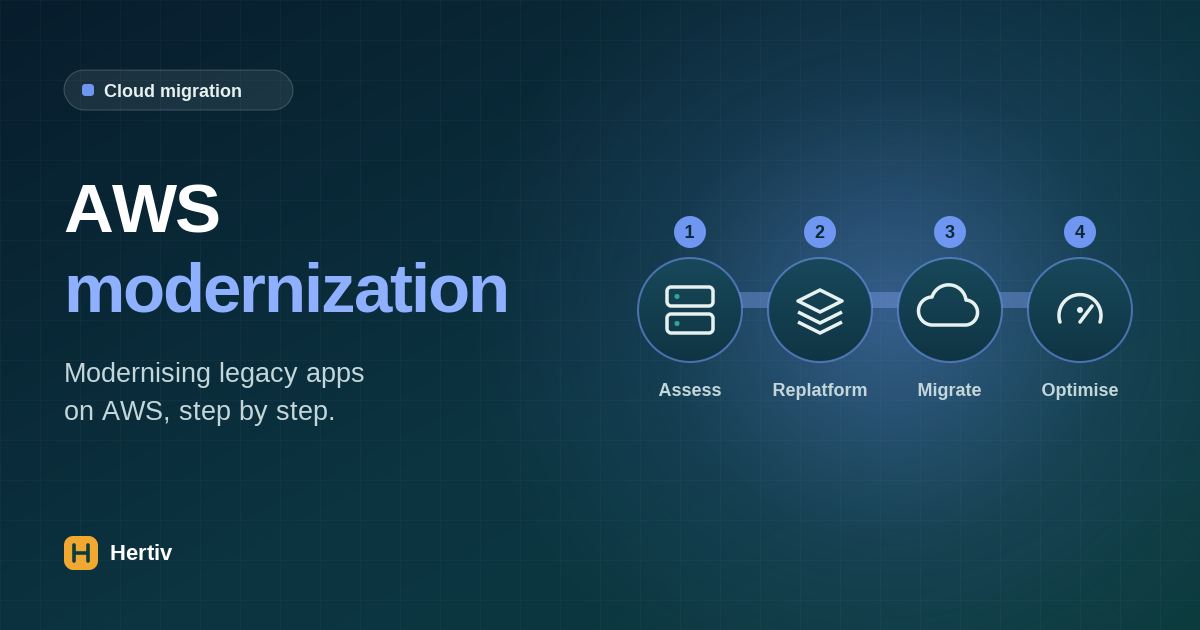
A typical sequence is assess, establish a landing zone, migrate a pilot application, then scale in waves with a repeatable pattern. Each step should produce something the business can see.
Step 1: Set up the AWS foundation. Define accounts, networking, identity, logging, guardrails and cost tagging before migrating anything. Retrofitting these later is expensive.
Step 2: Pick a pilot. Choose an application with real but bounded complexity, a willing team and a clear success metric. Avoid the hardest system first; you want to prove the pattern, not stress-test it.
Step 3: Modernize the pilot end to end. Include CI/CD, infrastructure as code, monitoring and a rollback plan. A migration without operational tooling just moves the problem.
Step 4: Codify the pattern. Turn what worked into templates and checklists so later waves are faster.
Step 5: Run waves. Group applications by similarity and dependency, and migrate in batches.
Example (hypothetical): a team plans four waves of five applications each. If the pilot takes six weeks and later waves take three weeks each, the total is about fifteen weeks of migration work, assuming no major dependency surprises. The arithmetic is simple; the risk is in the assumptions, so review them after each wave.
For teams building new services during modernization, custom software development can run in parallel without blocking the migration.
Which AWS services matter most during modernization?
The services that matter most are the managed ones that remove operational work: compute, databases, storage, messaging and identity. The right choice depends on the application, not on what is newest.
- Compute: EC2 for rehosted workloads, ECS or EKS for containerized services, Lambda for event-driven functions.
- Databases: RDS or Aurora for relational workloads, DynamoDB for key-value access patterns, ElastiCache for caching.
- Storage and delivery: S3 for objects and static assets, CloudFront for content delivery.
- Integration: SQS and SNS for messaging, EventBridge for event routing, API Gateway for managed APIs.
- Operations: CloudWatch for logs and metrics, IAM for access control, AWS Organizations for account structure.
A common pattern is to replatform a database to RDS while keeping the application on EC2, then containerize the application later. That splits risk across two smaller changes instead of one large one.
How do you modernize without a big-bang rewrite?
Use the strangler-fig pattern: put a routing layer in front of the legacy application and move functionality to new services incrementally. The legacy system keeps serving traffic until each piece is replaced, then it is retired.
A practical approach:
- Identify a bounded capability with clear inputs and outputs, such as authentication, search or notifications.
- Build the new service behind an API or message queue.
- Route a small percentage of traffic to the new service and compare results.
- Increase traffic gradually, keeping a fallback to the legacy path.
- Remove the old code once the new path is stable.
This keeps releases small and reversible. It also lets the team learn the new stack on real traffic without betting the business on a single cutover.
The main cost is running two systems for a period, which means duplicated data access and extra monitoring. Budget for that overlap explicitly, and set an end date for each capability so temporary dual-running does not become permanent.
How should you measure modernization success?
Measure modernization with delivery and operational metrics tied to specific applications, not with migration counts alone. Moving twenty servers to AWS proves activity, not improvement.
Useful metrics:
- Deployment frequency and lead time: how often the team ships and how long a change takes to reach production.
- Change failure rate and recovery time: whether releases are safer and outages shorter.
- Infrastructure cost per application: total AWS spend against the previous baseline, including support.
- Operational toil: hours spent on patching, backups and manual recovery.
- Availability and latency: measured against the service-level objectives the business actually cares about.
Set baselines before migration so the comparison is honest. Review the metrics after each wave, and adjust the plan if a path is not delivering the expected improvement.
Security deserves its own review. Moving to managed services changes the shared-responsibility boundary, and misconfigured storage or identity policies are a common source of incidents after migration. A cybersecurity services review alongside the migration catches these earlier.
What are the most common modernization mistakes?
The most common mistakes are treating modernization as an infrastructure project, skipping the foundation, and modernizing everything at once. Each one adds cost or risk that is hard to undo.
- Migrating without a landing zone. Accounts, networking, logging and guardrails set up after the fact are expensive to retrofit.
- Choosing refactor by default. Rewriting everything delays value and often stalls halfway.
- Ignoring the data layer. Applications move faster than their databases, and schema dependencies surface late.
- No rollback plan. Every wave needs a tested way back.
- Skipping cost tagging. Without tags, you cannot attribute spend or prove savings.
- Leaving operations behind. A migrated application without monitoring and runbooks is not modernized.
- No owner per application. Waves stall when nobody is accountable for the cutover.
A short pre-migration checklist covering these points prevents most of them. For teams that want an outside review of the plan before committing budget, software engineering services can cover architecture, delivery and cost modelling.
Key takeaways
- Modernization is a portfolio decision, not a single migration; assess every app before choosing a path.
- Rehosting is fastest and lowest risk; refactoring delivers the most long-term benefit but costs more.
- Managed services such as RDS, ECS, Lambda and S3 reduce operational overhead compared with self-managed servers.
- A strangler-fig pattern lets you modernize incrementally without a big-bang rewrite.
- Measure success with deployment frequency, lead time, change failure rate and infrastructure cost per app.
Frequently asked questions
How long does AWS application modernization take?
It depends on portfolio size and how many applications you refactor. A pilot usually takes weeks, and full portfolios run in waves over months. Most of the time goes into dependency discovery, testing and operational readiness rather than the migration itself.
Is rehosting to EC2 considered modernization?
It is a migration step, not full modernization. Rehosting changes where the application runs but not how it is built, deployed or operated. It is valid when speed matters, provided replatforming or refactoring follows for applications that need it.
Should we refactor our monolith into microservices?
Only where it solves a measured problem, such as independent scaling or release bottlenecks. Many monoliths modernize well as modular applications on containers. Splitting services adds operational complexity, so the business case should be specific.
How do we control AWS costs during modernization?
Tag every resource by application and owner, set budgets and alerts, and review spend after each wave against the previous baseline. Rightsize instances after migration rather than before, because real usage data is more reliable than estimates.
What skills does a modernization team need?
Infrastructure as code, CI/CD, container platforms, managed databases and observability, plus domain knowledge of the legacy applications. Security and cost awareness matter too. Small teams with broad skills usually move faster than large specialized ones.
How does generative AI fit into modernization?
It can help with code analysis, documentation and test generation, but it does not replace architectural decisions. Treat AI output as a draft that engineers review. The larger opportunity is usually building new AI features on top of the modernized platform.


