How to Choose an App Development Company in the United States
An app development company in the United States builds and ships mobile or web apps for you. Choose one on evidence of shipped work, team structure, security and clear contracts.
On this page
Short answer
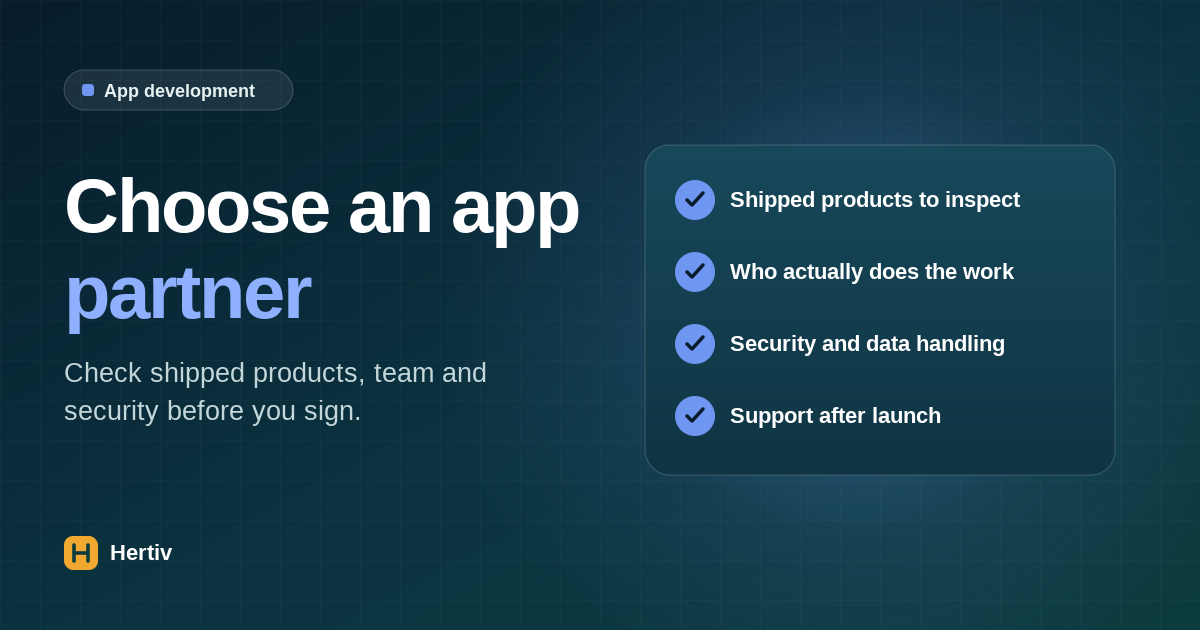
An app development company in the United States designs, builds and ships mobile or web applications on a client's behalf. Choose one by checking shipped products, who actually does the work, how they handle security and ownership, and whether the contract fixes scope, milestones and handover.
What does an app development company in the United States actually do?
An app development company in the United States is a services firm that takes a product idea or an existing system and delivers working mobile or web software, usually across discovery, design, engineering, testing and release. The good ones also handle the unglamorous parts: app store submission, backend infrastructure, analytics and maintenance after launch.
Scope varies a lot between firms. Some are design-led studios that produce polished interfaces with a thin backend. Others are engineering shops that assume you bring the product thinking. A third group builds internal tools and integrations rather than consumer apps.
Before you compare vendors, write down what you actually need:
- Platform: native iOS and Android, cross-platform, responsive web, or an internal tool
- Backend weight: simple CRUD versus real-time, payments, or heavy data processing
- Compliance: health data, financial data, or personal data from EU or UK users
- Ongoing work: one-off build versus a long maintenance and feature relationship
- Your own team: whether you have engineers who will take over the code later
That list filters the market faster than any shortlist. A firm that excels at consumer mobile apps may be a poor fit for a regulated B2B workflow, and the reverse is equally true.
The phrase "app development company united states" also hides a structural question: is the team you meet the team that builds? Many US-registered firms sell work that is delivered by partner teams elsewhere. That can be fine and often cost-effective, but you should know it before signing, because it affects time zones, communication and who owns decisions.
Which questions separate strong firms from weak ones?
The fastest filter is asking for evidence that can be checked rather than described. Strong firms answer specific questions with specifics; weak ones return adjectives.
Ask these in the first call:
- Show me two apps you shipped in the last two years that are live in the stores. Then open them. Check reviews for crash complaints and update frequency.
- Who writes the code, and where are they based? Ask for the ratio of in-house staff to contractors and partners.
- Who is my main contact, and are they technical? A project manager who cannot discuss architecture will slow every decision.
- How do you estimate, and what happens when the estimate is wrong? Look for a change-request process, not a promise that estimates are accurate.
- Who owns the code and the infrastructure accounts? The answer should be you, from day one.
- What does handover look like? Repositories, documentation, credentials and a working build pipeline.
- Can I speak to a past client whose project resembled mine? Reference calls are normal and good firms expect them.
For AI features specifically, the questions change. Model choice, data privacy, evaluation and cost per request matter as much as UI. The questions in our guide to choosing an AI development company cover that ground in more depth.
How should you compare US firms by engagement model?
Most US app development firms sell work in one of four ways, and the model shapes your risk more than the firm's brand does.
| Model | How it works | Best for | Main risk |
|---|---|---|---|
| Fixed-scope project | Agreed deliverables and price | Well-defined builds with stable requirements | Change requests get expensive |
| Time and materials | You pay for hours or sprints | Evolving products and discovery-heavy work | Cost drifts without tight reporting |
| Dedicated team | A standing team billed monthly | Long roadmaps and ongoing products | You carry hiring and management overhead |
| Staff augmentation | Individual engineers added to your team | Teams that need capacity, not direction | Integration depends on your own process |
Fixed-scope suits a defined app with clear screens and rules. It struggles when requirements are still moving, which is common for new products. Time and materials is more honest for uncertain work but needs weekly visibility into what was built.
A dedicated team or staff augmentation arrangement works when you already have product direction and need engineering capacity. It only pays off if you can manage the team.
Most disputes come from mismatched expectations about the model, not from bad engineers. Put the model, the reporting cadence and the acceptance criteria in the contract.
What should the contract and handover cover?
The contract should make ownership, scope and exit boring and explicit. Anything left vague becomes a negotiation later, usually when you have the least use.
Cover these points in writing:
- Intellectual property: all custom code, designs and documentation transfer to you on payment. Exclude only clearly listed pre-existing tools.
- Third-party components: list open-source licenses and any vendor SDKs with ongoing costs.
- Milestones and acceptance: define what "done" means per milestone, with a review window and a remedy if it is missed.
- Source code access: a repository you control, with regular commits, not a zip file at the end.
- Infrastructure and accounts: cloud, app store and analytics accounts in your company's name.
- Security and data: how client data is stored, who can access it, and what happens on termination.
- Warranty and support: a defined period after launch for defect fixes, and the terms for ongoing maintenance.
- Termination: notice period, final payment and handover obligations.
Handover deserves its own checklist. You should receive repositories with history, environment configuration, deployment scripts, architecture notes, an API reference if applicable, test coverage information, and credentials for every service used.
A short technical audit of the delivered code by an independent engineer is cheap insurance on a large build.
How do you assess security and compliance fit?
Security and compliance fit should be checked before the contract, not during the build. A firm that has never handled regulated data will learn on your budget.
Start with what your app touches. Health information, payment card data, children's data, and personal data belonging to EU or UK residents each bring obligations. If you sell to enterprises, expect security questionnaires about your vendor's practices.
Ask for:
- A written description of how they handle secrets, access control and code review
- How development, staging and production environments are separated
- Their practice for dependency updates and vulnerability scanning
- Whether they will sign a data processing agreement and confidentiality terms
- Which subprocessors or partner teams might touch your data
You do not need a certification badge to start, but you do need honest answers. A firm that says "we follow best practices" without specifics is telling you something.
For apps with AI features, add questions about prompt and model data retention, where inference happens, and what is logged. Our AI security page outlines the failure modes worth designing against. If your app handles payments or financial workflows, the compliance surface grows again.
Example (hypothetical): a team building a scheduling app for clinics plans a US launch first, then the UK. They ask each vendor how they would isolate patient data, where backups are stored, and how deletion requests are handled. One vendor's answers are vague on backups; that firm drops off the shortlist before any contract is discussed.
What does a realistic budget and timeline look like?
Budget follows scope, team size and the number of unknowns, so any single number is misleading. What you can control is how the spend is staged.
A typical sequence looks like this:
- Discovery: a short paid phase that produces user flows, a technical approach and a prioritised backlog
- First release: the smallest version that real users can use, built and released to a test group
- Iteration: fixes and features driven by usage data
- Maintenance: ongoing support, dependency updates and small improvements
Typical ranges vary widely by scope. A focused app with a modest backend sits at the lower end; anything with real-time features, integrations, payments or regulated data moves up. Cost also reflects where the engineers are based, which is why US firms differ so much from each other.
Two money-saving moves are worth naming. First, fund discovery separately and use it to test the firm before committing to the build. Second, decide early which parts of the product can wait; a smaller first release shortens the path to feedback.
For new products, our breakdown of MVP cost explains what drives the number. If you are building a SaaS product specifically, the backend, billing and multi-tenancy work deserves its own estimate rather than being folded into an app line item.
How to prioritise your shortlist in five steps
Move from a long list to a decision in a fixed sequence, so you compare firms on the same basis.
- Write a one-page brief. Cover the users, the core flows, platforms, compliance needs and your budget band. Send the same brief to everyone.
- Filter on relevant shipped work. Drop any firm that cannot show a live product close to yours in complexity or domain.
- Run a paid discovery or a small scoped task. A two-week discovery reveals more than three sales calls. Pay for it.
- Check references and ownership terms. Call a past client. Read the IP, handover and termination clauses before the final round.
- Compare total cost of ownership. Include maintenance, hosting, third-party services and the cost of switching later.
Use a simple scoring sheet with weighted criteria: relevant experience, team transparency, communication quality, security answers, contract terms and price. Weight the first four above price for anything you intend to run for years.
The firm you want is the one whose answers stay specific under pressure. If a vendor becomes vague when you ask who does the work or who owns the code, treat that as the answer. Hertiv builds mobile apps for iOS and Android and custom software with client-owned accounts and code from day one, and can join at discovery or take over an existing codebase.
Key takeaways
- Ask for shipped apps you can open, not screenshots or a portfolio page
- Confirm who writes the code: in-house staff, contractors or offshore partners
- Get intellectual property ownership and source code handover written into the contract
- Check data handling, security practices and compliance fit before signing
- Prefer fixed discovery milestones over a single large upfront commitment
- Test communication early: response time and clarity rarely improve after kickoff
Frequently asked questions
How long does it take to build a mobile app?
A focused first release typically takes a few months from discovery to launch, depending on complexity, integrations and how settled the requirements are. Apps with payments, real-time features or regulated data take longer. Add time for app store review and for the fixes that follow the first real users.
Should I hire a US company or an offshore team?
US firms usually offer closer time zones, easier contracting and local context on compliance. Offshore teams often cost less per hour. Many US companies blend both, so ask who actually writes the code and how communication will work before deciding which trade-off you prefer.
Who owns the source code after the project?
You should, and it should be written into the contract. Custom code, designs and documentation transfer to you on payment, with only clearly listed pre-existing tools excluded. Make sure repositories, cloud accounts and app store listings are in your name from the start.
What is a discovery phase and do I need one?
Discovery is a short paid phase that produces user flows, a technical approach and a prioritised backlog. It is worth doing when requirements are still uncertain, because it makes the build estimate meaningful and lets you test the firm before committing to a larger contract.
How do I evaluate a firm's security practices?
Ask for specifics: how secrets and access are managed, how environments are separated, how dependencies are updated, whether they will sign a data processing agreement, and which partner teams might touch your data. Vague answers about best practices are a signal to look elsewhere.
Can an app development company work with our in-house engineers?
Yes, and it is common. The arrangement works best when roles are explicit: who owns architecture decisions, who reviews code, and how work is merged. Augmentation adds capacity; it does not replace your product direction, so plan to stay involved in prioritisation.


