How Healthcare APIs Grow a Health Business
Healthcare APIs connect your product to patient records, appointments, billing and labs. Learn what they do, what they cost and how to add them safely.
On this page
Short answer
A healthcare API is a documented way for one software system to exchange health data with another, such as a clinic's booking system sending appointment times to a patient app, or a lab sending results to a doctor's record. For a health business, APIs turn a closed product into one that fits into the systems clinics, hospitals and insurers already use.
What are healthcare APIs?
A healthcare API is a documented interface that lets software systems exchange health information in a structured way. Instead of staff retyping a patient's details from one system into another, the API moves the data: an appointment booked in one app appears in the clinic's schedule, and a lab result appears in the patient's record.
The best-known healthcare API standard is FHIR, which defines common formats for patients, appointments, observations and prescriptions. Many clinics and hospitals already run FHIR-compatible systems, so a product that speaks FHIR can connect to them without a custom build for each customer. An API is only as good as the data behind it, so the quality of your records matters as much as the connection itself.
APIs do not replace your product. They connect it to the systems your customers already trust, which is why buyers often ask about them before they ask about features.
What can healthcare APIs connect?
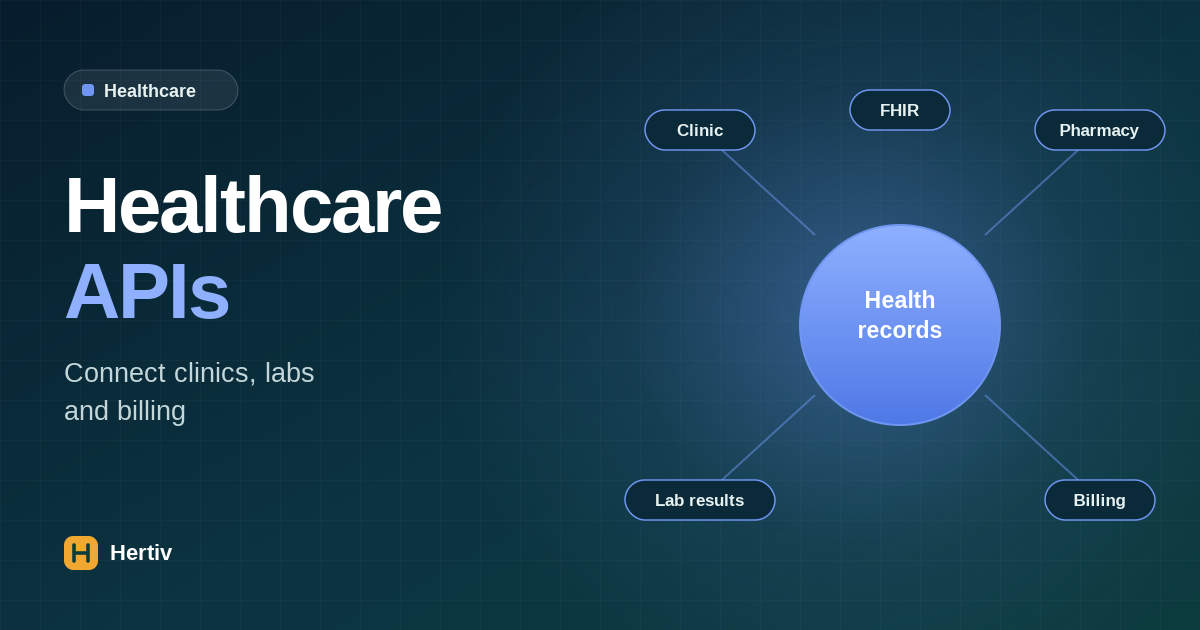
Healthcare APIs connect the everyday systems a health business touches. A scheduling API shares appointment slots and bookings. A records API shares patient details, allergies and history with consent. A lab API delivers results. A billing API shares claims and payment status. A pharmacy API shares prescriptions and stock.
Each connection removes a manual step and a source of errors. The table below shows the most common connections and what each one is worth to a business.
| API | What it shares | Business value |
|---|---|---|
| Scheduling | Slots, bookings, reminders | Fewer no-shows, fuller diaries |
| Patient records | Details, history, allergies | Faster intake, fewer forms |
| Lab results | Test results, flags | Faster decisions, less chasing |
| Billing and claims | Claims, payments, status | Faster payment, fewer errors |
| Pharmacy | Prescriptions, stock | Safer dispensing, less rework |
| Wearables and devices | Readings, alerts | Remote monitoring, earlier action |
Start with the connection your buyers ask for first. One working connection that a clinic uses daily is worth more than six half-finished ones.
How do healthcare APIs grow a business?
Healthcare APIs grow a business in three ways. First, they shorten the sales cycle: a buyer who can connect your product to their existing system in days will sign faster than one who faces a months-long integration project. Second, they raise retention: once your product is woven into the clinic's daily flow, switching to a rival means unpicking that connection.
Third, they open new customers. A hospital that only buys software that speaks FHIR will never see a product without an API, no matter how good it is. The API is often the entry ticket, not a feature, and teams that treat it as one find the sales conversation changes.
Example (hypothetical): a clinic booking app adds a scheduling API. Before the API, each new clinic took 6 weeks to onboard; after it, onboarding takes 2 weeks. For 10 clinics a year, that saves 40 weeks of onboarding work, or about 4 weeks per clinic, which the team can spend on support instead of setup.
What rules apply to health data?
Health data is personal data, and the rules are strict. You need a clear legal basis to hold it, the patient's consent where the law requires it, and a written agreement with every system you exchange data with. Data should travel encrypted, access should be logged, and only the fields each side needs should be shared.
The exact rules depend on the country: the United States uses HIPAA, Europe uses the GDPR, and other countries have their own health privacy laws. Get advice from a lawyer who knows health data in each country you sell into, before you build, not after a customer asks.
Never store more health data than the job needs, and never keep it longer than the agreement allows. A small, well-guarded data set is easier to defend than a large one, and it is also cheaper to protect.
How to add a healthcare API to your product
Adding a healthcare API is a design job before it is a coding job. Decide which systems you must connect to, which standard they use, and which data fields each side needs. Then build one connection well, test it with a real partner, and only then add the next one.
- Ask your buyers which system they use and which standard it supports.
- Pick one connection, usually scheduling or records, and design it first.
- Write the data agreement and the consent flow before you write code.
- Build the connection with encryption, logging and access controls.
- Test it with one real partner clinic on real, consented data.
- Publish clear documentation so the next partner can connect alone.
Good documentation is part of the product. If a partner's developer cannot connect in a day from your docs alone, the docs need work, not the partner.
How to choose the right healthcare API standard?
FHIR is the default choice for most new healthcare products, because it is the standard that clinics, hospitals and government systems increasingly expect. It covers the common objects, patients, appointments, observations, prescriptions, and it has a large community writing guides and tools for it.
Some older hospital systems still use HL7 version 2, a message-based standard from an earlier era. If your first big customer runs HL7 v2, you may need a connector that translates between the two, rather than rebuilding your product around the older standard. Ask each buyer which standard their system speaks before you commit.
The choice is rarely permanent. Many products start with one FHIR connection, add a translation layer for older systems later, and keep the internal model clean. The standard is a means to an end: the end is a connection that works every day without manual fixes.
What does a healthcare API cost?
The cost of a healthcare API has three parts: building it, running it and keeping it compliant. Building one connection usually takes weeks of a small team's time. Running it adds hosting, monitoring and support. Compliance adds audits, legal advice and security testing, which continue for as long as the API is live.
Some platforms charge for API access, and some charge per call, so check the vendor site for current pricing before you budget. The cheapest option is often the standard one: building on FHIR costs less over time than maintaining a custom connection for every customer.
Common mistakes
The most common mistake is sharing too much data. An API that returns a full patient record when the other side only needs an appointment time creates risk for no benefit. Share the smallest set of fields that does the job, and log every access.
Another mistake is treating the API as a side project. If the API is slow, undocumented or unmonitored, partners stop using it and the sales team loses its best argument. Give the API the same care as the main product: tests, monitoring and someone who owns it.
Key takeaways
- An API connects your product to systems buyers already use
- FHIR is the standard most clinics and hospitals expect
- One working connection beats six half-finished ones
- Consent, encryption and logging are part of the build
- Good docs let the next partner connect alone
Frequently asked questions
What is FHIR?
FHIR is a standard for exchanging health information, defining common formats for patients, appointments, observations and prescriptions. Most modern clinic and hospital systems support it, so a product that speaks FHIR connects more easily.
Do I need a lawyer before building a healthcare API?
Yes. Health data rules differ by country, and a lawyer who knows health privacy can tell you what consent, agreements and retention rules apply. Get the advice before you build, not after a customer asks.
How long does it take to add a healthcare API?
One connection usually takes a few weeks of a small team's time, plus time for the data agreement and testing with a real partner. The first connection is the slowest; later ones reuse the same patterns.
Can a small health business afford a healthcare API?
Yes, if you start with one connection on a standard like FHIR. The cost is weeks of work, not a new department, and the connection often pays for itself by shortening onboarding and winning customers who require it.
What is the difference between an API and an integration?
An API is the documented interface that lets systems talk. An integration is one completed connection built on that interface. You build the API once, then each customer integration uses it.
How do I keep health data safe through an API?
Use encryption in transit and at rest, share only the fields each side needs, log every access, and review the logs. Test the API with the same care as the main product, including what happens when a request is wrong.


