Apache Hadoop for Big Data Analytics in Manufacturing
Apache Hadoop stores years of factory sensor data across cheap machines and runs analysis jobs on all of it. Here is how manufacturers use it, step by step.
On this page
Short answer
Apache Hadoop is open-source software for storing and processing very large data sets across many ordinary computers. In a factory it stores sensor readings, machine logs and quality checks, then runs analysis jobs that find faults, predict failures and cut downtime.
How does Apache Hadoop help manufacturers use big data?
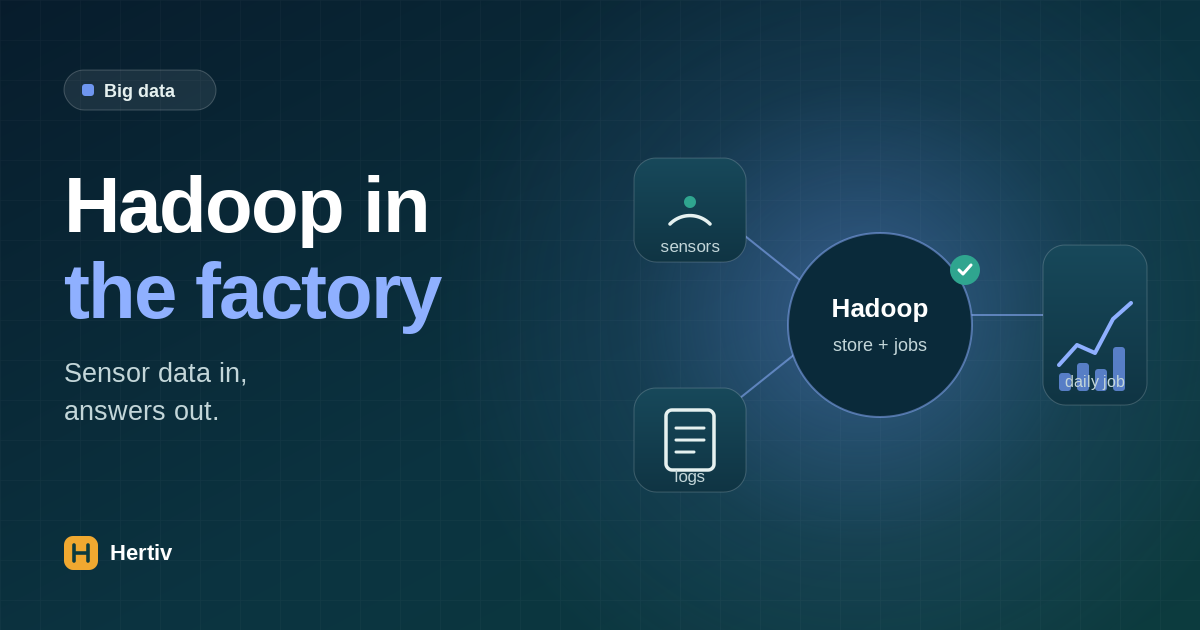
Apache Hadoop is open-source software for storing and processing very large sets of data across many ordinary computers at once. In a factory it takes in sensor readings, machine logs, quality checks and orders, stores them cheaply, and runs analysis jobs that would be too slow on a single server.
| Hadoop part | What it does | Factory use |
|---|---|---|
| HDFS | Stores files across many machines | Years of sensor data kept cheaply |
| MapReduce | Splits analysis jobs across machines | Daily quality and downtime summaries |
| YARN | Shares machines between jobs | Several analyses running at once |
| Hive | Asks questions in SQL-like queries | Weekly defect and yield reports |
| Spark | Fast in-memory analysis, often run with Hadoop | Near-real-time alerts on sensor data |
The point of Hadoop in a factory is not the software itself. It is that a plant can keep years of machine data and ask questions of all of it, instead of deleting last month's readings to save space.
What factory data goes into Hadoop?
The data that helps most is the data machines already produce: sensor readings, vibration and temperature, production counts, downtime logs, quality inspection results, energy use and maintenance records. Orders and supplier data join later, once the machine data is working.
- Sensor and machine readings. Temperature, vibration, pressure and speed, recorded every second or every minute.
- Downtime and maintenance logs. When each machine stopped, for how long, and what was fixed.
- Quality and inspection results. Defect counts, measurements and pass or fail rates by batch.
- Energy and utility use. Power, water and compressed air use by line and by shift.
- Orders, stock and supplier records. What was made, what was shipped, and what arrived late.
Start with one data source, not five. A plant that loads vibration data from one line and finds one real fault pattern learns more than a plant that loads everything and drowns in it.
How to set Hadoop up for a factory in five steps
A factory Hadoop setup works best when it starts small and grows only after the first analysis pays off. Five steps keep it that way.
- Pick one line and one question. For example, why does line two stop twice a shift? One question keeps the project honest.
- Collect the data. Connect the sensors and logs for that line, and check the readings are clean and timestamped.
- Set up a small cluster. A few ordinary servers running HDFS and YARN are enough to start; add machines only when the data grows.
- Run one daily job. A MapReduce or Hive job that answers the one question every day, with the result sent to the people who run the line.
- Put the result where people work. A simple report or dashboard on the shop floor beats a perfect report nobody opens.
Step four is where most projects fail. A daily job that nobody reads is wasted work, so the result must reach the shift lead in a form they can act on the same day.
How does Hadoop fit with the factory's other software?
Hadoop does not replace the systems a factory already runs. It sits beside them: the machines and sensors keep sending data to their usual control systems, and Hadoop takes a copy for storage and analysis. The control system keeps running the line, while Hadoop answers questions about the past.
The usual neighbours are the manufacturing execution system, which tracks orders and work in progress, and the maintenance system, which holds work orders and spare parts. Hadoop joins its sensor history to those records, so a fault pattern can be traced to a batch, a shift or a supplier.
- Control systems. Keep running the line in real time; Hadoop takes a copy of their data.
- Execution systems. Hold orders and batches; joining them to sensor data shows which batches had faults.
- Maintenance systems. Hold work orders; joining them to downtime logs shows which fixes actually lasted.
- Dashboards. Show the daily job results to shift leads in a form they can act on.
Keep the boundary clear. Hadoop stores and analyses history; it does not control machines. A job that writes back to a control system needs its own safety review, and most plants never need one.
What does Hadoop cost a manufacturer?
Hadoop software itself is free to download, but the machines, the setup and the person who keeps it running are not. A small cluster on a few machines is the usual starting point, and the cost grows only when the data does.
| Cost part | What it covers | When you pay |
|---|---|---|
| Servers | Ordinary machines that store and process data | One-off, then replacement over years |
| Setup and configuration | Installing Hadoop and connecting data sources | One-off, before the first job runs |
| Staff time | The person who runs the cluster and writes jobs | Ongoing, every month |
| Power and cooling | Electricity for the machines | Ongoing, by use |
| Support | Help when the cluster fails or needs an upgrade | As needed, or a monthly contract |
Budget for staff time first. The servers are a one-off cost, but the person who keeps the cluster healthy and writes the analysis jobs is the cost that decides whether the project lasts.
Example (hypothetical): one line, one month of sensor data
Example (hypothetical): a plant puts 200 sensors on one line, each sending one reading a second. That is 200 readings a second, or 17,280,000 readings a day, since 200 times 86,400 seconds equals 17,280,000. Over 30 days the line produces 518,400,000 readings.
The team stores the readings in Hadoop and runs one daily job that flags any sensor whose average temperature rose by more than 5 degrees over its last seven days. In the first month the job flags three machines, and two of them turn out to need a bearing change before they fail.
The job runs in under an hour a day on a small cluster, so the plant keeps it running and adds a second line the next month. The win is not the software; it is that the data was kept and asked a question every day.
Common mistakes
The most common mistake is buying a large cluster before knowing the question. A big cluster with no clear analysis job is an expensive way to store data nobody reads.
- Big cluster before the question. Start small and grow only after the first job pays off.
- Loading every data source at once. One clean source beats five messy ones.
- No one owns data quality. Bad timestamps and missing readings make every analysis wrong.
- Treating Hadoop as real-time. Hadoop is built for batch jobs; alerts that need seconds belong elsewhere.
- Skipping backups. A cluster that holds years of data needs a backup plan before it holds anything.
Pair Hadoop with a clear analysis goal. A predictive model for manufacturing is one way to turn stored sensor data into a maintenance plan.
Key takeaways
- Hadoop stores years of factory data across cheap machines.
- HDFS, MapReduce, YARN and Hive cover storage, jobs and queries.
- Start with one line and one question, not the whole plant.
- Staff time, not servers, is the cost that decides if it lasts.
- Hadoop is built for daily batch jobs, not real-time alerts.
Frequently asked questions
What is Apache Hadoop used for in manufacturing?
Hadoop stores large sets of factory data, like sensor readings, machine logs and quality checks, across many ordinary computers. It then runs analysis jobs that find fault patterns, predict failures and summarise downtime and yield.
Is Hadoop free for manufacturers?
The software is free to download, but the servers, the setup, power and the staff time to run it are not. A small cluster on a few machines is the usual starting point, and costs grow only when the data does.
How much data can Hadoop handle in a factory?
A small cluster can hold years of sensor data from many lines. A line with 200 sensors sending one reading a second produces over 17 million readings a day, which Hadoop stores and analyses without trouble.
Is Hadoop real-time?
No. Hadoop is built for batch jobs that run on a schedule, like a daily summary or a weekly defect report. Alerts that need an answer in seconds belong in a streaming system, not in Hadoop.
Do I need Spark to use Hadoop?
No. Hadoop works on its own with MapReduce and Hive. Spark is often run with Hadoop because it analyses data faster in memory, but it is a separate tool, not a requirement.
What is the first step to using Hadoop in a factory?
Pick one production line and one question, such as why it stops twice a shift. Connect that line's data, set up a small cluster, and run one daily job that answers the question. Add more lines only after the first one pays off.


