Anthropic API Alternatives: 6 Options Worth Comparing
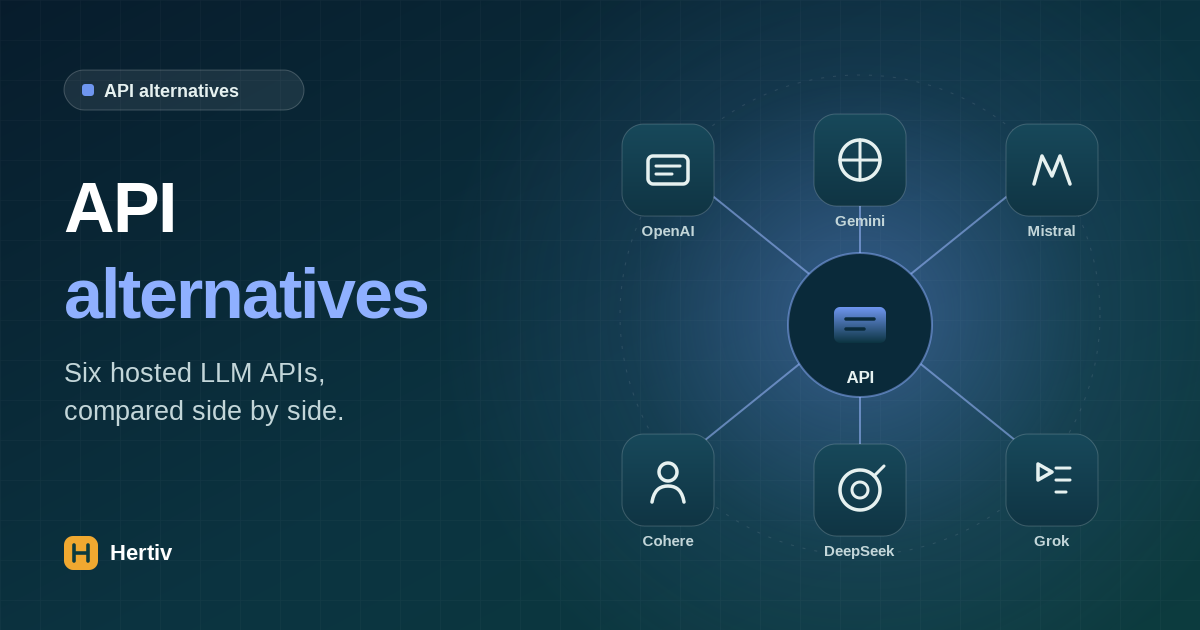
Looking beyond the Anthropic API? Compare six alternatives - OpenAI, Gemini, Mistral, Cohere, DeepSeek and Grok - on model range, strengths and when each one fits.
On this page
Short answer
The main alternatives to the Anthropic API are the OpenAI API, Google Gemini API, Mistral AI, Cohere, DeepSeek and the xAI Grok API. Each offers hosted language models through an API, but they differ in model range, pricing, data handling and tooling. The right pick depends on your workload, budget and how much control you need over deployment.
Which Anthropic API alternatives are worth comparing?
The alternatives worth comparing are the ones with hosted models, a documented API and a track record of serving production traffic. That filter keeps the list short and practical.
Use this comparison to shortlist. Pricing changes often, so check the vendor site for current rates before you commit.
| Provider | Best known for | Model access | Pricing |
|---|---|---|---|
| OpenAI API | Broad model range | Hosted API | See vendor site |
| Google Gemini API | Google ecosystem fit | Hosted API | See vendor site |
| Mistral AI | Open-weight models | API and self-host | See vendor site |
| Cohere | Enterprise search and RAG | Hosted API | See vendor site |
| DeepSeek | Low-cost reasoning models | API and self-host | See vendor site |
| xAI Grok API | Real-time data access | Hosted API | See vendor site |
Start with one provider for a proof of concept, not three. A small test on your own prompts tells you more than any feature table.
OpenAI API
1. OpenAI API: best for broad model choice
The OpenAI API is the most widely used alternative, with a range of models for chat, reasoning, vision and audio, plus mature tooling for function calling and structured output. Most AI libraries and frameworks support it first, which shortens integration time.
It fits teams that want a safe default with strong documentation and a large community. If your product already depends on OpenAI-style tooling, switching costs are low. Pricing is usage-based; check the vendor site for current rates.
Pros
- Wide model range and strong tooling
- Large community and framework support
Cons
- Costs can grow fast at high volume
- Less control over model hosting
Google Gemini API
2. Google Gemini API: best for Google Cloud teams
The Gemini API serves Google's Gemini models through Google AI Studio and Google Cloud. It fits teams already running on Google Cloud, since billing, identity and logging sit in the same place as the rest of the stack.
Gemini models handle text, images, audio and video in a single model, which suits products that mix media. The free tier covers small tests; production pricing is on the vendor site.
Pros
- Strong fit with Google Cloud services
- Multimodal input in one model
Cons
- Best value mainly inside Google Cloud
- Model behaviour changes with new versions
Mistral AI
3. Mistral AI: best for open weights and self-hosting
Mistral AI offers both a hosted API and open-weight models that teams can run on their own hardware. That mix suits teams with strict data rules or a need to run models inside their own cloud.
Its models are known for strong performance at modest size, which keeps hosting costs down. If you need to fine-tune or inspect model weights, Mistral is one of the few mainstream options. See the vendor site for API pricing.
Pros
- Open weights for self-hosting and fine-tuning
- Efficient models for the size
Cons
- Smaller ecosystem than OpenAI or Google
- Self-hosting adds operations work
Cohere
4. Cohere: best for enterprise search and RAG
Cohere focuses on enterprise language work: chat models, embeddings and reranking for retrieval-augmented generation. Its Command models and Embed models are built for searching company documents and grounding answers in them.
It fits teams building internal search, support agents or document question-answering, where retrieval quality matters more than general chat skill. Cohere also offers private deployment for regulated industries.
Pros
- Strong retrieval and embedding models
- Private deployment options
Cons
- Narrower general-purpose model range
- Less suited to consumer chat products
DeepSeek
5. DeepSeek: best for low-cost reasoning work
DeepSeek offers API access to its reasoning models at prices that undercut most rivals, and its model weights are also available for self-hosting. That combination appeals to teams with heavy token volume and a tight budget.
It fits batch work, evaluation pipelines and products where cost per token is the main constraint. Check the vendor site for current pricing, and test output quality on your own prompts before moving a customer-facing feature to it.
Pros
- Low API prices for reasoning models
- Weights available for self-hosting
Cons
- Newer provider with a shorter track record
- Support and tooling are less mature
xAI Grok API
6. xAI Grok API: best for real-time information
The xAI Grok API serves Grok models with access to real-time information from the web and from X. It fits products that need fresh answers about current events, trending topics or live data.
For most other workloads it is a narrower choice than OpenAI or Gemini, but for news, social monitoring and live research the real-time access is a genuine difference. Pricing is on the vendor site.
Pros
- Real-time data access built in
- Strong reasoning models
Cons
- Smaller ecosystem and fewer integrations
- Less suited to regulated enterprise use
How to choose the right Anthropic API alternative
Choose by workload first, not by benchmark scores. The model that wins a public test may not win on your prompts, your data or your budget.
- List your workloads. Chat, search, code, reasoning and media each favour different providers.
- Test on your own prompts. Run the same 20 real prompts through two providers and compare answers and cost.
- Check data rules. Confirm where data is processed and whether the provider trains on your inputs.
- Price a real month. Estimate tokens from current usage, not from a demo, and check the vendor site.
- Plan the exit. Keep prompts and evaluation sets provider-neutral so switching stays possible.
A short AI proof of concept with a fixed evaluation set is the cheapest way to compare two providers before committing.
For a deeper look at model options, see the top LLM tools guide.
Common mistakes when switching LLM providers
Most switching failures come from skipping evaluation, not from picking the wrong model. Teams move a feature, discover edge cases late, and then blame the provider.
- Switching on price alone. A cheaper model that needs more retries can cost more in the end.
- No evaluation set. Without fixed prompts and expected answers, quality debates are guesswork.
- Hard-coding provider quirks. Prompts tuned to one model often fail on another.
- Ignoring data rules. Some providers retain API data by default; check the terms first.
- Moving everything at once. Migrate one workload, measure it, then decide on the rest.
If you are planning a first LLM feature, how to build an AI proof of concept covers the steps.
LLM development services can help with the build itself.
Key takeaways
- OpenAI, Gemini, Mistral, Cohere, DeepSeek and Grok are the main hosted alternatives to the Anthropic API
- Mistral and DeepSeek also offer open weights for teams that need to self-host
- Cohere is the strongest pick when retrieval and enterprise search matter most
- Price a real month of your own usage before choosing; demo pricing is misleading
- Test two providers on the same 20 real prompts before migrating a live feature
Frequently asked questions
Is there a free alternative to the Anthropic API?
Yes, several providers offer free tiers or credits for small tests, including Google AI Studio and some open-weight models you can run yourself. Free tiers suit testing, but production workloads need a paid plan, so check the vendor site for limits.
Which Anthropic API alternative is cheapest?
It depends on your workload, because pricing varies by model, input and output tokens, and volume. DeepSeek and Mistral are often cheaper per token, but a model that needs more retries can cost more overall. Price a real month of your own usage.
Can I switch from Claude to another provider easily?
The API call itself is similar, but prompts tuned for Claude often behave differently on other models. Keep an evaluation set of real prompts, test the new provider against it, and expect to adjust prompts before the switch.
Do these alternatives offer fine-tuning?
Most hosted providers offer fine-tuning or customisation of some kind, and open-weight providers let you fine-tune the weights yourself. Check the vendor site, because the options and limits differ by provider and model.
Which alternative is best for RAG and document search?
Cohere is built for that use case, with strong embedding and reranking models. OpenAI and Google also work well for RAG. The deciding factor is usually retrieval quality on your own documents, so test with a real sample.
Should I use more than one LLM provider?
Many teams do, using one provider for the main workload and another as a fallback or for specific tasks. It adds complexity in prompts and billing, so start with one provider and add a second only when you have a clear reason.


