Android vs iOS for Startups: Which First?
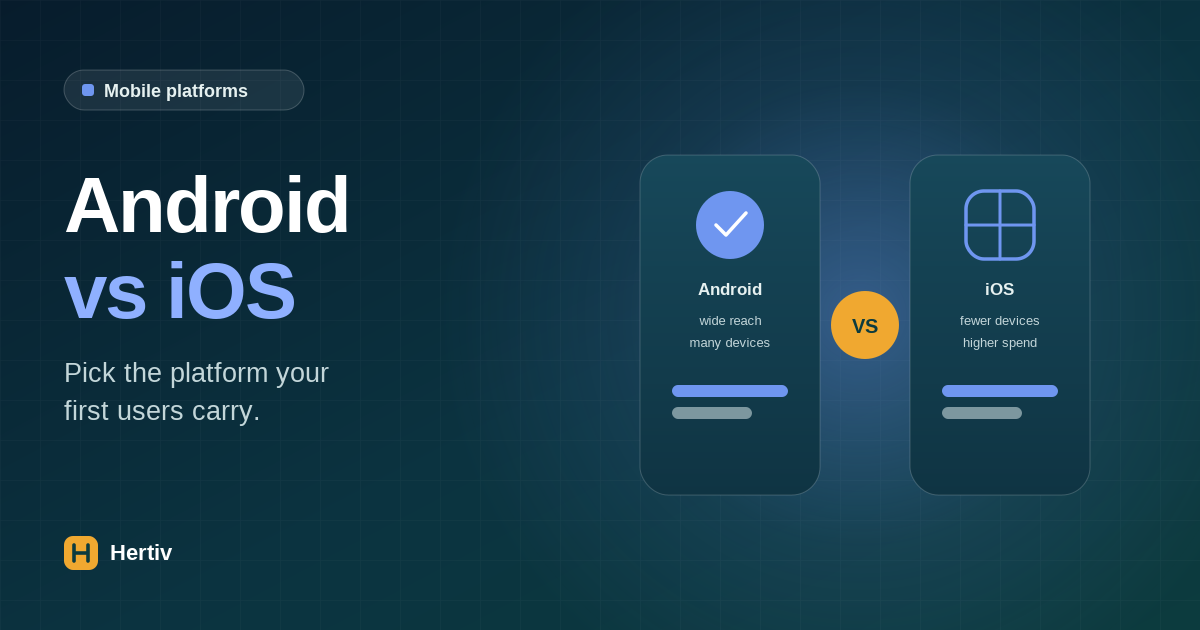
Android vs iOS for startups is a choice of audience, cost and speed, not of which platform is better. Here is how the two compare and how to pick one to build first.
On this page
Short answer
Android vs iOS for startups is the choice of which phone platform to build for first when you cannot afford both. The answer depends on which phones your first users carry, what the build costs, and how the store rules treat what you sell.
What is the Android vs iOS decision for startups?
Android vs iOS for startups is the choice of which phone platform to build for first when you cannot afford both. The decision matters because the two platforms reach different audiences, cost different amounts to build and test on, and have different store rules.
The question is not which platform is better in general. It is which one your first users carry, which one lets you test your idea fastest, and which one your budget can support. Many startups build one platform first and add the second only after the idea is proven.
Start with your audience. If your users are mostly in one region or income group, that alone often decides the answer, because Android and iOS market shares differ sharply by country and by price segment.
Android vs iOS: how they compare for a startup
Compare the two platforms on audience, cost, speed and store rules, not on personal preference. The table below covers the points that change the decision for a small team.
| Factor | Android | iOS |
|---|---|---|
| Audience | Wider global reach, more price segments | Strong in the US and Western Europe |
| Devices | Many models and screen sizes | Few models, consistent screens |
| Build cost | Higher testing cost across devices | Lower testing cost, fewer devices |
| Store review | Faster, more automated | Slower, stricter on rules |
| Payments | More payment options | Strict rules for digital goods |
| Users who pay | Lower average spend per user | Higher average spend per user |
No row on its own decides the question. A paid app for US users points to iOS; a free app for a global audience points to Android. Most startups weigh audience first and cost second.
Testing is the hidden cost in the table. Android has many device models and screen sizes, so a team must test on more phones than on iOS, where the device range is small. That extra testing time shows up in every release, not only in the first build, so it should be part of the cost comparison.
Which platform should your startup build first?
Build for the platform your first 1,000 users already carry. That is the only audience that matters before launch, and it is easy to check with a landing page, a waitlist or a survey.
- US or Western Europe, paying users. Start with iOS, where spending per user is higher and testing is simpler.
- Global or emerging markets. Start with Android, where the audience is larger and the device range is wider.
- Internal or staff tools. Build for the phones your team already uses, and skip the store entirely if you can.
- Hardware features. If the app depends on a specific sensor or accessory, check which platform supports it well.
- Both audiences matter. Consider a cross-platform build instead of two native apps, and accept the trade-offs.
If the audiences are split evenly, pick the platform your team knows best. A team that ships fast on one platform learns faster than a team that struggles on both.
How to decide in five steps
Work through these steps with real numbers from your own audience, not with general market data.
- Survey your waitlist. Ask which phone your first users carry and count the split.
- Price both builds. Get an estimate for each platform, including testing across devices.
- Check store rules. Confirm how payments, subscriptions and content rules apply to what you sell.
- Test the risky feature. Build the hardest screen or integration first and check it works on the chosen platform.
- Ship one platform. Launch, measure retention and revenue, then decide whether the second platform is worth the cost.
Write the decision down with the numbers behind it. If the second platform is added later, the same numbers tell you whether the audience is there. A guide to choosing the right mobile app platform covers the same decision in more detail.
Example (hypothetical): a startup picks one platform first
Example (hypothetical): a startup has a waitlist of 2,000 people, with 60% on Android and 40% on iOS. Building both natively would take 900 hours for iOS and 900 hours for Android, a total of 1,800 hours at $80 an hour, which is $144,000.
Building Android first takes 900 hours at $80 an hour, which is $72,000, and saves $72,000 against building both. The team launches on Android, measures retention for three months, and only then funds the iOS build with revenue from the first launch.
The choice was not about which platform is better. It was about reaching the larger half of the waitlist first and using real usage data to fund the second build.
What are the common mistakes?
The most common mistakes are building both platforms before the idea is proven, choosing by personal preference, and ignoring the cost of testing across Android devices.
- Building both at once. Two native apps double the build and maintenance cost before you know if anyone wants the product.
- Choosing your own phone. Founders often pick the platform they carry, not the one their users carry.
- Ignoring Android testing. Android has many models and screen sizes, so testing takes longer than on iOS.
- Forgetting store rules. Payment and content rules differ between the stores and can force a redesign.
- No plan for the second platform. If the app succeeds, the second platform needs a budget and a date, not a vague promise.
When to build the second platform, or go cross-platform
Add the second platform when the first one proves the idea: retention is healthy, users ask for the other platform, and revenue covers the build. Until then, the money is better spent on the product itself.
Cross-platform is an alternative when both audiences matter from day one. One codebase serves both stores, which saves build cost, but you trade some native feel and may hit limits with hardware features. Read native vs hybrid app development to weigh that trade-off before committing.
Whichever route you take, keep the back end shared. A single API for both platforms means the second build reuses accounts, data and payments instead of starting over. For a scoped estimate, a partner for mobile app development can price one platform first and the second as a follow-on.
Key takeaways
- Build for the platform your first 1,000 users already carry, not the one you carry
- iOS usually costs less to test and earns more per user; Android reaches a wider global audience
- Building both natively before the idea is proven doubles cost with no extra learning
- Survey your waitlist for the phone split before you choose
- Add the second platform only after retention and revenue prove the idea
Frequently asked questions
Should a startup build for Android or iOS first?
Build for the platform your first users carry. If your waitlist is mostly iOS users in the US or Western Europe, start there. If it is mostly Android users globally, start with Android. The audience split is the strongest evidence.
Is it cheaper to build for Android or iOS?
iOS is usually cheaper to test because there are fewer device models, while Android testing across many models takes longer. Build cost also depends on the app itself, so get an estimate for both before deciding.
Can I build both at once with one codebase?
Yes, with a cross-platform framework. One codebase serves both stores and saves build cost, but you trade some native feel and may hit limits with hardware features. Weigh that trade-off before committing.
How long does it take to build one platform first?
A first version for one platform is a normal app project and takes a few months, depending on features. Building both natively roughly doubles the front-end work, which is why most startups launch one platform first.
Do the app stores have different rules?
Yes. Review is usually slower and stricter on iOS, especially for payments and digital goods, while Android review is faster and more automated. Check the rules for what you sell before you choose.
When should I build the second platform?
When the first platform proves the idea: retention is healthy, users ask for the other platform, and revenue covers the build. Until then, spend the money on the product itself.


