5 Alternatives to Nearshore Software Development Outsourcing
Nearshore outsourcing is one way to add developers. These five alternatives fit different budgets, timelines and levels of control.
On this page
Short answer
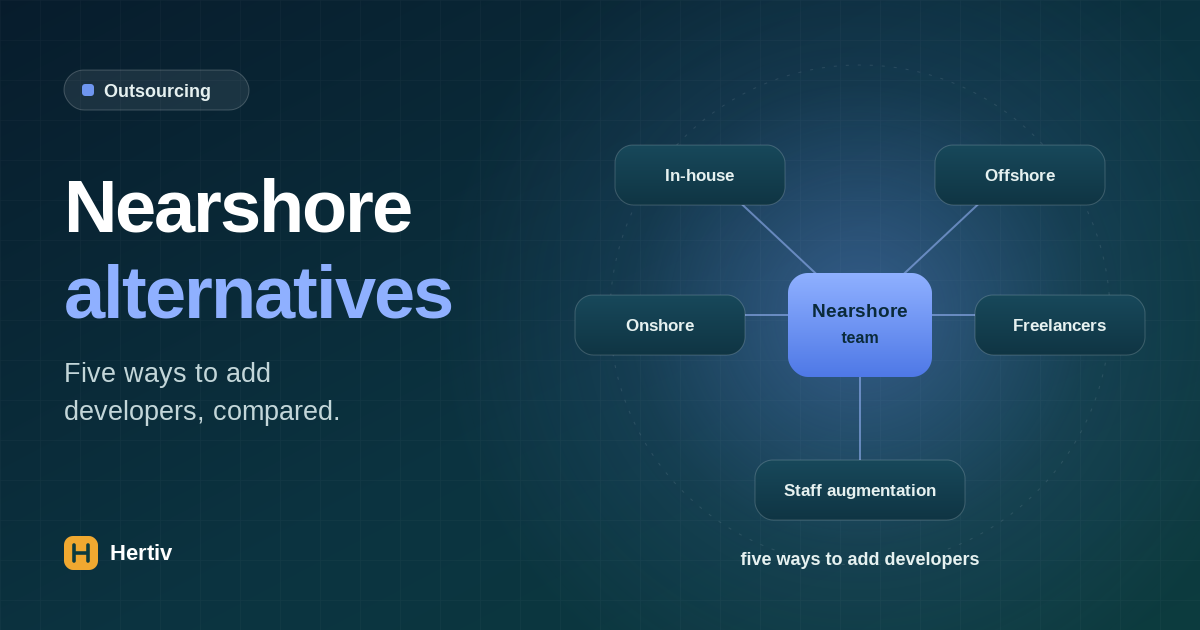
Nearshore outsourcing means hiring a development team in a nearby time zone that you do not employ directly. The alternatives are in-house hiring, offshore outsourcing, onshore outsourcing, freelancers and staff augmentation. Each trades cost, control and speed differently, so the right pick depends on how long the work lasts and how closely you need to direct it.
Which alternatives to nearshore outsourcing are worth comparing?
The alternatives worth comparing are in-house hiring, offshore outsourcing, onshore outsourcing, freelancers and staff augmentation. Each one trades cost, control and speed differently, so the right pick depends on how long the work lasts and how much of it you need to direct.
| Alternative | What it is | Best when | Setup time |
|---|---|---|---|
| In-house hiring | Developers on your payroll | Long-term core product | Weeks to months |
| Offshore outsourcing | Team in a distant, lower-cost region | Large scope, tight budget | Days to weeks |
| Onshore outsourcing | Team in your own country | Regulated work, close collaboration | Days to weeks |
| Freelancers | Individual contractors per task | Short, well-defined tasks | Days |
| Staff augmentation | Contract developers inside your team | Adding skills to an existing team | Days to weeks |
Nearshore outsourcing sits in the middle: a team in a nearby time zone that you do not employ directly. The alternatives below move one step in each direction, closer to you, further away, or inside your own payroll. Compare them on the same three questions: who directs the work, who carries the risk, and how fast you can start.
The rest of this article takes each alternative in turn, with what it does well, where it falls short, and the kind of team it fits. Read the comparison first, then the detail, and use the five-step check at the end to make the call.
<h3>1. In-house hiring: best for long-term core products</h3>
In-house hiring means the developers work for you, in your offices or remote, on your payroll. You set the priorities, the tools and the code standards, and the knowledge stays inside the company when a project ends. That control is the main reason teams hire in-house for the product that earns the revenue.
The cost is time and commitment. Hiring takes weeks or months, and you carry salaries, benefits, equipment and management overhead whether the workload is high or low. For a product that will run for years, that cost is usually worth it. For a three-month build, it rarely is.
Pros:
- Full control over priorities, tools and quality
- Product knowledge stays in the company
- Easiest to align with long-term strategy
Cons:
- Slowest to start: hiring takes weeks or months
- Fixed costs even when the workload drops
- Hard to hire rare skills quickly
<h3>2. Offshore outsourcing: best for tight budgets and large scopes</h3>
Offshore outsourcing means a development team in a distant region, usually with lower rates than nearshore or onshore teams. The model suits large, well-specified builds where the cost saving outweighs the time-zone gap. Many teams use it for maintenance, testing and feature work that can be planned in advance.
The trade-off is coordination. A time-zone gap of eight hours or more means questions wait a day for an answer, so the work needs clear specs, written decisions and a regular handover rhythm. Teams that plan around the gap do well; teams that need constant live discussion do not.
Pros:
- Lowest rates for large scopes
- Large talent pools for common stacks
- Easy to scale a team up or down
Cons:
- Time-zone gap slows feedback loops
- Needs detailed specs and written decisions
- Quality varies widely between vendors
<h3>3. Onshore outsourcing: best for regulated work and close collaboration</h3>
Onshore outsourcing means a team in your own country, working in your time zone, under the same laws and business hours. It suits regulated work, such as health or finance software, where data rules and audit trails matter, and projects where the team needs to join calls and workshops without a time-zone gap.
The cost is the highest of the outsourcing options, since rates match your local market. The saving comes from avoiding the overhead of hiring: you get a team without carrying payroll, and you can end the engagement when the project ends.
Pros:
- Same time zone, language and legal framework
- Simple for regulated data and audits
- Fast feedback and easy workshops
Cons:
- Highest outsourcing rates
- Smaller talent pool than offshore
- Still an external team to manage
<h3>4. Freelancers and contractors: best for short, well-defined tasks</h3>
Freelancers are individual developers hired per task or per sprint. The model fits short, well-defined work: a landing page, a bug fix, a small integration, or a design pass. You pay for the task, not for a team, and you can start within days.
The risk is continuity. A freelancer can leave mid-project, and the knowledge leaves with them. The model also needs a clear brief: freelancers work best when the task, the acceptance criteria and the deadline are written down before they start.
Pros:
- Fastest to start, often within days
- Pay per task, no long-term commitment
- Easy to find specialists for one-off work
Cons:
- No continuity if the person leaves
- Needs a very clear brief to work well
- Managing several freelancers takes time
<h3>5. Staff augmentation: best for adding skills to an existing team</h3>
Staff augmentation adds contract developers to your own team, working under your managers and your process. It fits teams that have a product and a roadmap but are short of a skill, such as a mobile developer or a DevOps engineer, for a few months.
Unlike full outsourcing, you keep control of the work: the augmented developers join your standups, your code reviews and your backlog. The vendor handles hiring, payroll and replacement if someone leaves. That split is why teams use it to fill gaps without changing how they work.
Pros:
- Your team keeps control of the work
- Fast way to add a missing skill
- Vendor handles hiring and replacement
Cons:
- Needs a team and a process already in place
- Rates sit above offshore outsourcing
- Contract developers still need onboarding
How to choose between the alternatives
You choose between the alternatives by matching the model to the work, not by picking the cheapest rate. Run these five steps before you sign anything.
- Define the work. Write down the scope, the deadline and who directs the work day to day.
- Set the time horizon. Work that lasts years points to in-house hiring; work that lasts weeks points to freelancers or staff augmentation.
- Check the rules. Regulated data, security reviews and audit needs can rule out offshore or freelance models early.
- Compare total cost, not the rate. Add management time, onboarding, handover and rework to the headline rate before you compare.
- Start small. Run a two-week trial with one developer or one small feature, then decide whether to scale up.
If you already have a team and only need extra hands, staff augmentation is usually the fastest fit. If you need a whole product built, compare an outsourcing partner against in-house hiring on the same total-cost basis.
Key takeaways
- Nearshore is the middle option; the alternatives move closer to you, further away, or onto your payroll
- In-house hiring gives the most control and the slowest start; freelancers give the fastest start and the least continuity
- Offshore outsourcing trades a time-zone gap for lower rates on large, well-specified work
- Staff augmentation fits teams that already have a process and need one missing skill
- Compare total cost, including management and rework, not the headline rate
Frequently asked questions
Is nearshore outsourcing cheaper than onshore outsourcing?
Usually, yes. Nearshore teams sit in nearby regions with lower rates than your local market, while onshore teams charge local rates. The gap depends on the countries involved. Compare the total cost, including management time and handover, rather than the hourly rate alone.
When is in-house hiring better than outsourcing?
In-house hiring wins when the product is core to the business, the work lasts years, and the knowledge must stay inside the company. Outsourcing wins when the work is a defined project with an end date, or when the skill is needed for a few months only.
Can I combine two alternatives at once?
Yes, and many teams do. A common mix is an in-house core team with staff augmentation for a missing skill, or an offshore team for planned feature work plus freelancers for small tasks. Keep one owner for the backlog so the two groups do not pull in different directions.
What is the main risk of offshore outsourcing?
The main risk is slow feedback: a large time-zone gap means questions wait a day for an answer. The fix is written specs, a regular handover rhythm and a named contact on each side. Teams that plan around the gap do well; teams that need constant live discussion struggle.
How fast can staff augmentation start?
Often within days to two weeks, since the vendor already employs the developers and only needs to match one to your stack and your process. That is faster than hiring and usually faster than setting up a full outsourcing engagement.
Do freelancers work for large projects?
Rarely on their own. A large project needs a team, a shared process and continuity, which individual freelancers cannot guarantee. Freelancers work well for bounded tasks inside a larger project that your own team or a vendor already runs.


