AI Voice Agent Trends Worth Following This Year
AI voice agents are getting faster, multilingual and better at handing off to humans. Here are eight trends that matter for teams building or buying voice agents.
On this page
Short answer
AI voice agents are moving from simple phone menus to agents that hold a real conversation, switch languages and hand off to a human without making the caller repeat themselves. The eight trends that matter most cover real-time voice, multilingual agents, emotion-aware replies, clean handoffs, voice in apps, on-device models, consent and analytics.
Which AI voice agent trends matter this year?
AI voice agents are moving from simple phone menus to agents that hold a real conversation, switch languages, and hand off to a human without making the caller repeat themselves. The eight trends below cover the changes that matter most for teams building or buying voice agents.
Use the table to see which trend fits your problem. A support team with long phone queues should look at trends one and four first, while a team selling in several countries should start with trend two.
| Trend | What is changing | Who it helps most |
|---|---|---|
| Real-time voice | Agents answer with little delay | Support and sales teams |
| Multilingual agents | One agent speaks several languages | Teams serving several countries |
| Emotion-aware replies | Agents read tone and adjust | Complaints and care teams |
| Clean human handoff | Callers are not asked to repeat themselves | Callers and agents alike |
| Voice inside apps | Voice works in the app, not only on the phone | App and product teams |
| Smaller on-device models | Voice runs closer to the user | Teams with strict data rules |
| Recording and consent | Consent and records are built in | Regulated industries |
| Voice analytics | Call data improves the script | Quality and training teams |
None of these trends removes the need for a human. The best voice agents handle the routine calls well and pass the hard ones to a person with the full context. AI voice agent development covers how these agents are built for phone and voice channels.
Real-time voice and Multilingual agents
1. Real-time voice: best for natural conversations
Voice agents used to pause noticeably before answering, which made callers talk over them or hang up. Newer real-time voice models listen and speak with far less delay, so the conversation feels closer to talking with a person, with interruptions handled instead of breaking the call.
Its strength is the feel of the call. When the agent answers promptly and can be interrupted, callers finish their request instead of asking for a human at the first pause. The trade-off is cost and setup: real-time models need a steady connection and more computing power than a simple recorded menu.
Pros:
- Calls feel closer to talking with a person
- Callers finish requests instead of asking for a human
- Interruptions are handled instead of breaking the call
Cons:
- Needs a steady connection and more computing power
- Costs more per minute than a simple menu
- Long calls still need a human for hard cases
2. Multilingual agents: best for serving several countries
A team that serves customers in several countries used to need a separate voice agent for each language, each with its own script and recordings. Newer agents can speak several languages from one setup, switching when the caller switches, and keeping the same answers and rules across languages.
Its strength is one system for many markets. A change to the script is made once and applies in every language, instead of being rebuilt five times. The trade-off is quality: the agent must be tested in each language, because a phrase that works in English can sound wrong or rude in another language.
Pros:
- One setup serves several languages
- Script changes apply everywhere at once
- Callers can switch language mid-call
Cons:
- Each language still needs testing by a native speaker
- Accents and dialects can still be misheard
- Some languages have weaker voice quality
Emotion-aware replies and Clean human handoff
3. Emotion-aware replies: best for difficult calls
Voice agents are starting to read tone, pace and word choice, and to adjust how they reply. An agent that hears a frustrated caller can slow down, use simpler words and offer a human sooner, instead of repeating the same script in the same tone.
Its strength is fewer escalations that go wrong. A caller who feels heard is more likely to stay on the line and accept the next step. The trade-off is that tone reading is not perfect: it can misread sarcasm, a quiet voice or a caller speaking a second language, so it should guide the agent, not decide the outcome.
Pros:
- Frustrated callers get a calmer, simpler reply
- Human handoff happens earlier on hard calls
- Callers are more likely to stay on the line
Cons:
- Tone reading can be wrong, especially across languages
- Should guide the reply, not decide the outcome
- Needs care with privacy rules on voice data
4. Clean human handoff: best for calls the agent cannot finish
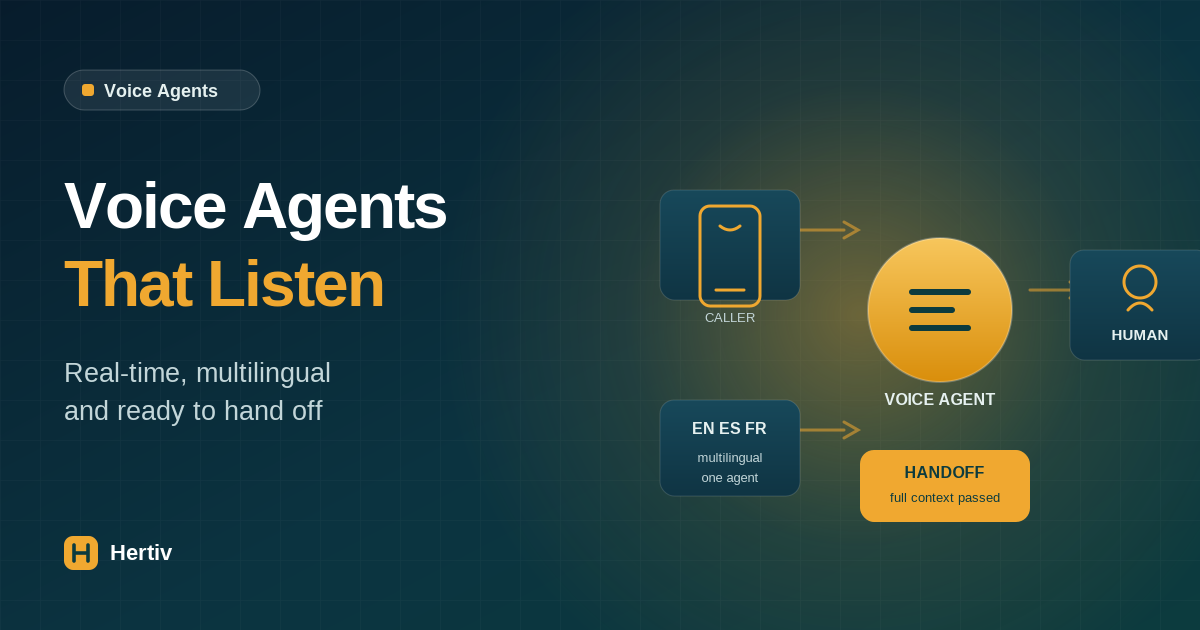
The worst part of calling a company used to be explaining the problem to a machine, then explaining it again to a person. Voice agents are now built to pass the full context to the human agent: who is calling, what was already said, and what was tried, so the caller starts from where the machine left off.
Its strength is that the caller is not punished for using the agent first. A good handoff keeps the caller, the summary and the relevant records together, and the human picks up within seconds. The trade-off is that the handoff needs the phone system, the agent and the CRM to work together, which takes integration work.
Pros:
- Callers do not repeat themselves to the human
- Human agents start with the full context
- More callers are willing to try the agent first
Cons:
- Needs the phone system and CRM to work together
- A bad handoff is worse than no handoff
- Human staffing still sets the wait time
Voice inside apps and Smaller on-device models
5. Voice inside apps: best for hands-free help
Voice agents are moving beyond the phone line and into apps, where a user can speak a request instead of tapping through menus. A driver can ask for the next delivery, a cook can ask for the next step of a recipe, and a field worker can log a job while holding tools.
Its strength is that it fits moments when hands and eyes are busy. The agent knows what the user is looking at in the app, so it can answer in context instead of asking the user to describe the screen. The trade-off is noise: a voice agent in a busy place must handle background sound, or it will mishear the request.
Pros:
- Works when hands and eyes are busy
- Answers in the context of what is on screen
- Fewer taps for common tasks
Cons:
- Background noise can cause misheard requests
- Not every task suits voice
- Needs a clear way to confirm before acting
6. Smaller on-device models: best for privacy and speed
Voice models are getting smaller, so some of the work can run on the user's own phone or device instead of in a distant data centre. The first part of the call, such as turning speech into text, can happen on the device, which keeps the voice data closer to the user and cuts the delay.
Its strength is privacy and speed. Less voice data leaves the device, which helps teams with strict data rules, and the agent starts listening sooner because the round trip to a server is shorter. The trade-off is capability: a small on-device model cannot do everything a large server model can, so hard questions still go to the server.
Pros:
- Voice data stays closer to the user
- Less delay before the agent starts listening
- Works better on a weak connection
Cons:
- Small models cannot handle the hardest questions
- Device power and storage set the limit
- Updates must reach every device
Recording and consent and Voice analytics
7. Recording and consent: best for regulated industries
As voice agents handle more calls in banking, insurance and healthcare, recording and consent are being built into the agent itself. The agent asks for consent at the start, records what was agreed, and stores the call in a way the compliance team can find later.
Its strength is that compliance is part of the call, not an afterthought. A team can show what the caller agreed to, what the agent said, and when, without rebuilding the record from logs. The trade-off is friction: a long consent script at the start of every call annoys callers, so it must be short and clear.
Pros:
- Consent and records are part of the call
- Compliance teams can find the record fast
- Disputes can be checked against the recording
Cons:
- Long consent scripts annoy callers
- Storage rules vary by country
- Recordings must be protected like other data
8. Voice analytics: best for improving the script
Every voice call is a record of what customers actually ask, in their own words. Voice analytics turns those calls into a list of the most common requests, the phrases that confuse callers, and the points where callers give up and ask for a human.
Its strength is that the script improves from real calls instead of guesses. A team can see that callers keep asking for a delivery date in a different way, and add that phrasing to the agent. The trade-off is that the data must be handled with care: call recordings hold personal details, so access and retention need clear rules.
Pros:
- Scripts improve from real caller words
- Confusing phrases and drop-off points are visible
- Training for human agents gets better examples
Cons:
- Recordings hold personal details and need protection
- Insights need a person to act on them
- Small call volumes give weak signals
How to choose an AI voice agent trend to follow
You choose an AI voice agent trend by matching it to the calls that cost your team the most time, then testing one change with real callers. A trend that fits another team's problem may not fit yours.
- List your top five call reasons. The trend that helps those calls is the one to follow first.
- Check where callers give up. If they ask for a human early, fix the handoff; if they mishear, look at real-time voice.
- Decide what must stay human. Complaints, money and health calls need a clear path to a person.
- Run a four-week test. Put the change on a small share of calls and compare completion rates and caller feedback.
- Check data and consent rules. Recording, storage and consent differ by country, so confirm them before scaling.
The test is the decision. A trend that lifts call completion and caller satisfaction on your own calls is worth keeping, whatever the vendor claims. What an AI voice agent is and how it works explains the building blocks behind these trends.
What are the common mistakes?
The most common mistakes are launching a voice agent on every call type at once, hiding the human handoff, and treating the launch as the end of the work. Each of these leaves callers stuck and the team blind to why.
- Launching too wide. Starting with every call type makes it hard to tell which part is failing.
- Hiding the human option. Callers who cannot reach a person will hang up and call back angry, or not at all.
- No weekly review. If nobody listens to failed calls, the same mistakes repeat for months.
- Ignoring accents and noise. An agent tested only in a quiet office will struggle with real callers.
- Forgetting consent. Recording calls without a clear consent step creates legal trouble.
Voice agents work when they handle routine calls well, pass hard calls to a person with context, and get better every week from real call data. AI voice agent use cases shows where the technology is already working in practice.
Key takeaways
- Real-time voice makes calls feel closer to talking with a person
- One multilingual agent can serve several countries from a single setup
- A clean handoff passes the full context to the human agent
- Smaller on-device models keep voice data closer to the user
- Test one trend on a small share of calls before scaling it
Frequently asked questions
What is an AI voice agent?
An AI voice agent is software that talks with a caller by phone or voice channel, understands what the caller says, and answers or acts on it. It can book, check, explain and pass the call to a human when the request needs one.
Are AI voice agents replacing call centre staff?
No. They handle routine calls, such as checking an order or booking a slot, and pass hard calls to people. Staff spend more time on complaints, complex cases and sales, where a human makes the difference.
How long does it take to build a voice agent?
A simple agent for one call type can be live in a few weeks, while a full agent covering many call types takes longer. The build time depends on the number of call reasons, the systems it must connect to, and the testing needed.
Do voice agents work in noisy places?
They are improving, but noise is still a challenge. An agent in a car or a busy shop will mishear more often than one on a quiet phone line. Teams should test with real callers in real settings before launch, not only in an office.
Is it legal to record calls with a voice agent?
It depends on the country and the consent given. Most places need the caller to be told the call is recorded and to agree, or at least to be given a choice. Teams should check the rules where their callers live before turning recording on.
How do I measure whether a voice agent works?
Useful measures include the share of calls the agent finishes without a human, caller satisfaction after the call, and the time saved per call. Listen to failed calls each week to find the phrases and cases the agent still gets wrong.


